

Topics worth your time this issue: how residential electrical infrastructure is becoming the basis for a distributed compute pitch, the three companies that control 70% of global gas turbine production, Aescape’s bankruptcy nine months after an $83M raise, and the food robotics startup that once built a Rube Goldberg machine for burgers.
Interesting Links
- The most interesting climate startups aren’t leading with decarbonization and net zero framing anymore — they’re pitching energy. Residential electrical infrastructure runs at roughly 40% of peak capacity on average, and that gap has become the basis of a new residential compute pitch: if households have behind-the-meter capacity, why not turn it into compute? Span’s new XFRA whitepaper details a distributed compute cloud: high-end GPUs and a 15 kWh battery installed alongside new-construction homes, coordinated via Span’s smart panel. NVIDIA is the launch partner, PulteGroup is the initial homebuilder, and the target is 1 GW of annual deployment capacity by 2027. The core bet is speed-to-power arbitrage, assuming a 100 MW centralized data center needs substation upgrades and interconnection queues stretching 3-5 years; theoretically, a box next to a Pulte home would require just an electrician. Homeowners receive a smart panel and battery at no upfront cost, plus a monthly payment that offsets their utility and broadband bills.
- It will be interesting to see if other companies with similar capabilities (Base Power or Tesla Powerwall) launch competing offerings. Both have the installed base and customer access to copy this move if the niche proves to be economically viable. Like our coverage of Boom Supersonic repurposing its engine tech. into gas turbines (#161), both are bets that the compute-vs-power gap is wide enough to build a business inside.

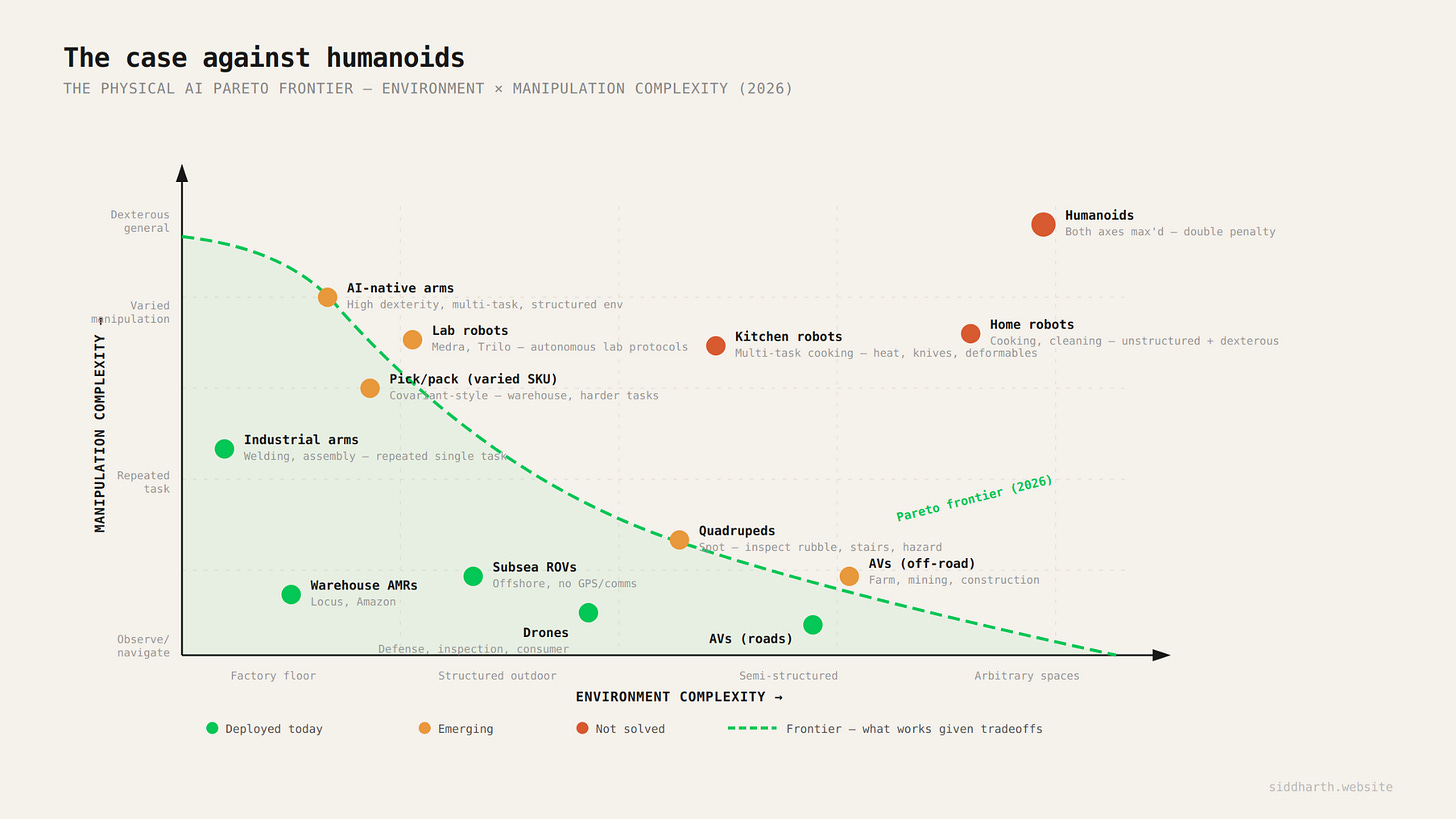
- The Case Against Humanoids maps every deployed robot category onto a Pareto frontier of environment complexity against manipulation complexity. Humanoids land alone in the upper-right corner, a “double penalty” position where technical risk is multiplicative. The warehouse math: a Locus-style AMR at roughly $13K/year handles 100–150 picks/hour; a $150K humanoid manages 30–50 at ten times the power draw. The rare tasks humanoids exist to handle (spills, damaged packages, peak-season reorganization) happen weekly rather than hourly, and rarely earn back the capex. Modifying a facility to suit a wheeled robot (adding a ramp, drilling through a wall) almost always beats buying a bipedal generalist to navigate the existing one. The core argument is that humanoids only pencil out where task variety is extreme, per-task volume is low, and the environment is a fixed constraint. Worth reading for the contrarian framing; hold the conclusions loosely!
- Two new analysis tools on our radar that feel closer to a digital lab notebook than most general-purpose tools: 1) WORC is what happens if Jupyter Notebook and MATLAB had a chimera offspring and raised it from birth to be an engineer. It includes math blocks, FEA, python executables, vendor spreadsheets, and reasoning all in one linked document. 2) Blockpad is chasing the same result from a different angle, pitching itself as a blend of Excel and Mathcad for engineering calculations.
- Both capture the same ethos that when variables, solvers, and commentary share one document, writing up the work naturally falls out of doing the work.
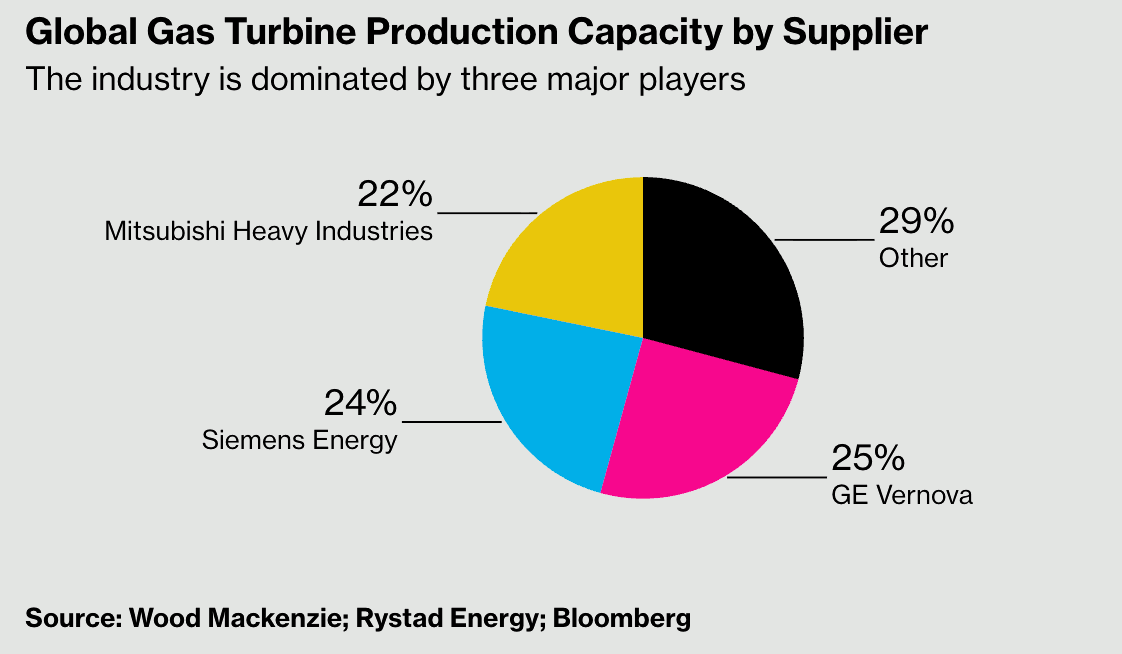
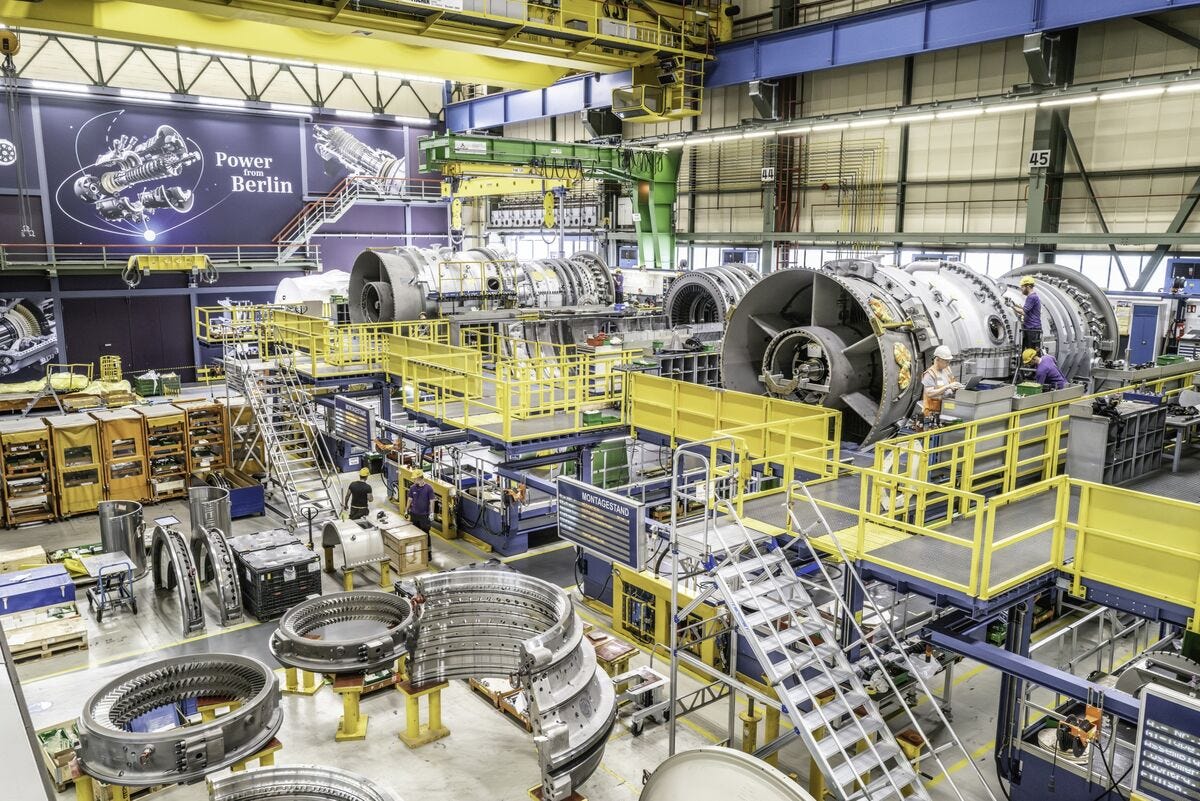
- A useful companion piece to the XFRA whitepaper above, Bloomberg’s Bottlenecks series takes a closer look at the global gas turbine shortage where three companies (Siemens Energy, GE Vernova, and Mitsubishi Heavy) control more than 70% of the large turbine production capacity. A single large combined-cycle turbine generates 500-600 MW, so while the volume seems comparatively low (GE Vernova produced 55 last year, expanding to 70-80 in 2026), each unit has an outsized impact on grid capacity. Exhaust from the gas turbine feeds a heat recovery steam generator, which drives a second turbine downstream. Combined-cycle efficiency: ~60%, versus ~35% simple-cycle.
- To set the scale, 500-600 MW is enough to power roughly 400,000 homes.
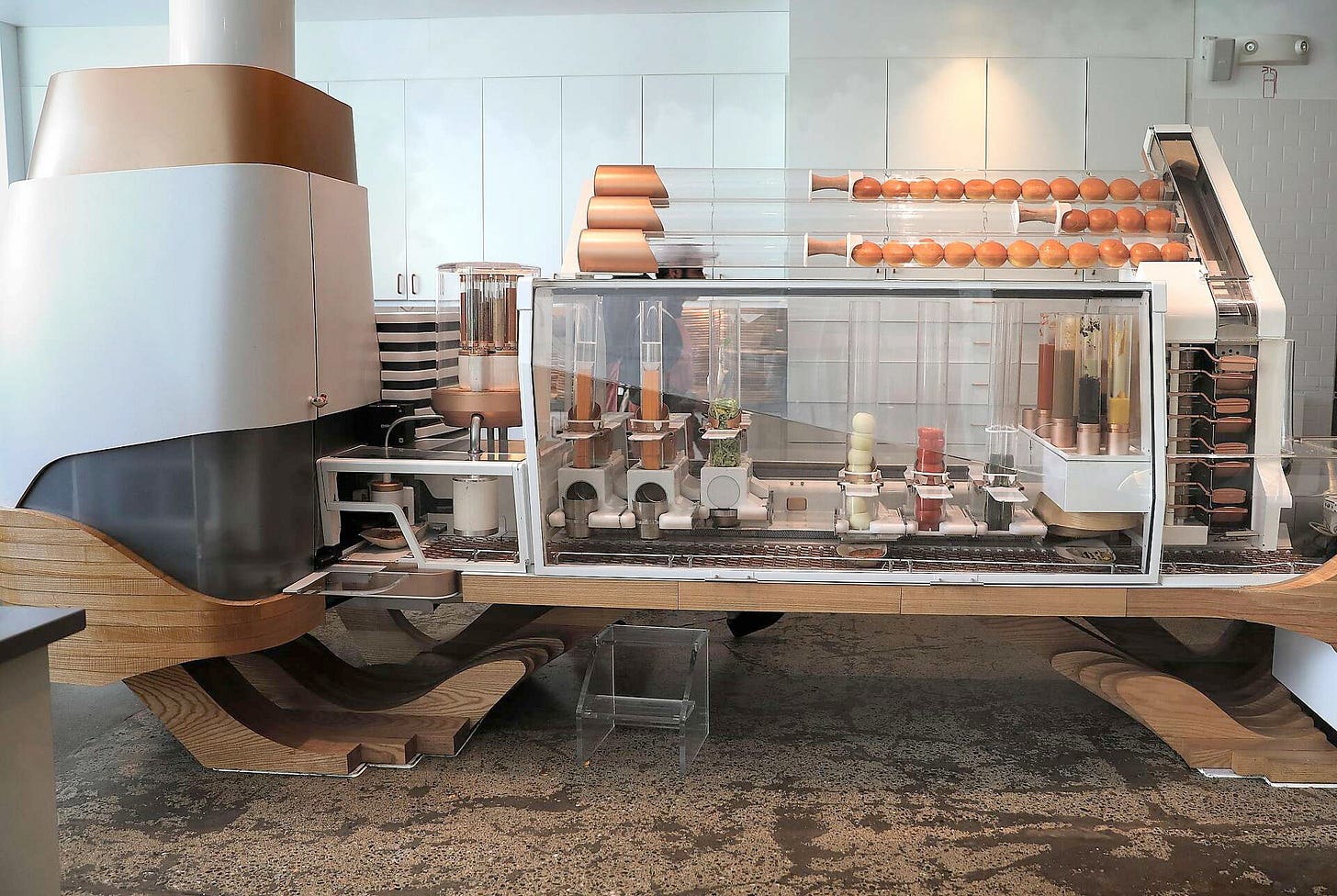
- What engineers find compelling and what customers will pay for are different filters, and hardware makes that gap more obviously expensive. A recent example: Aescape, the robotic massage startup that announced an $83M strategic round last March, was pushed into involuntary bankruptcy nine months later and is now liquidating via Article 9 sale. Creator is another — the food robotics startup built what was essentially a Rube Goldberg machine for burgers before shutting down after a stalled investment deal with SoftBank’s Vision Fund. At this point, a catalogue of high-profile startups that raised significant capital and didn’t make it would be just as interesting as tracking the ones that did.
- And one fun link to round out the week: Big Office Chair doesn’t want you to know that swapping in these $20 caster wheels makes any office chair significantly better.
Startup News
- Ulysses raised $38M in Series A funding, bringing total funding to $46M to develop a family of unmanned surface and subsurface vessels for defense, ocean science, and commercial survey missions. Their flagship product, Mako, is a mini-torpedo-shaped UUV with a 5k-foot depth rating, 72-hour endurance, and up to 200 lb payload capacity; starting price is $50K, an order of magnitude cheaper than comparable systems from HII and L3 Harris. The company has already generated $5M in revenue across government, commercial, and scientific partners (including the U.S. Navy and the Great Barrier Reef Foundation) before expanding into defense applications. The round was led by a16z’s American Dynamism fund, with participation from Booz Allen Ventures and Harpoon Ventures.
- Slate Auto raised $650M in a Series C round, bringing total funding to ~$1.4B to bring its stripped-down, affordable electric pickup truck to market. The company has booked 160,000 refundable reservations with first deliveries targeted for late 2026. The Slate Truck targets the extreme low end of the market, starting at around mid-$20k in the single bare-bones configuration, with post-delivery customization options including an SUV conversion kit for around $5,000. The round was led by TWG Global; prior backers include Jeff Bezos’ family office and General Catalyst.
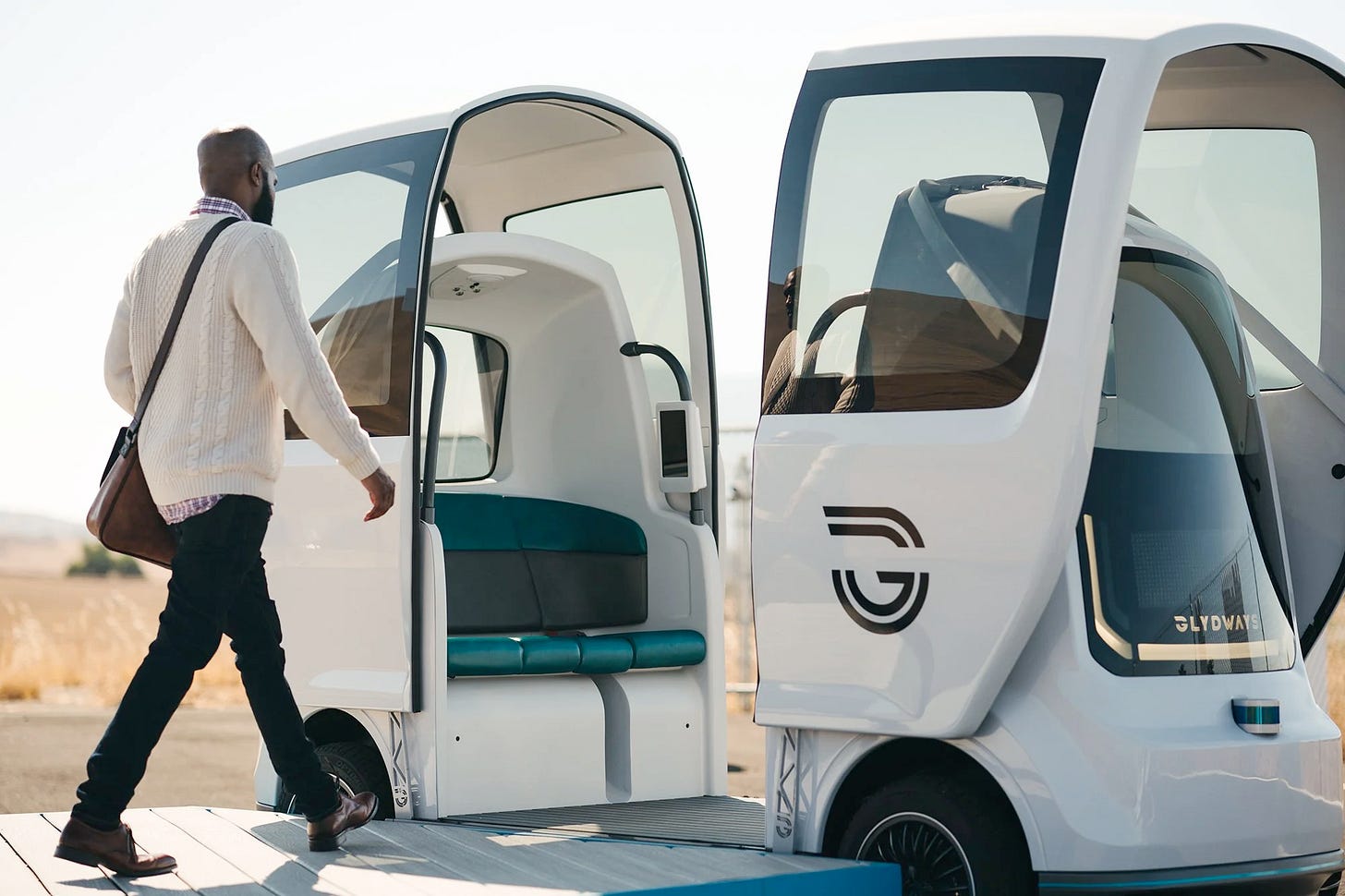
- Glydways is in talks to raise an additional $250M at a $1B+ valuation for its closed-loop autonomous transit system using podlike vehicles running on dedicated expressways. The company has 20+ projects under negotiation globally, with active agreements in Abu Dhabi and Dubai and a system near Atlanta’s Hartsfield-Jackson Airport targeting pilot operations by year-end. Suzuki will manufacture the vehicles.
- Booster Robotics, a China based humanoid startup, raised ~$140M (roughly 1B RMB) to expand its global delivery network and prepare for a consumer-grade product launch. The company’s flagship small humanoid robot has shipped over 1,000 units across 20 countries and 400 clients, with new orders in January and February up by 800%.