View this email in your browser

Highlights this week: 💰 the top industrial vc's, ⚡️ dc-dc control theory, and ⏱ reverse engineering a soyuz clock.
🔗 Last week’s most-clicked link: The rise and fall of the industrial r&d lab.
Startup News 🚀💰:
- Amper, a startup developing a plug-and-play-solution to digitize manufacturing, raised an $11M Series A led by Lewis & Clark Ventures along with Foundation Capital, Corazon Capital, Slow Ventures, SOSV, Converge VC and GTMfund.
- Pipedream Labs, a startup developing an underground microdelivery network, came out of stealth with a $1.6M pre-seed and details on what they’ve been up to since.
- CellMEAT, a startup developing cell-based shrimp, has secured an $8.1M Series A led by NauIB.
- Agility Robotics, a developer of bipedal robots for warehouse work, raised a $150M Series B led by DCVC.
- Mytaverse, a platform for enterprises in a virtual shared metaverse, raised $7.6M in a Seed round led by Blumberg Capital
- FourJaw, a startup developing a ‘fitbit for manufacturers’ + analytics platform, raised $1M in early-stage funding led by SFC.
Interesting Links 🔗:
- The top 40 investors in industrial tech. Industrial technology funding in the last decade has amounted to more than $160 billion, at a 24% share of total VC funding, with 29 VC-backed unicorns. The short list includes AE Industrial Partners, Bolt, Boost VC, Construct Capital, Eclipse Ventures, Emerald Technology Ventures, Founders Fund, Heartland Ventures, Khosla Ventures, Lemnos Labs, Lux Capital, mHUB, Monozukuri Ventures, New Enterprise Associates (NEA), OSS Ventures, SOSV, Speedinvest, and The Engine.
- Reverse-engineering a 1984 digital clock from a Soyuz spacecraft. The clock is much more complex inside than one might expect, with over 100 integrated circuits on ten circuit boards.
- A nice bio on Bob Widlar, legendary IC designer and founder of the Widlar current source, the Widlar bandgap voltage reference, and the Widlar output stage. He also developed the first commercial analog chip (op-amp), the uA702. It went on the market in 1964 for $300 each. That's $2500 adjusting for inflation!
- Patrick Collison, Stripe founder, has curated a list of examples of people quickly accomplishing ambitious things together: The US decided to build the world's first nuclear submarine in July 1951. It entered service on September 30 1954, 1,173 days later. Today, build times for nuclear submarines are closer to ~20 years; In one year, between 1998 and 1999, Shenzhen added 1 million residents (a 22% increase), growing from 4.4 million to 5.4 million people.
- Looking at Energy Use in US Residential Buildings. Modern housing uses substantially less energy than older housing on a per-square-foot basis. A 50-year difference in house age translates to roughly a 50% reduction in energy use. Most of that reduction comes from reduced energy used for heating. After age, the largest variable that affects home energy use is climate - homes in cold climates use about 30-40% more energy than homes in warm climates, most of which is due to increased heating requirements.
- Why America can’t build things anymore. The New York Subway system opened with 28 stations in 1904, just four and a half years after the first contract was awarded. By contrast, the 2017 Second Avenue subway opening, with just three stations, took seventeen years.
- Back to the basics -- a good primer on control theory and designing DC-DC converters. Along with an experimental explanation (including SPICE models), this is plenty to dive into on the topic of DC power converters.
- Air Force pilot Chuck Yeager broke the sound barrier in a Bell X-1 on October 14, 1947. America’s first rocket-powered research plane, the X-1 was designed to push the unknown limits of high-speed and high-altitude flight with a superbly designed airframe and liquid-fueled rocket motors. A great piece on the engineering and personal challenges associated with this achievement.
- Work on the Xerox Alto, the first GUI-oriented computer, started in November 1972 because of a bet: "Chuck said that a futuristic computer could be done 'in three months' and a Xerox exec bet him a case of wine that it couldn’t be done". Building the Alto required extensive hardware, operating system, and application design and implementation. The first complete Altos were introduced on March 1, 1973. Here are Butler Lampson’s design notes for the Alto operating system.
- Whether you think Chamath is a champion or a charlatan, his VC firm, Social Capital, writes an annual letter that is a worthy read. This time around, we need to invest in the less glamorous, but equally important, parts of our economy so that we emerge from this current phase stronger and more independent than when we started. We need to show the world that we have a resilient supply chain, a well incentivized and motivated workforce, and the strategic resolve to invest in a broad swath of capabilities from AI and semiconductors to natural gas and nuclear power.
- SpaceX’s Starlink is coming to Hawaiian Airlines in a bid to try and fix in-flight Wi-Fi
- Researchers Describe the Skies of Exoplanets. This paper describes (in the greatest detail to date) the atmospheres on distant planets. They found that almost all the exoplanets with a thermally inverted atmosphere were extremely hot, with temperatures over 2000 Kelvins. Importantly, this is sufficiently hot that the metallic species TiO (titanium oxide), VO (vanadium oxide) and FeH (iron hydride) are stable in an atmosphere. NVIDIA GPU’s were used to process much of the data from this experiment, and the NVIDIA team wrote up a detail from their perspective.
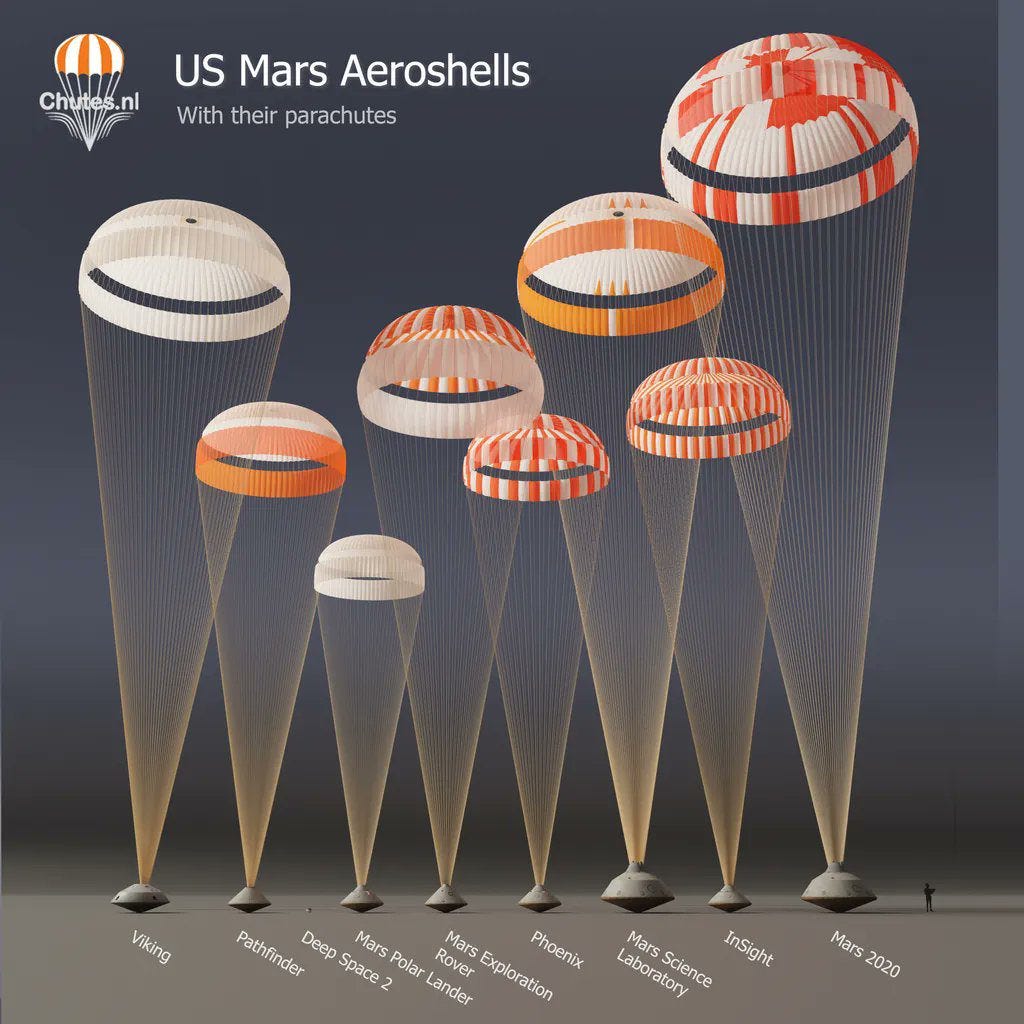
One Interesting Picture 📸: 🪂🪂