Highlights this week: 🔬 The fall of american industrial r&d labs, 🎬 ranking every chess movie, and 🚀 elon’s interview
🔗 Last week’s most-clicked link: This fun brain teaser.
⚡️ Analog Interviews: Jama Mohamed, Co-Founder & CEO @ Sahara Cloud
Startup News 🚀💰:
- Baukunst, a new VC firm named after “the art of building” and formed by former Bolt partners (+ TheAnalog.io early subscriber, Tyler Mincey), announced the launch of their $100M early-stage fund. The firm is leaning into its concept of “creative technologists,” which it describes as the intersection in the Venn diagram of visionary thinkers at the forefront of cultural and societal change, and technologists who don’t shy away from being at the bleeding edge of where tech is moving.
- Laiye, a Beijing-based company that provides a one-stop platform for automating office tasks of varying degrees of complexity, raised a $160 million Series C led by Hopu Magnolia, alonbg with VMS Group, Youshan Capital, Lightspeed China, and Lightspeed Venture Partners.
- Glacier, a startup building next-generation robotics for recycling, raised a $4.5M Seed round led by NEA.
- Gravity Sketch, a startup building a platform to design, collaborate on, and produce 3D objects, raised a $33M Series A led by Accel, along with GV, Kindred Capital, Point Nine and Forward Partners.
- Chipotle launched a $50M venture fund focused on restaurant tech.
Interesting Links 🔗:
- The rise and fall of the American industrial R&D lab. Many of the best new products, tools, and ideas came from research labs within large corporations from the 1930’s to 1970’s. This brief period also happened to be the era when scientific, technological, and economic productivity sped forward at its fastest ever clip. Yet almost as soon as it arrived, the fruitful period was over and we returned to a situation where small companies and small-business-like teams at universities developed innovations outside of large companies and sold them in a market for ideas. The promising spark? Google and big tech (Google employs 1,700 AI Researchers. Bell Labs had 15,000 employees and 1,200 PhD’s in the 1960’s).
- Interesting study linking IQ and SAT scores, tied to (intended) undergraduate majors. No surprise math/engineering lie at the peak. Surprising to see “military technologies” towards the lower end of the spectrum (albeit, the overall spread isn’t huge).
- Here’s a list of every chess movie, ranked. Chess blew up during the pandemic. Chess.com added 1.5M new users in Apr 2020, and has over 80M users today. The Gary Kasparov documentary, Game Over, is especially interesting.
- Nobody knows where gears came from. Some say the Chinese invented them, although the first documented gears are Greek. It has been suggested that water wheels using lantern pinions were the first gears.
- Will there be any more profound, fundamental discoveries like Newtonian physics, Darwinism, Turing computation, QM, molecular genetics, deep learning? Maybe. Thread by AI Researcher, Owain Evans, explores this thought in some detail. Along the same lines is a good read on whether there'll be fundamental new discoveries in basic physics.
- In 2013, there was a huge explosion in the sky over Chelyabinsk, in central southern Russia. A thousand people were injured, mainly by flying glass from broken windows. A 20-meter-wide, 11,000 ton asteroid had made impact, and we weren’t aware. Luckily, it was in a remote region of Russia and resulted in minor injuries and broken windows. If the asteroid were closer to 100-meters wide might be more like a nuclear strike. How likely is a major, devastating impact? And what can we do, and what are we doing, about it?
- OpenAI released an AI program that can create and edit images from natural language instructions, DALL-E 2. It’s a reminder that predictions about AI are very difficult to make. A decade ago, the conventional wisdom was that AI would first impact physical labor, and then cognitive labor, and then maybe someday it could do creative work. It now looks like it’s going to go in the opposite order.
- The Hollywood Analogy on a scientific renaissance. In the early 1950s, the U.S. government was spending less than $1B/year on research at universities and colleges. The launch of Sputnik set off a wave of federal research spending, increasing sixfold by the 1970s and well over $100B/year today. Despite the huge increase in spending, Patrick Collison and Michael Neilsen write in the Atlantic that the return on scientific investment is diminishing. Regardless of what’s causing it, they argued, improving the pace of discovery is paramount. 1950's Hollywood serves as a useful analogy for understanding the current institutional changes underway in science, especially for trying to predict how the new scientific world order might look. The golden age of science may be drawing to a close, but something better is coming.
- Elon Musk’s TED interview is amazing. Early, dark days at Tesla. Twitter takeover. Elon says he knows “more about manufacturing than anyone currently alive on earth”.
- TSMC says 2nm chips will enter production in 2025. The semiconductor giant plans to put its first 3nm processes into production later this year and have 2nm ready to go by the end of 2025.
- Great essay by Sara Hooker from Google Brain on the incentive structures and motivations between hardware, systems, and algorithms research. This essay introduces the term hardware lottery to describe when a research idea wins because it is suited to the available software and hardware and not because the idea is superior to alternative research directions. Examples from early computer science history illustrate how hardware lotteries can delay research progress by casting successful ideas as failures. These lessons are particularly salient given the advent of domain specialized hardware which make it increasingly costly to stray off of the beaten path of research ideas.
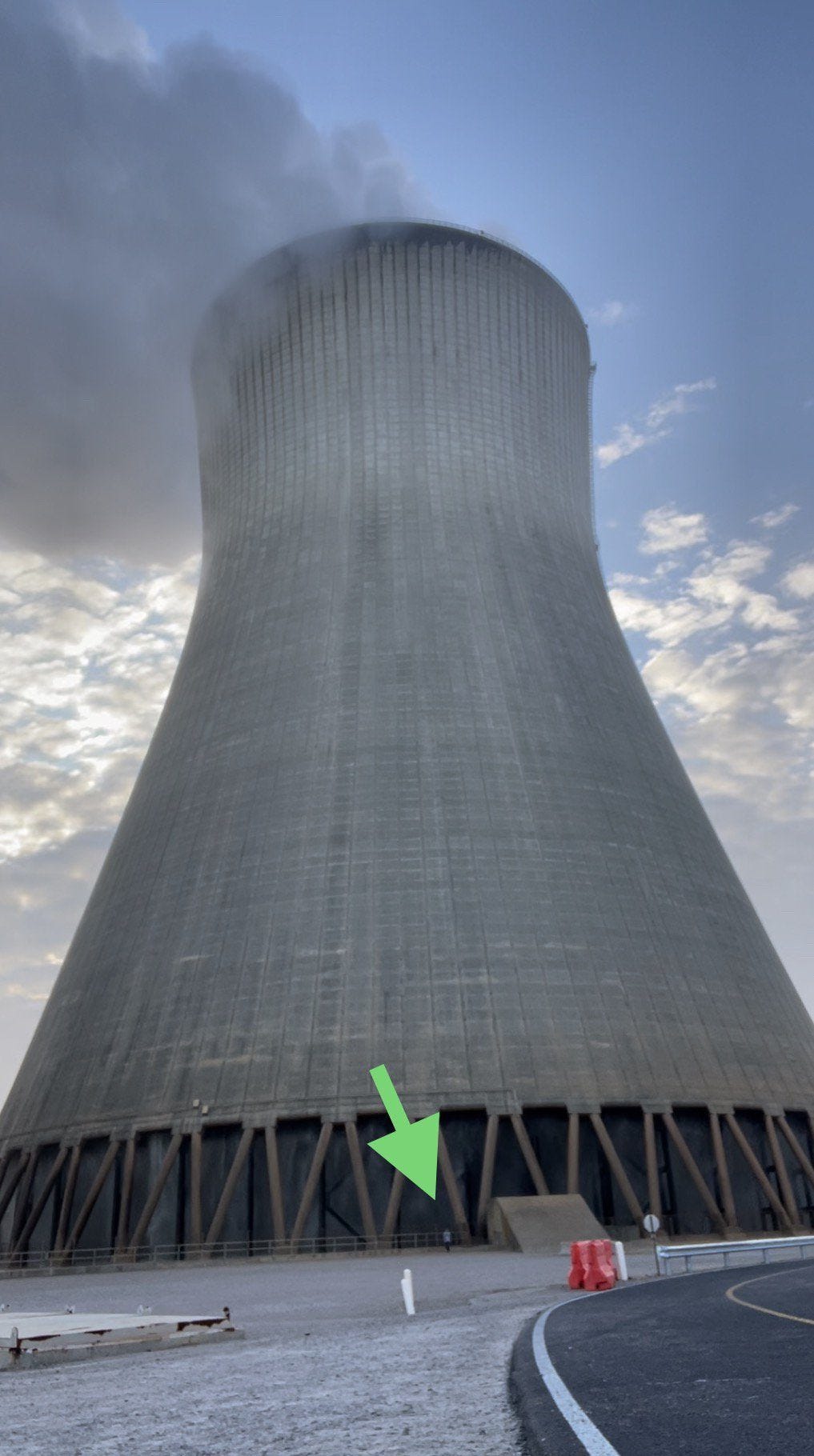
One Interesting Picture 📸: nuclear cooling tower, human for scale