Highlights this week: 👨💻 reading power mosfet datasheets, 📋 spacex's memo, and ☁️ a new theory on dreaming.
🔗 Last week’s most-clicked link: This primer on control theory and designing dc-dc converters.
Startup News 🚀💰:
- South 8 Technologies, a pioneer in electrolyte formulations for next-generation lithium batteries, raised a $12M Series A led by Anzu Partners along LG Technology Ventures, Shell Ventures, Foothill Ventures, and Taiyo Nippon Sanso Corporation.
- Tive, a startup developing supply chain visibility tools, raised a $54M series B led by AXA Venture Partners with participation from Sorenson Capital, Qualcomm Ventures, Fifth Wall, SJF Ventures and Floating Point Ventures.
- Exafunction, a startup developing a platform to abstract away the complexity of using hardware to train AI systems, raised a $25M Series A led by Greenoaks with participation from Founders Fund.
- Verana, a startup developing innovative 5G radio-access networks (RAN) solutions, raised a $28M Series B led by DC Investment Partners, along with Spark Capital, BOLD Capital Partners, Aspiro Capital, Taiwania Capital, and TDK Ventures.
- Andreessen Horowitz earmarks $500M to invest in Indian startups.
- US providing $3.1B to support domestic EV production. Canada (+Stellantis) investing $2.8B for Canadian EV production.
Interesting Links 🔗:
- Fascinating new theory on dreaming from observing a deep neural net. By hallucinating out-of-distribution sensory stimulation every night, the brain is able to rescue the generalizability of its perceptual and cognitive abilities and increase task performance.
- How to read a power MOSFET datasheet.
- Aging effects and degradation mechanisms in semiconductors have always been around in theory. Now, large hyperscalers are reporting compute glitches and random defects they are not used to seeing. Metal migration, trapped charges, increased leakage, dielectric breakdown, and more.
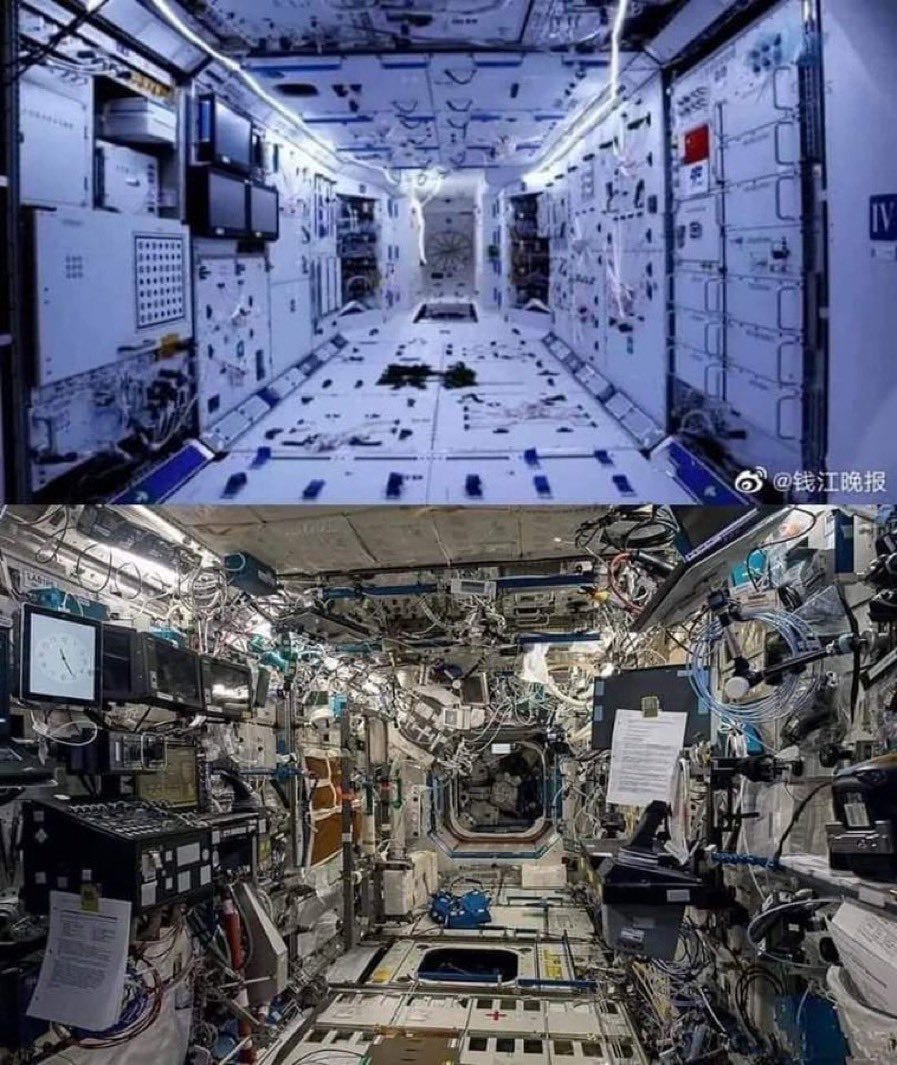
- SpaceX is so committed to safety and transparency, they released a memo describing how Starlink trajectories are designed to avoid conjunctions with the ISS and Chinese Space Station Tiangong. The maneuvers, the mechanics, the math -- really interesting to see it all laid out.
- Great “intro” video from Infineon on semiconductors and how they’re made. From sand to semiconductor.
- Toner transfer is by far the fastest way to make a circuit board at home — simply print the circuit out on a laser printer, iron it onto the copper, and etch. Obviously, I recommend you go directly to the folks over at Royal Circuits for your PCB needs. Sometimes, it’s fun to learn about the DIY side of things, and how difficult custom manufacturing really is.
- How investments in manufacturing will benefit the semiconductor ecosystem. Intel’s new $88B site, Biden’s $100B US Manufacturing pledge, TSMC’s $44B expansion plan, and more.
- Equipment recommendations for a home electronics lab. Scopes, multimeters, knobs, logic analyzers.
- Collection of two-MOS-transistor circuits, spanning a wide range of applications. Using these building blocks, circuit designers can assemble a vast array of complex analog functions. This (incomplete) collection serves as a reference and inspiration to junior circuit designers and hopefully contains at least one unexpected example for the professional engineer.
- The Dynamo and the Computer: An Historical Perspective On the Modern Productivity Paradox. Famous paper by Stanford economist Paul A. David on the conjecture of rapid technological innovation with disappointingly slow gains in measured productivity. Economists found it paradoxical for the growth accountants’ residual measure of “the advance of knowledge” to have vanished at the same time a wave of major innovations was appearing -- microelectronics, telecom, composites, biotech, etc.
- High-Speed Constraint Values and PCB Layout Methods. This book provides PCB layout designers a relatively simple method to determine if a digital signal requires high-speed management and to offer a range of constraint values and layout methods to mitigate or eliminate the problems.
One Interesting Picture 📸: 🌌 China’s Tiangong vs the International Space Station