Highlights this week: 🚀 intro to high-speed flight, 👨🔬 choosing an oscilloscope, and 🤠 a deep-dive into texas instruments
🔗 Last week’s most-clicked link: The ultimate hardware engineering job/interview question bank.
⚡️ Analog Insights: Defense Spending By State
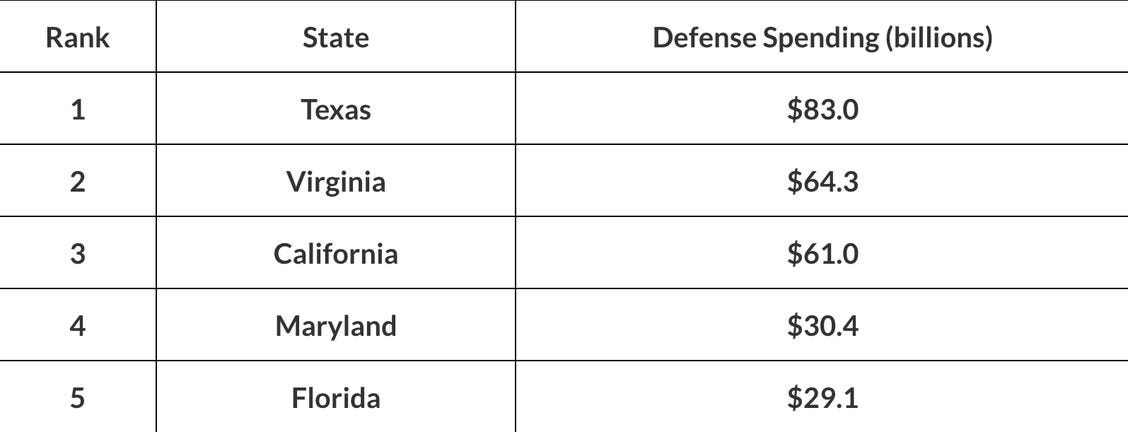
DoD contract obligations and payroll spending totaled $593.9 billion (2.8 percent of the country’s GDP). Lockhheed Martin was the top recipient, earning nearly $73B. Of those funds, $439.4 billion were spent on contracts for products and services, while the remaining $154.6 billion paid the salaries of DoD personnel.
Startup News 🚀💰:
- Atomic Industries, which makes plastics faster, and cheaper raised $3.2 million (and remains in stealth mode) led by Point72 Ventures.
- Pixxel, a hyperspectral imaging satellite startup, raised a $25M Series A led by Radical Ventures, along with Seraphim Space Investment, Lightspeed Partners, Blume Ventures, Sparta LLC, and Inventus Capital India.
- Grover, a company developing a model for electronics subscriptions has raised $330 million ($110 Million in equity) in a Series C round. Energy Impact Partners is leading the equity portion.
- Built Robotics, a robotics company looking to automate construction equipment has raised a $64 million Series C led by Tiger Global.
- Munro Vehicles, a manufacturer of electric four-wheel drive vehicles has raised $975,000 in a pre-seed round led by Elbow Beach Capital.
Interesting Links 🔗:
- Single-chip processors have hit their limit. Miniaturization of transistors has slowed, yet growth in transistor counts in leading-edge designs continues to grow . Apple’s M1 Ultra has 114 billion transistors and a die area of 860 square millimeters. Multichip packaging provides better power efficiency and performance with regard to monolithic designs, as the die size for chips becomes larger and wafer-yield issues become more prominent.
- An (incredibly detailed, rooted-in-physics) introduction to high speed flight. “In the next decade we anticipate commercial high-speed flight will return to the market, regulations around overland sonic boom will be changed thanks to NASA’s X-59 program, and hypersonic technologies will transition from military to civilian flight.”
- The 2030 cost of semiconductor content in a SAE Level 4 car with an electric drivetrain could be about $4,000 compared with $500 for an SAE Level 1 car powered by an internal-combustion engine. The global semiconductor industry is projected to become a trillion-dollar industry by 2030 -- 70 percent of growth is predicted to be driven by just three industries: automotive, computation and data storage, and wireless.
- Forum on other great niche, industry-specific newsletters to subscribe to. Like https://8bitnews.io/ for retro computing.
- Things to consider when choosing an oscilloscope: bandwidth, rise time, long record lengths, sampling rate, automated waveform measurement, etc.
- Two physicists walk into a bar and start playing a game of darts. One turns to the other and says, “Let’s make a bet. If you lose this game, you have to use the word ‘penguin’ in your next paper.” That’s how CERN physicist John Ellis ended up naming the bottom-quark particle decay path “penguin diagrams”.
- Grain can become like quicksand very quickly, with grain bins killing nearly a dozen farmers each year. Modern grain unloading augers move at least 2,000 bushels of grain an hour and, often, several times that in the largest grain systems. At these rates, the average man can be covered in corn within 11 seconds. (sidenote: quicksand itself is really not all that fatal. Humans won’t sink more than waist-deep due to quicksand being 2x as dense per cubic centimeter).
- Many software and web applications that are already internationalized and are successfully supporting many languages, often suffer catastrophic failure when they add support for the Turkish language. This page explains the difficulty of supporting the Turkish language and typical solutions.
- Intel is announcing the opening of its new D1X Mod 3 expansion (renamed Gordon Moore park) at its Hillsboro, Oregon manufacturing facility. 270k+ sq ft more clean room space. Ian Cutress gives a detailed tour of the fab.
- The Huge Endeavor to Produce a Tiny Microchip. A fantastic overview by the NYT on the entire semiconductor fabrication process with real-life statistics on Intel’s existing fabs. Intel’s two sites in Chandler collectively draw about 11 million gallons of water a day from the local utility. To build its future factories, Intel will need roughly 5,000 skilled construction workers for three years.
- Deep-dive podcast into Texas Instruments -- the business, its history, and how to value it’s stock.
One Interesting Picture 📸: take your time 🚰