

👋 Happy Saturday! This week’s highlights include lecture notes on how to define requirements (MRD → PRD → engineering spec, with Agile adaptations for regulated programs), a closer look at Waymo’s Zeekr robotaxis, and a deep dive into how subnormal floating-point numbers make audio fades unexpectedly CPU-intensive.
Interesting Lecture Notes: The Art of Getting Requirements Right
A good reminder that requirements aren’t just paperwork, it’s how teams decide what to build before the first prototype exists. This week’s lecture from a 2015 CMU course on ‘Requirements and Methodical Engineering’ for Embedded Systems is a goldmine on thinking through requirements deliberately instead of hacking toward a solution.

The classic waterfall approach starts with MRD (marketing requirements document that defines broad business goals, market needs, and customer problems) → PRD (product requirements document that states what the product must do to satisfy the MRD) → engineering spec (a detailed technical plan for meeting the PRD). Each step flows into the next and only changes if there’s a major re-think.
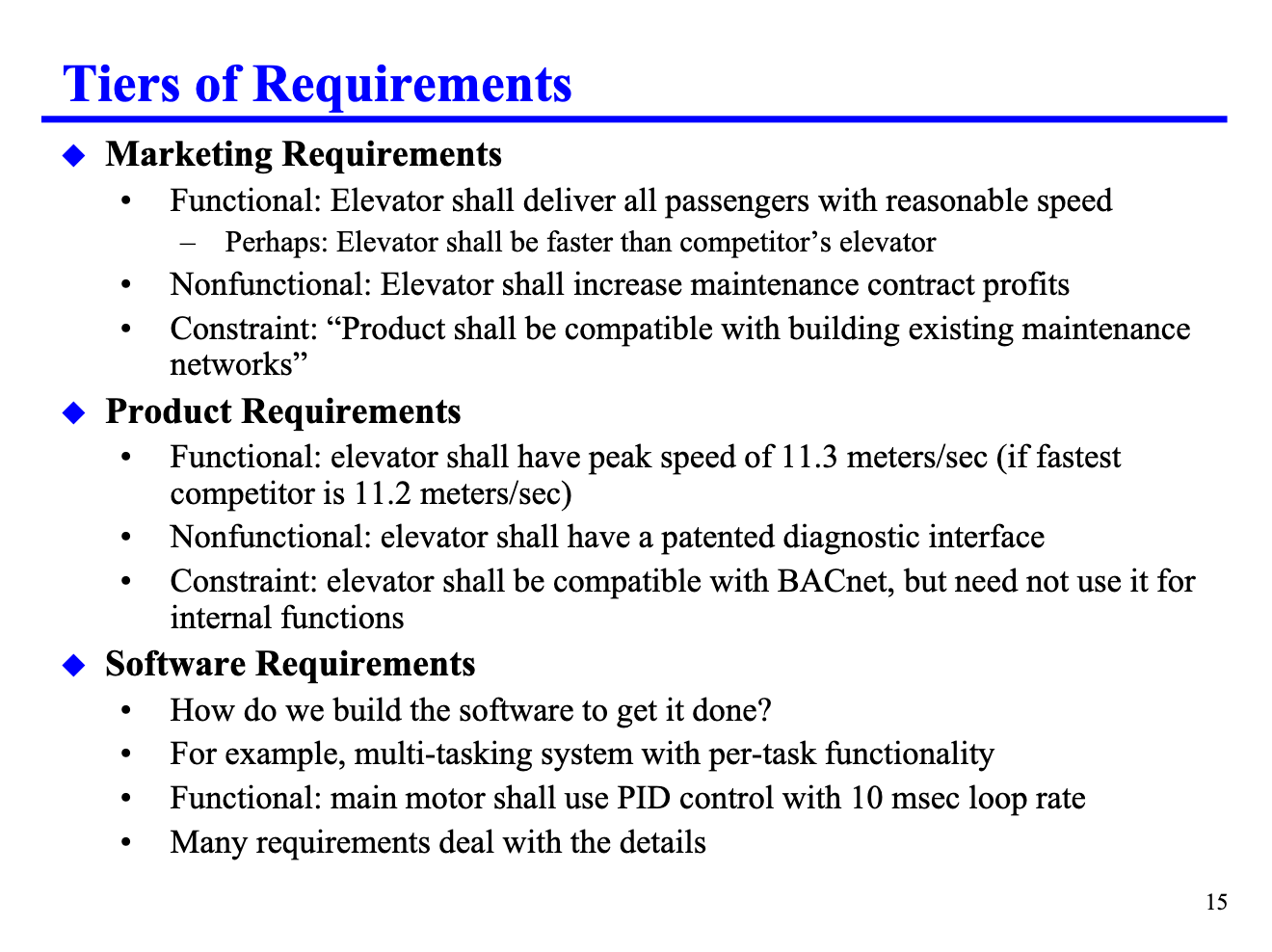
This is one way to do requirements, whereas the Agile framework takes the opposite approach: requirements are lightweight and adaptive with just enough detail to move forward, then refined through ongoing testing and feedback even late in the process. In regulated industries (aerospace, defense, medical), regulations force staged validation and documentation. Agile works within that by breaking development into smaller iterations (test → learn → improve) that reduce risk instead of betting everything on a single end-of-program sign-off.
To paraphrase Thomas Cathcart:
“To the optimist the glass is half full. To the pessimist, the glass is half empty. To the engineer, the glass is twice as large as it needs to be.”
Interesting Photo: Waymo’s Zeekr Robotaxi Fleet

Spotted in California: one of Waymo’s new robotaxis built by Zeekr, a premium EV brand owned by China’s Geely Auto Group. The van-like EV is a configurable cabin that can run with driver controls or once regulations allow, without steering wheels or brake pedals. Waymo sources base vehicles from manufacturers like Zeekr as inputs to its factory, then adds its own sensors, compute, and autonomous driving software. Waymo is using the same integration model for Hyundai’s Ioniq 5, built at the company’s new ‘Metaplant America’ facility in Georgia.

Interesting Video: The Math Behind Audio Fades
Of all the everyday tasks on a computer, fading out audio can be among the most CPU-intensive. The culprit is subnormal floating-point numbers: values so close to zero they’re smaller than IEEE 754’s smallest 'normal' number (for single precision, that’s on the order of 10⁻³⁸). These tiny values representing numbers closer to zero than the smallest normal floating-point number trigger a microcode exception, so a floating-point multiply that normally takes 3–6 cycles can jump to 100–200.
With subnormals enabled in the digital audio workstation demo, CPU usage jumped from 22% to 64% during playback while disabling them kept the increase much smaller, topping out around ~32%.
Manufacturing & Startup News
More leftovers from our weekly research:
- Many of the now-bankrupt Nikola’s EV semi trucks are being sold at auction. A construction startup, Lumina Vehicles, purchased several trucks for a fraction of the original cost and plans to use the trucks’ batteries to recharge electric construction equipment on short-haul trips to job sites.
- TerraBlaster raised $4M in pre-seed funding to develop a soil analytics device using laser-induced breakdown spectroscopy in agriculture.
- Wattch raised $6M in seed funding to expand its IoT-based monitoring platform for solar and battery storage systems.
- Orbital Paradigm secured $1.6M in pre-seed funding to develop reusable re-entry capsules for safe payload return from orbit.
- PeroCycle raised $4.9M in seed funding to pilot perovskite-based carbon-recycling technology for steel plant decarbonization.