Highlights this week: The ‘Ideal Switch’💡Injection-Molding IC Packages 🏭 and the US Tooling Industry ⚙️
📝 Featured Article: VR headsets are uncomfortable after a few hours largely due to the difference in parallax and focal depth, light-field displays solve this through stacked LED layers, time division multiplexing, and integral displays.
🎤 Featured Interview: Read our interview with Ali Alqaraghuli who we featured twice on Analog & .
Interesting Links 🔗:
- Learn how the “ideal switch” works, from Menlo Micro (writeup here). Electromechanical relays are big, slow, and don’t last long. Solid-state switches are inefficient (esp at high currents and/or frequencies). These high frequency micro-mechanical ‘ideal’ switches use small metal contacts between glass plates to switch RF signals in M pole, N throw configurations. The absence of normal semiconductors from these switches give them very high power and low insertion losses.
- A new Construction Physics issue explores the fall of the American machining industry. For most of the 20th century the US had the largest machining tools industry in the world. Whereas imports had been just 10% of the US market in 1973, by the late 1990s they were closer to 60%, and by 1986 75% of NC machines were imports. Japan alone made up 50% of the US NC market in the late 1980s. For a deeper understanding of industrial history at the manufacturing level, read Max Holland’s book.
- Don’t build SaaS! Fifty Years put together this treasure map that highlights large markets with low startup investment, largely in ‘physical’ industries. From the paper industry to chemical products and plastics, this interactive page shows market sizes, dollars invested, and where opportunities lie.
- Injection molding is the method of choice to embed ICs in medical sensors and consumables. The plastic’s processing temperature must be low enough not to soften or liquefy the solder that attaches the IC to a substrate. Plastic materials are not equally suited for the sterilization required by medical applications. Consequently, only few of the sterilization methods are compatible with both the plastic material and ICs.
- A deep-dive on how to perform EM modeling of an IC including packaging at the LVS (layout vs schematic) stage of design. Modeling package layers together with on-die metals can reveal degradation in performance that may violate a specification or cause the device to fail. From ANSYS using RaptorX.
- A useful wiki of oscilloscope-related terms and features from PicoTech. Rise time is inversely proportional to the bandwidth of an oscillation by a factor of 0.35 (Tr = 0.35/BW). 0.35 is a constant determined by the scope input’s internal circuitry.
- How to Simulate a Power Supply. Robert Feranec & Benjamin Dannan set up the simulation of a power supply, compare the results with real measurements on a test board, and fix the real power supply. Detailed schematic-level model of the power supply and in-depth analysis of the output charts.
- Another talk from Jim Keller, CEO of Tenstorrent on how to design AI hardware. To beat a GPU they need very efficient matrix multipliers which can handle AI computations. Just as important is the software that maps the AI computations to the new custom hardware designed on chip.
Startup News 🚀💰:
- Oxford Space Systems have raised $3.96M in venture funding from Future Planet Capital, UK Innovation & Science Seed Fund. Oxford develops foldable antenna arrays for space satellites.
- Elysian Aircraft came out of stealth this week with a concept design of an electric aircraft and a 10-year roadmap to operation. Backed by Caravelle and Panta Holdings they have raised $10M to date.
- Landmoto raised a $3M extension to their Series A. The company develops two-wheel electric vehicles manufactured in Cleveland, Ohio. Special purpose vehicle Nunc Coepi Ventures invested.
- Farm-ng raised a $10M Series A for their robotic farmhand assistant, the Amiga. Data is still being measured, but the robots could give a 50-80% labor boost. There is also a full developer kit with the robot, allowing for custom functionality. Acre Venture Partners invested.
- AstroScale has released new details about their $25.5M Space Force contract awarded last Fall. The company will assist with in-space refueling of Space Force assets by navigating a roughly gasoline-pump-sized satellite to supply hydrazine in GEO to client satellites.
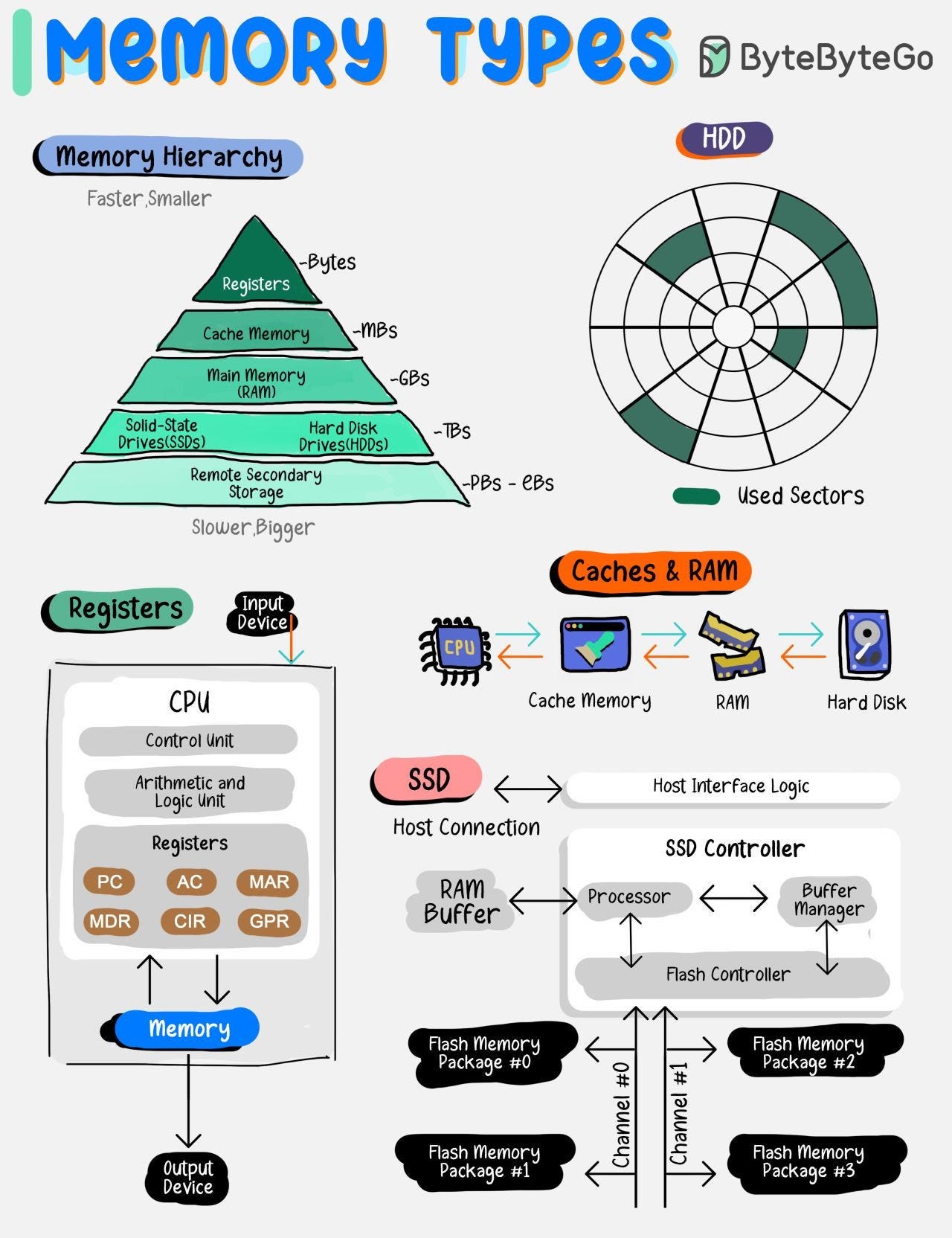
Different types of memory from ByteByteGo.