Highlights this week: 1930’s Auto manufacturing 🏭 EE lab bench essentials 🔬and Errors in semi manufacturing ⚠️
📝 Featured Article: How to write a PCBA functional test specification, from FixturFab.
🎤 Featured Interview: Read our interview with Adam Hook, President of SMTA Upper-Midwest.
Interesting Links 🏭
[manufacturing]: A comprehensive story (from 2001!) of how Arrow Electronics implemented lean manufacturing in their chaotic wire harness assembly operation. The core element of lean manufacturing is standardization through planning using takt times, cycle times and efficient job function sequences. To achieve these elements, the overall plan requires elimination, or at least coordinated control, of the chaos in the manufacturing environment. Arrow attempted this by designating the starting point as just one line.
[manufacturing]: America’s Advanced Manufacturing Problem—and How to Fix It. An article from the American Affairs Journal analyzed different historical and economic factors between the US and other high-output manufacturing nations. The article recommends several action steps to address America’s manufacturing challenges, such as improving manufacturing institutes, backing R&D for manufacturing technologies, and providing scale-up financing.
[manufacturing]: Auto manufacturing in 3 parts: 1) Film from 1936 showing the manufacture of Chevrolets from foundry to finished vehicles. 2) The modern car manufacturing process. 3) Tesla’s ‘unboxed’ auto manufacturing process for next-gen vehicles (super deep-dive here).
[engineering]: This article provides a guide to designing-in supercapacitors. Supercapacitors are easy-to-use energy storage devices, comparable to batteries, that can be charged by any current-limited power source. The authors demonstrate how charging and operating times can be calculated, with an example of a circuit design that allows the charging of the capacitor under non-ideal conditions and the operation of any electronic application.
[engineering]: A recent post from SemiAnalysis discussing the sources of error at a high level in semiconductor lithography. There are four principal sources of error: line edge/width roughness, optical proximity correction, and edge placement error.
[engineering]: The Engineering Toolbox, a directory of online engineering tools for a variety of disciplines from drawing tools to physiology. The electrical section has a good spread of industrial guides, and interesting section on soil resistivity for installing earth electrodes.
[engineering]: A complete breakdown of an electronics lab workbench with a full table links to all products including lab tools, prototyping hardware, and desk.
[engineering]: Some niche electronics educational YouTube content covering ham radio, test & measurement from w2aew. Power electronics and simulation from Sam Ben-Yaakov.
Startup News 🚀💰:
FlashPCB, a manufacturing startup out of Philadelphia, just launched their 3-day ultra-quick-turn PCBA service. “From the moment you checkout we start working on your board. In three business days it's on its way to you”. We’re curious to hear if anyone has used them and what their experience has been!
ForgeHQ, a hardware procurement platform in the Winter YCombinator batch, have launched.
ClearMotion, a company developing vehicle suspensions systems which uses sensors to anticipate suspension events and create a smoother ride raised a $42.55M Venture round.
Lightship has raised a $34M Series B. Obvious Ventures and Prelude Ventures invested. The company develops an all-electric RV the L1 which is manufactured in Boulder, Colorado. Check out the Munro teardown for a detailed look.
It has been a big week for haptic VR I/O hardware. Bhaptics raised a $7.4M Series C for VR haptic suits based in South Korea. Meanwhile, Disney released a video of their Holo Tile VR treadmill, which went viral.
Andreessen Horowitz released the American Dynamism top 50 report - AI Edition. There is an interesting section on AI robotics specifically including past features from the news section.
EE Interview Prep 🤓
Register below with your student email for a 20 minute interview prep meeting with The Analog. You’ll be interviewing with 1-2 EE’s from companies like SpaceX, Apple, Neuralink, and hardware startups.
We will send you some material to prepare with in advance.
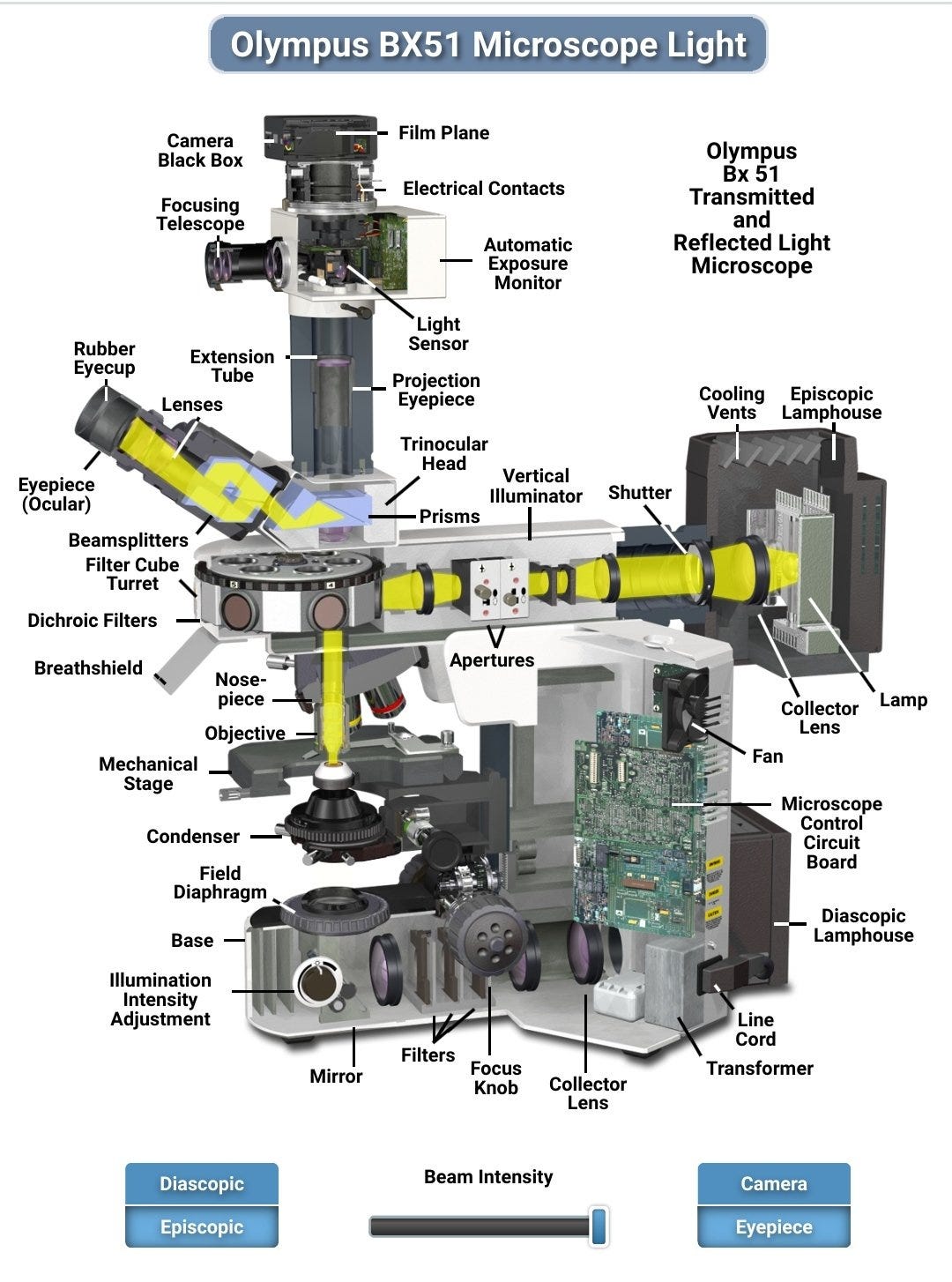
A cutaway diagram of an Olympus BX51 microscope.