Highlights this week: 🛩️ NASA unveils the X-59 🎡 CES ‘24 🔋 long-life nuclear batteries
📝 Featured Article: Using PartsBox to build satellites with Orbit NTNU.
🎤 Featured Interview: Read our interview with Elie Rosen of BLT.
Interesting Links 🔗:
- NASA and Lockheed Martin have released the X-59, an experimental aircraft meant to demonstrate quiet supersonic flight at speeds of up to mach 1.4 (925 mph). The aircraft has an ultra-thin design with the cockpit in the middle of the aircraft with a vision system to give the pilots forward visual input. This research paper reviews sonic boom prediction and reduction methods for next-gen supersonic aircraft.
- 3M paper explaining how touchscreens work. Projected capacitive technologies detect touch by measuring the capacitance at each addressable electrode. When a finger or a conductive stylus approaches an electrode, it disturbs the electromagnetic field and alters the capacitance. This change in capacitance can be measured by the electronics and then converted into X,Y locations that the system can use to detect touch.
- Primer on reading a datasheets, including typical device performance, minimum and maximum requirements and characteristics, and what you can do to the device without harming it. After the primer, read this in-depth walkthrough of reading a power mosfet datasheet.
- Nuclear power plants produce around 20% of US electricity and the majority in France. Yet the industry is stagnant. Should we have built more nuclear plants in the 60s and 70s when coal was the primary alternative? Almost certainly. It may not make sense to build new plants today, but we can reduce how much existing plants cost to operate and fast-track new technologies to the market through better regulation.
- A (timeless?) HBR article from 1989 on reforming job shop manufacturing. PCB assembly involves a range of operations: preparation of components, manual insertion of components, limited machine insertion of components, hand soldering, wave soldering, visual inspection. Slashing lot sizes (our goal was lots no larger than five boards) and reducing lead times meant that workers had to be able to perform a range of these operations rather than specialize in one. So the department began extensive cross-training. Workers who operated assembly machines were taught how to program them.
- Great overview of the PCB manufacturing process from Virginia Tech. Electroless copper plating is a process that provides a uniform copper coating onto the surface and through holes of PCB’s, also adhering to non-conductive surfaces like fiberglass. It also provides a seed layer for further electroplating. Here’s a great article from Summit Interconnect comparing the differences between DC and Pulse Plating for Beginners.
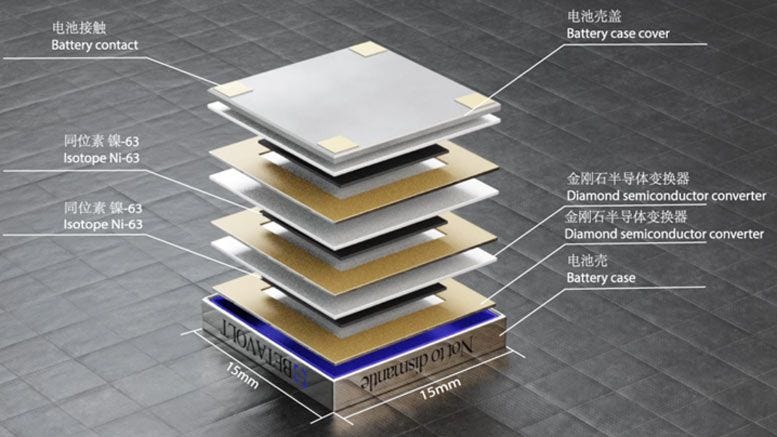
- Betavolt claims to have produced a 50yr lifespan atomic battery which uses a radioactive isotope of nickel (Ni-63)and a special diamond semiconductor converter (example) to harvest power. Apparently, the battery won’t leak radiation even if subjected to gunshots or puncture.
CES 2024 Links 🔗:
- Impulse Labs unveils the ‘future of cooking’ with a battery-integrated cooktop. Read about their long-term vision here – there are 140M homes in America, and if we put batteries and inverters in 3+ major appliances per home, we can deploy ~1.4 TWh of storage onto the grid -- WITHOUT major electrical work.
- Infinix has unveiled a wireless charging system at CES that can deliver 7.5W of power at frequencies below 7.68MHz. With a maximum distance of 20cm and a coupling angle of up to 60 degrees this is a huge operational range for consumer devices.
- Qualcomm have released a new SoC that can handle both ADAS functions and infotainment at once.
- A group at the Oak Ridge National Laboratory and Siemens AG have 3D printed a steam turbine blade using wire arc 3D printing. This technique involves using a robotic arm to precisely guide a wire into an arc welder to form a part. This is an advantage to larger parts 50kg> where having a casting made can be very difficult at lower volumes.
- Siemens have partnered with Sony to launch an XR headset intended for CAD applications. The product will initially work with NX Designer with a 30% claimed productivity improvement due to stereoscopic inputs. Also built with the Snapdragon XR2.
- RealWear have launched the Navigator Z1, the first AR headset to hold ATEX/IECEx certifications, meaning the device is certified spark-free and can operate in flammable atmospheres. This is a critical requirement to bring industrial AR to hazardous industries such as oil and gas. Powered by Snapdragon 625.
- Abbott released a first-of-kind leadless pacemaker at CES which leverages wireless ‘implant to implant’ communication through the body to synchronize to separate devices on the hearts left and right atrium. More information about wireless communication in the body here.
- Efforts are continuing to create a wearable device that is kind of like a retainer, and would allow users to use their tongue as a peripheral input. The device is initially intended for people with disabilities who do not have use of their hands.
Startup News 🚀💰:
- Minesto has successfully launched and recovered the first MW level tidal kite. The company’s Dragon 12 system can extract up to 1.2MW of electrical energy from tides and other ocean currents.
- SpaceX plans to launch 144 rockets this year. At a rate of 12 per month, or one launch every 2.8 days approximately 60% of the launches will support Starlink which currently has 5,170 active satellites as of writing, with FCC licensing for 12k and an active application for an additional 30k.
- A new AI wearable product, Rabbit R1 launched this past week at CES. Similar to the Humane AI pin a few months ago, people are going crazy for these and there the second 10k pre-order batch has sold out.
- Sightful have launched the first AR laptop, effectively a compute dock with a keyboard, and AR glasses with can provide up to 100” of AR display space. The laptop runs on a SnapDragon XR2.
The stack up of a nuclear battery developed by Betavolt in China.