Highlights this week: 🔋 battery management algorithms, 🏭 japanese job-shop manufacturing economy, and 🤖 what went wrong at xerox.
🔗 Last week’s most-clicked link: The DeLorean returns with a stylish, 300-mile EV — dubbed the Alpha5.
Startup News 🚀💰:
- The Six Five Summit, June 7-9. Speakers from Intel, Groq, SiFive, Marvell, Lattice Semiconductor, and more.
- Rebellions, a South-Korean that builds chips designed for artificial intelligence applications, raised a $50M Series A from Temasek’s Pavilion Capital, Korean Development Bank, SV Investment, Mirae Asset Capital, Mirae Asset Ventures, IMM Investment, KB Investment, and KT Investment.
- FarmWise, a California-based weed-removal startup that works with some of the largest farms in the US, raised a $45M Series B led by Fall Line Capital and Middleland Capital, with participation from Taylor Farms, GV, Playground Global, and Calibrate Ventures.
- RealWear, a Washington-based provider of assisted reality solutions for frontline industrial workers, raised a $23.5M Series C led by Foundry Group with participation from Qualcomm Ventures, Kopin, and Columbia Ventures Corporation.
- Spain's government approved Tuesday a plan to spend €12B in the semiconductor and microchip sector. The aim of the plan is to double its current semiconductor market share to 20% in 2030.
- The Bosch Group is raising its venture capital funding for the current business year with a new €250m fund to invest in startups. The fund from Robert Bosch Venture Capital GmbH (RBVC) is the company’s third, looking at a shortlist of around 100 startups out of 2000 applications
Interesting Links 🔗:
- Great video covering battery management system algorithms, and a lot of the fundamentals to consider when building/buying a BMS. These include sensing/hv-control, over/under V/I/T control, state of charge/health estimation, cell balancing.
- One of Japan’s secrets to its success in having a well-run domestic automotive supply chain is the presence of readily available plating job shops that can work lock-in-step with the Tier 1 and Tier 2 component manufacturers requiring either anti-corrosion or decorative plating. These plating job shops are contracted out to plate parts on behalf of manufacturers which do not have in-house plating capability. A whopping 1,350 plating job-shops live nearby and deliver just-in-time goods to automotive manufacturers.
- Planning EDA’s next steps: Cadence CEO Anirudh Devgan talks about everything from AI and advanced packaging to continued scaling and an increased focus on R&D and new opportunities.
- TI’s power topologies handbook. Slightly formula-heavy, but a very cut-and-dry reference for all the major topologies (buck, boost, flyback, etc.).
- The Atoms and Bits Renaissance, a great perspective piece by Two Sigma Ventures on their excitement and bullishness towards subscription hardware businesses solving some of humanity’s most pressing problems in healthcare, climate, and beyond. They’re eyeing the convergence of computing, algorithms, logistics, and financial infrastructure.
- Freedom’s Forge is a book recommended by a subscriber -- we haven’t read it yet (ordered!), but it seems like a very interesting read on American willpower and manufacturing prowess in times of great need. Drafting top talent from companies like Chrysler, Republic Steel, Boeing, Lockheed, GE, and Frigidaire, Knudsen and Kaiser turned auto plants into aircraft factories and civilian assembly lines into fountains of munitions. In four short years they transformed America’s army from a hollow shell into a truly global force, laying the foundations for the country’s rise as an economic as well as military superpower.
- Printed antennas vs chip antennas. Blog post on the differences between the two, along with a link to chip antenna options to review and design in.
- Xerox PARC’s engineers on how they invented the future -- and how Xerox lost it. The inside story of personal computing at the legendary research lab. PARC originated/nurtured technologies that led to these developments (among many others): laser printers, structured VLSI design, networks that link personal computers in offices, semiconductor lasers that read and write optical disks.
- Nearly 20 years after the Concorde jet failed, aircraft-makers are still trying to master high-speed flights. But can they? Interesting opinion piece on whether this convergence of technology can create something both profitable and economically useful that just wasn’t possible 10-15 years ago. NY to London in 3 hours at the same price as current business travel.
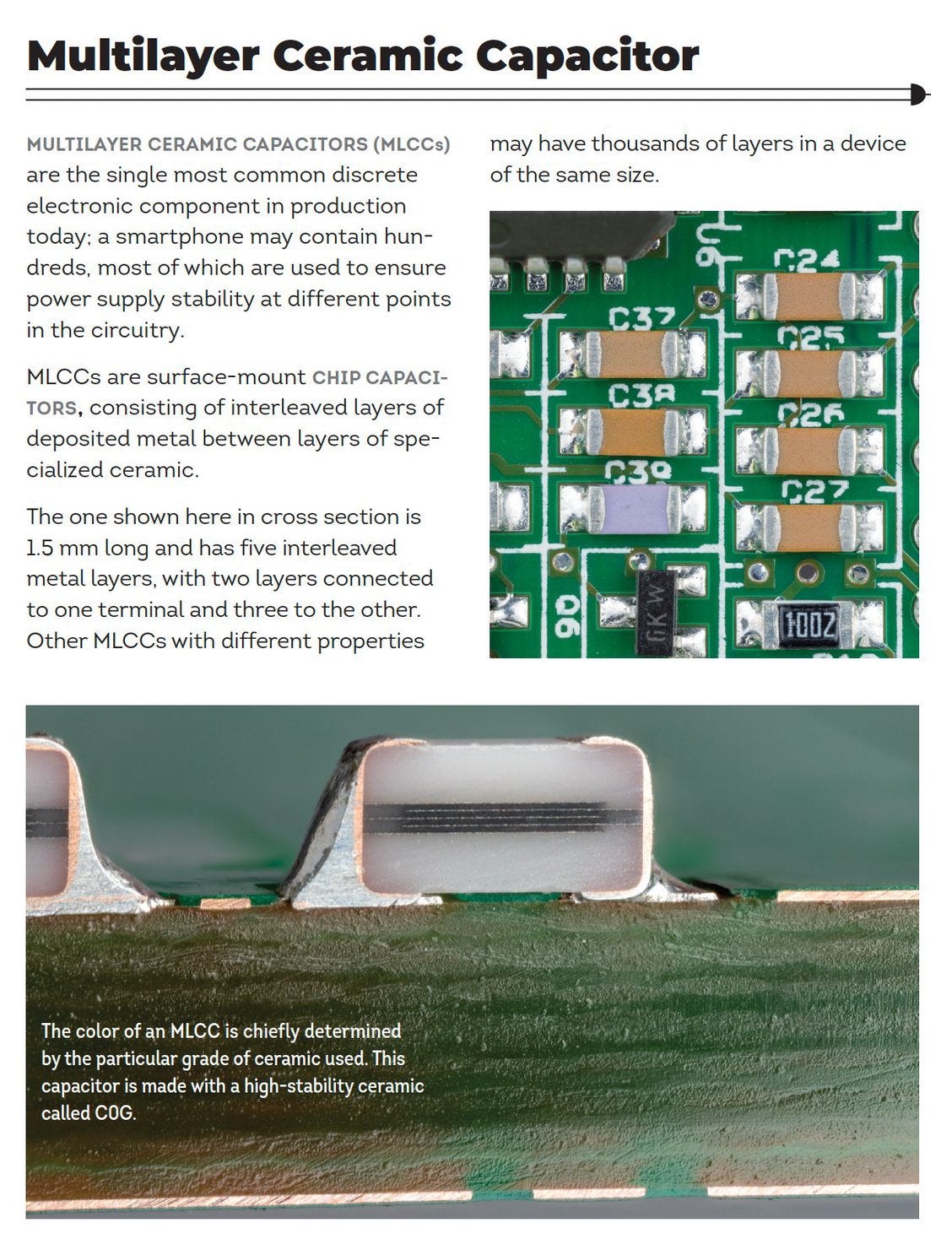
One Interesting Picture 📸: inside a capacitor