Kick off the year entering our design challenge with Makelab: design a 3D printable household hack for a chance to win $500 in print credits! Submissions due by 2/02.
Join our live workshop on 2/05 with Hardware Velocity to learn how ex-Google, Apple, and Razer execs define product requirements, build prototypes, and scale hardware to production—register here.
Interesting Links 🏭
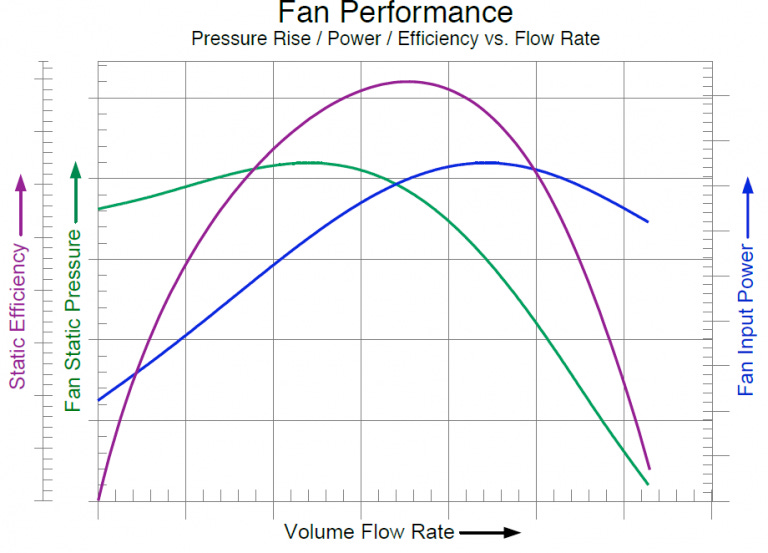
Fan Performance Curve Example: Airflow Rate vs. Static Pressure with Input Power and Efficiency Trends.
Look around you, and there’s likely a fan humming away at work—cooling your laptop and keeping you warm via forced convection through air ducts, among other common commercial and consumer applications. Fan manufacturers publish performance curves for almost every fan on the market that characterize key metrics like volume flow rate (the fan's capacity to circulate air within a space), static pressure (fan’s pressure resistance, higher values denote fan needs to work harder to maintain desired flow rate), and input power. This article covers the basics of how performance curves are generated in flow tunnels using standard test methods to custom setups like automotive HVAC testing.
Generating a fan performance curve for an automotive HVAC system
On the topic of fans, bladeless fans are a fascinating application of the Coanda Effect— the same principle used to generate lift on aircraft—where a fan with “no blades” can multiply mass flow rate by up to 15x! Bladeless fans like the ones popularized by Dyson use an impeller to draw air into the base and accelerate it through a narrow slit around a hoop-shaped airfoil. As the high-speed airfollows the curvature of the hoop surface (i.e. Coanda Effect), this creates a low-pressure zone that draws in additional air that combined with entrainment, amplifies the total air volume. From the Bladeless Fan Club: the best 10-minute explanation of bladeless fans, covering their mechanics and how Bernoulli’s Principle and the Coanda Effect actually work in real life.
An annotated cross-section of a bladeless fan
A quick reference on lithium-ion battery safety and testing standards. Lithium-ion batteries are generally safe when properly integrated and monitored within a product. However, thermal runaway events can lead to catastrophic outcomes. Thermal runaway happens in three separate phases: overheating (reversible damage), electrolyte decomposition (irreversible damage), and finally uncontrolled thermal runaway (high risk of oxidation and fire). For individual cells, a simple nail puncture test that simulates an internal short can verify that thermal runaway remains contained, but larger systems like EV battery packs with numerous cells require thorough testing under varying conditions to prove safety.
Both the New Glenn from Blue Origin and the Starship-7 rocket launches were partially successful last week. New Glenn achieved its desired payload orbit, but was unable to recover the first stage via landing. Starship completed a second, even more graceful chopsticks catch of the Super Heavy Booster, but the second stage developed a small fire in the aft section and disintegrated in a spectacular explosion. Full timeline of the Starship-7 flight test linked here.
General thoughts: Both of these launches have big implications for space in 2025. New Glenn will be carrying the Amazon Kuiper project to orbit and deploying new space vehicles for government and commercial use. For Starship, it’s the first time reusing the Raptor engines in between flights.
Flight Test 6: The test payload used a toy banana to serve as a zero-g indicator, complemented by a human-sized banana decal on the ship’s exterior. In Flight Test 7: Deployed 10 Starlink simulators that matches the size and weight of Starlink satellites.
“Inverse multi-port radio design” just might become a buzzword of the next decade. Advancements in AI have allowed researchers to design numerous multi-port passive elements with previously unachievable performance compared to human designs. From the paper directly: The passive structures include one-port structures such as antennas; two-port structures such as matching networks, filters; three-port structures such as diplexers, combiners, splitters, switches; four-port structures such as couplers for quadrature signal generation, baluns for differential signal generations; and higher order networks such as beamforming structures with lens-like properties
Some fun links:
SpaceX sells an 8” banana plushie—roughly 1/247th the height of Starship (1,982”).
Harbinger raised a $100M Series B to scale production of its modular all-electric chassis for medium-duty trucks like walk-in vans, RVs, and box trucks. Their focus is narrow—one product, one market—which is in part why they raised notable capital in 2025 years after EV startups continue to fall apart. The round was led by Capricorn Investment Group and Leitmotif.
Harbinger’s first commercial delivery of their medium-duty EV chassis to THOR Industries, an American RV manufacturer.
The latest in space, a triplet of Series C rounds:
Stoke Space has raised a $260M Series C round, bringing its total capital raised to $480M to continue development of their 100% reusable rocket. For context: rocket reusability has mostly focused on first stages, as SpaceX first proved with the Falcon 9. Stoke Space is also tackling the problem of reusing the second stage, by using an actively cooled metallic heat shield designed to survive the extreme heat of reentry.
Loft Orbital has raised a $170M Series C round to expand manufacturing facilities for their satellite-as-a-service platform. The company simplifies satellite deployment by integrating customer payloads with vendor-sourced satellite buses, the main body and structural component of a satellite (power, propulsion, comms, etc.). This approach reduces operational complexity and cost compared to bespoke solutions. We actually have satellites on a shelf which are all basically identical from a hardware perspective, and we just configure those satellites to apply a customer payload. The round was led by Tikehau Capital and Axial Partners.
Phase Four announced the first close of their Series C round, raising 60% of the target raise to continue development of their electric propulsion system for satellites. The total amount was not disclosed and the round by Artemis Group Capital.
Biosphere emerged from stealth and announced $8.8M in seed funding to develop UV-sterilized bioreactors—tools for growing cells or microbes used in drugs, synthetic biology, and fermentation. The round was led by Lowercarbon Capital and VXI Capital.