

Three topics this issue, no filler: a state of robotics report that leads with both record investment and a notable list of shutdowns, using 3D printed tooling for small injection molded parts, and a Boeing 737 supply chain map.
Interesting Presentation: The State of Robotics in 2026
Every year brings a new hype cycle, and robotics has had more than its share of false dawns. The honest caveat is that this is still a genuinely nascent field, developing fast enough that the frameworks for thinking about it are still catching up to the technology itself. F-Prime’s State of Robotics covers the full landscape in investment trends, deployment reality across verticals from defense to logistics to humanoids, and where the capital is deploying.
A few things worth pulling out: the headline number is $20B+ invested in 2025 at an all-time high, with almost all of the funding gains in the last two years coming from mega-rounds of $50M+.
The report also gives you an honest look at the other side of the ledger; alongside the record investment, 2025 saw a notable wave of shutdowns across both private and public companies, with agriculture robotics hit especially hard.
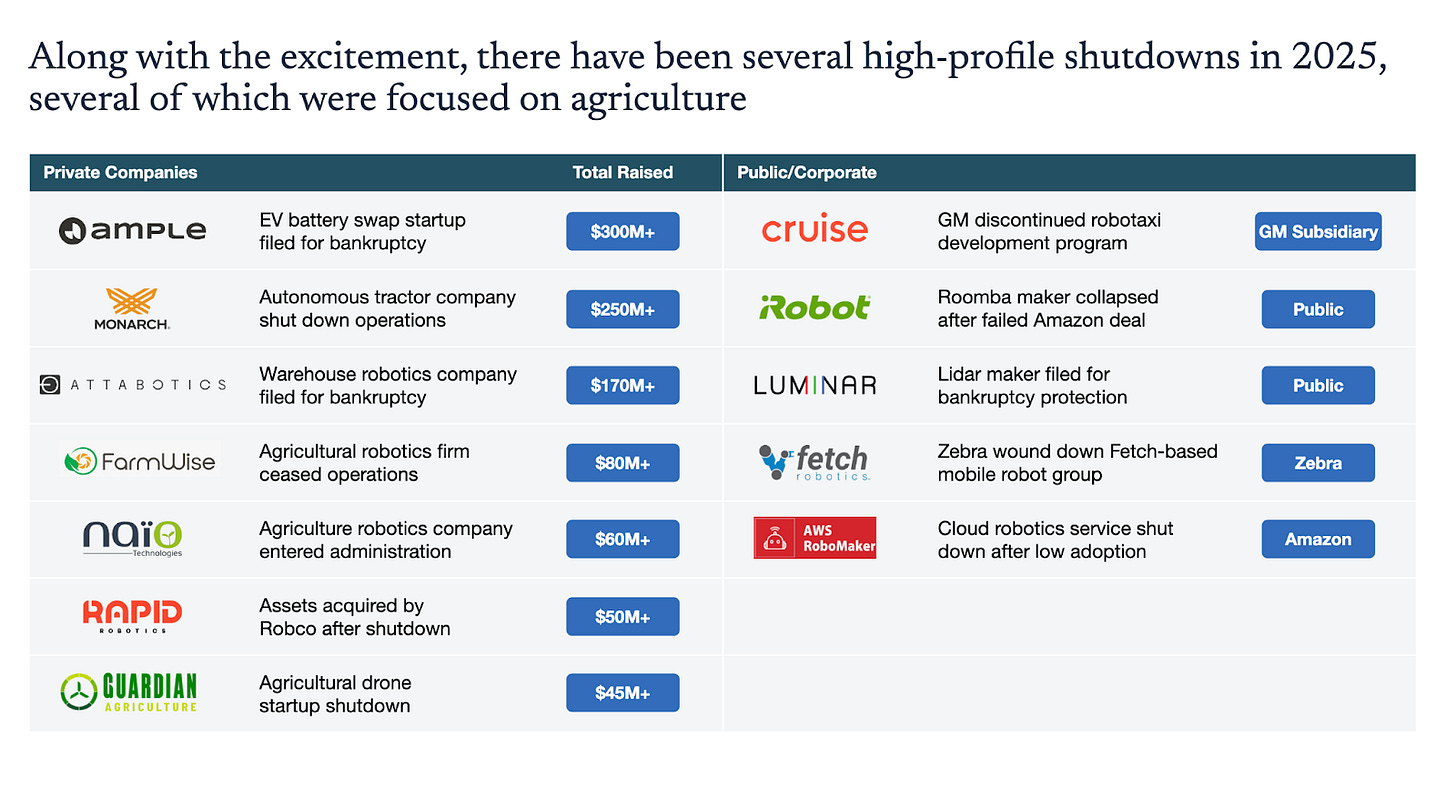
Monarch, FarmWise, and Naïo ceased operations; Cruise was wound down by GM; iRobot collapsed after a failed Amazon acquisition. Companies that collectively raised over $1B (not inclusive of Cruise), gone in the same year the industry hit its funding peak.
The capital today is largely flowing toward the bet that advances in foundation models and generative AI will do for robotics what scaling did for language models. From UC Berkeley roboticist Ken Goldberg:
Most roboticists still believe in what I call good old-fashioned engineering, which is pretty much everything that we teach in engineering school: physics, math, and models of the environment.
But there is a new dogma that claims that robots don’t need any of those old tools and methods. They say that data is all we need to get us to fully functional humanoid robots.
This new wave is very inspiring. There is a lot of money behind it and a lot of younger-generation students and faculty members are in this new camp. Most newspapers, Elon Musk, Jensen Huang, and many investors are completely sold on the new wave, but in the research field, there’s a raging debate between the old and new approaches to building robots.
Also worth reading: his editorial paper on closing the 100,000 year data gap in robotics, and Not Boring’s recent essay on world models.
Interesting Video: Tooling at Prototype Speed
A friendly PSA to all engineers and builders: if you want to truly learn a process, go straight to the source. Or in this case, 3D print injection molds instead of sending tooling overseas.
Using a desktop injection molding machine (TARS) with PETG-CF printed tooling, this is a real method to start tooling and test designs for small injection molded parts the same day. Obviously not a true path to production by any means, but it’s a viable method to validate a part design before committing to real tooling. One interesting challenge: FDM layer lines technically act as micro-undercuts on the mold walls, though a light acetone wipe might smooth that out to not matter.
Stuff Made Here also has a great video on the same idea applied to sheet metal, using 3D printed tooling to form parts directly.
Interesting Chart: The Boeing 737 Supply Chain
Final assembly in the United States, inputs from a global supply chain. Follow the map (via Julie Peasley) to see how critical global dependencies are, especially in aviation.

Manufacturing & Startup News
More leftovers from our weekly research:
- Amazon acquired Rivr, a Zurich-based robotics startup building a stair-climbing delivery robot, adding another approach to its last-mile delivery efforts.
- Claros raised a $30M seed round to build hardware that reduces power conversion losses in data centers by moving voltage regulation closer to the chip and pushing toward DC-based power distribution.
- Cocoon Carbon raised a $15M Series A round to build a U.S. demonstration plant producing cement substitutes from electric arc furnace slag.
- Uber is committing up to $1.25B to Rivian to deploy up to 50,000 robotaxis by 2031, built on autonomous versions of the R2 platform.
- The U.S. Navy awarded a contract worth up to $71M to Gecko Robotics to use wall-climbing robots to inspect ship hulls, decks, and welds across its fleet.