

Recent Engineering 🔧
- SpaceX’s Starship completed its third test flight, reaching speeds beyond 26,000 km/h and an altitude of 234 km before breaking apart upon re-entry. The mission also tested tank-to-tank propellant transfer and payload bay functionalities.
- On a personal note I highly recommend giving the biography on Elon Musk by Walter Isaacson a read for those intrigued by the rapid innovation at SpaceX. Their mantra of “build fast, break often, and iterate to success” is rare to see in aerospace, and especially with the grandeur of their current projects!

- Tesla released fly-over footage showcasing the intricacies of its Giga Berlin factory operations. The video highlighted various stages of its automotive production process, including advanced casting, stamping techniques, body in white, and more.
- Rivian unveiled a new model, R2, which received 68,000 orders in less than 24 hours. In an interview with their CEO, he shared lessons are being applied from from R1 to make R2 more affordable. This includes part consolidation, larger castings, 4695 cells instead of 2170, and assembly sequence improvements.
- Stratolaunch’s Roc, which features a 117-meter wingspan, carried out a flight test with its hypersonic robotic aircraft, the Talon-A. The Roc serves as a platform for hypersonic R&D for its own and other clients' hypersonic vehicles. The Talon-A can be seen between the Roc’s twin fuselages below:
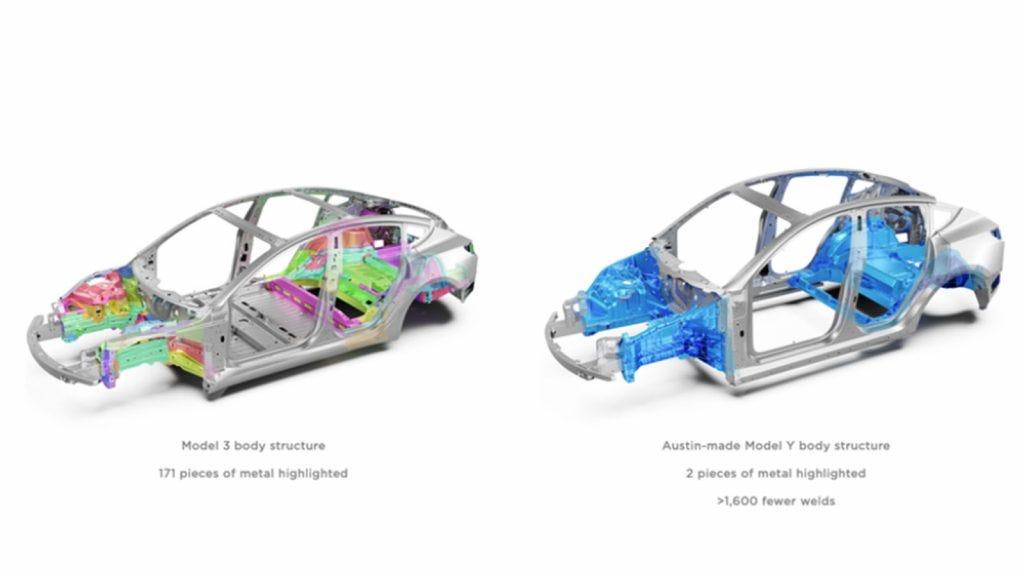
If you look closely, you'll see still images of their large, high-pressure aluminum die-casting presses. These machines produce castings that have successfully replaced approximately 171 components, predominantly sheet stampings and a few smaller castings, eliminated around 1,600 welds, and reduced the need for 300 robots in the production line.

Startup News 🌱
- Orbio Earth is using freely available satellite data to detect methane leaks. This service will save oil companies from paying a $900 fine for each metric ton leaked, in addition to reducing climate change. They’ve raised a $4 million seed round from the European Space Agency and other VC firms.
- DarwinAI, a Canadian startup, was purchased by Apple for its AI that can visually inspect components throughout manufacturing processes. This AI was also developed to be more compact, allowing it to run on smaller hardware.
- Furno recently secured a $6.5 million seed round to decarbonize cement production. The plant they’ve developed reduces emissions by 70% and achieves a thermal efficiency above 80%. Here’s a high level overview of the process:
- Pass raw materials through XRF spectrometer to characterize composition
- Add any corrective materials, such as clay and bauxite, needed
- Route materials to the kiln to complete all four stages (preheating, calcining, sintering, and cooling) in a single reactor
- Monitor the process with ML for instantaneous combustion optimization

Resources for ME’s:
Globe Explorer lets you search for any topic and it returns categorized information containing links, models, diagrams, projects, and much more. Check out these search results below:


Question of the Week: GD&T Specifications 📐
This question was derived from Arch1medes’ YouTube channel. Given the following drawing and part dimensions, which parts are in spec?

Starting with Ø10±1, which refers diameter of the hole itself, we can compare Item 3 to see if the parts are all within the bounds of 9 and 11 units. In this case, they all pass.
Moving on to the tolerance pertaining to the hole’s location relative to its nominal location, we can see that this must be within a diameter of 2 units according to Ø2. We can calculate this by subtracting the respective nominal value from Item 1 and 2 and then applying Pythagorean Theorem to get the total offset distance.
Part A is offset the center by 1 unit, Part B is offset by 0.99 units, and Part C is offset by 1.13 units. Part C does not fit within that 1 unit radius limit, thus Part A and B are the only ones in spec.