Highlights this week: Starships third test flight 🚀 a naturally occurring superconductor 🦹 a 100kW wireless ev charger 🪫
📝 Featured Article: Why git is good for hardware development by Allspice outlines all the benefits of using version control technology for hardware development.
🎙️Featured interview: Revisit our interview with Peter Staples of Blue Clover Devices.
Interesting Links 🏭
[engineering]: A rigorous theoretical electrical engineering paper on absorption thickness in non-metal backed transparent layers. In essence, there is now an equation similar to the case of a metal backed layer. This translates to improving efficiency in devices like solar panels or wireless energy transfer systems. A common example is the development of more efficient solar panels that can absorb a broader spectrum of light with minimal loss, directly impacting renewable energy's cost-effectiveness and accessibility. This breakthrough promises significant advancements in sustainable energy solutions.
[manufacturing]: Some DIY videos of various casting processes, like sand and investment casting, that really help provide a first-principles understanding. Short of doing the actual casting and pouring of molten metal itself, El Segundo startup Rangeview is taking the investment casting industry head-on and providing foundries with highly accurate printed molds. They’re doing it orders of magnitude faster and with higher precision than the traditionally tedious and error-prone lost-wax method of creating the ceramic mold.
[engineering]: Using the principle of a drinking bird toy, this method generates electricity from the natural process of evaporating water. By simulating the toy's bobbing action, it captures energy from evaporation, converting it into mechanical motion. This motion is then transformed into electrical energy through a device that generates power when its parts rub together. Remarkably, this setup can produce over 100 volts from natural evaporation, enough to power up to 20 liquid crystal displays, temperature sensors, and calculators, showcasing an innovative and sustainable way to harness energy from water.
[manufacturing]: Intel has released a new chiplet-to-chiplet communication protocol focused on 3D SiP packages called universal chiplet interconnect express (UCIe). Seen as a new multi-generational communication protocol by Intel UCIe improves the power and area of a chiplet by allowing chiplet “bumps” to be placed as close as 1um together. Although UCIe requires using a lower frequency, the power per bit is up to an order of magnitude lower, so total bandwidth can actually exceed conventional systems as bumps get smaller.
[engineering]: The Three Ages of FPGA’s by Steven Trimberger gives an overview of three key developmental periods in FPGA history: ‘85-’91 the age of expansion, ‘92-’99 the age of accumulation, and ‘00-’07 the age of stagnation. This leads into the challenges of the last decade plus of FPGA history, with the Zynq platform rising at the start of 2014.]
[manufacturing]: A good post from SemiAnalysis on the PCIe retimer market analyzing Aries Labs in detail. Aries currently ships in 80% of AI data center products worldwide and they are driving into some major connectivity categories as well aside from just PCIe retimers. A retimer is a very similar concept to a repeated except it actively filters any noise in the signal and only transmits the original data. This is a critical technology for the latest generation of PCIe specifications, which would otherwise require the use of high-cost PCB materials for signal integrity.
[manufacturing]: A neat idea for reverse engineering a PCB using a pick and place machine to trace out the board outline and find the component centers. With this info, you could superimpose the gerbers and be in a pretty good position compared to the original board database, or intelligent board data such as ODB++.
Startup News 🚀💰:
SpaceX’s Starship made steady progress this week in its third test flight from Boca Chica, TX. The flight lasted nearly 50 minutes with some incredible footage of plasma forming upon re-entry shortly before the rocket broke up.
Two interesting YC launches this week: Dime a MRP System, and Basalt Tech, a satellite operating system.
Cerebras Systems has revealed the world's largest chip with 4 trillion transistors. The Wafer Scale Engine 3 (WSE-3) achieves the high transistor count by scaling the existing node of the WSE-2 to 2048 instances. As the name suggests, this is a ‘wafer scale’ processor meaning with is built onto an entire 300mm silicon wafer.
Aethero is a space startup looking to develop edge computing capabilities in LEO, in effect becoming a mini cloud service provider to other space developers. With just a $1.7M Seed round and a five person team, the company will complete a test launch later this year. The goal is to provide computers for other satellites with much less latency than sending data down to Earth for processing.
Furno has raised a $6.5M Seed round to develop a new type of kiln that is able to more efficiently combust fuel when making concrete. Energy Capital Ventures Led with Cantos, Neotribe and O’Shaughnessy Ventures participating.
Telo Trucks raised a $5.4M Strategic round at a $10M valuation. The company is developing a small-footprint EV truck aimed at city-dwellers who need a smaller option than the more popular North American ¼ ton pickup class which is also widely available as EV’s via F-150 Lightning, etc. Go Ahead Ventures led with Underdog Labs, WorkPlay Ventures participating.
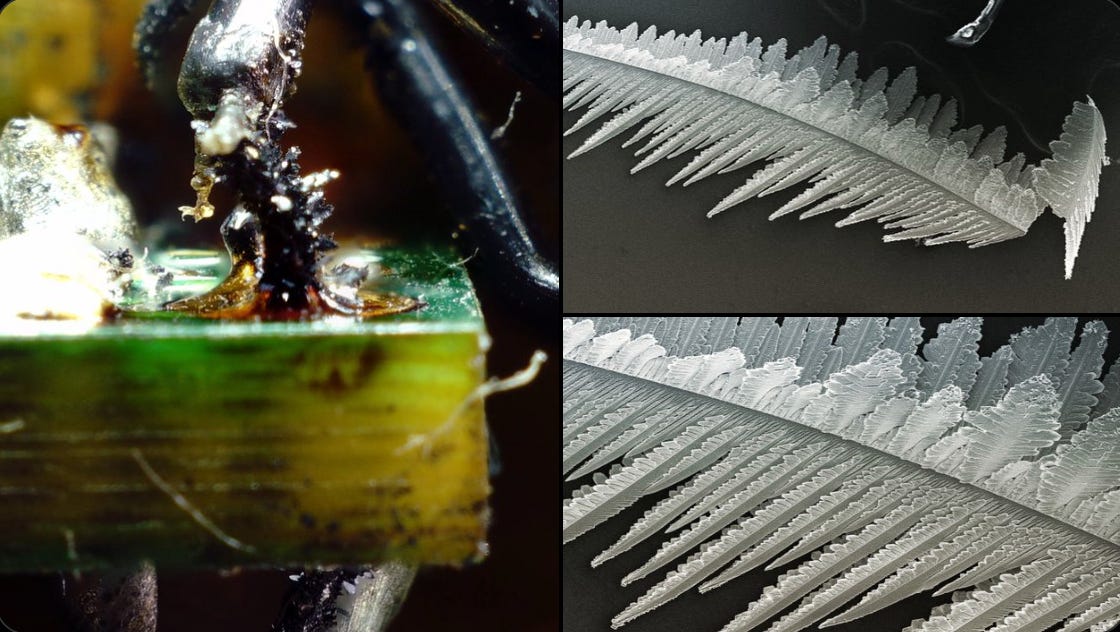
Crystal growth from a PCB in a downhole drilling operation.