Highlights this week: Neuralink’s first human patient 🤯 the fundamentals of internet infrastructure 🛜 solder paste printing for nerds 🤓
📝 Featured Article: CI/CD’s impact for hardware lifecycles by Allpsice.io
🎙️Featured interview: Read our interview with Jan Rychter, the founder of our sponsor Partsbox`who also found the time to catch up with us!
Interesting Links 🏭
The internet’s infrastructure is a massive, global web of physical hardware, consisting of more than 5 billion kilometers of fiber-optic cable, more than 574 active and planned submarine cables that span over 1 million kilometers in length, and a constellation of more than 5,400 satellites offering connectivity from low earth orbit. Anna-Sofia Lesivm shares a deep dive through the fundamentals of internet digital communication architecture.
The National Institute of Standards and Technology have shrunk a tabletop system for converting light into microwaves into a chip-sized format, reducing power usage and making it more applicable for use in everyday devices. Integrated into systems, these chips could increase radar sensitivity, the accuracy of analog-to-digital converters and the clarity of astronomical images captured by groups of telescopes. The device can produce a 20GHz signal with noise values ranging from -96dBc Hz−1 to -135dBc Hz−1. The chip works by sending a short laser pulse into a reflective cavity which then uses a frequency comb, to focus the energy into a specific bandwidth which can be converted to an electrical signal via photodetection.
Researchers were able to non-invasively insert electrodes into the brain of a zebra fish. The fascinating method uses naturally occurring enzymes already present in the insertion site to cause an injectable gel to polymerize. These gel “wires” could make way for bioelectronic devices that mesh better with our bodies, after fish testing is complete.
The new Audi Q6 eTron will have flexible OLED rear display lights. While this technology was introduced on the previous model, the Q6 will have 360 switchable OLED segments in the rear. This means the tail light actually has enough resolution to form some symbols. The plan is to use these tail lights to create other signals beyond the basic four signal + hazards in use today. From a design and manufacturing perspective, flexible OLEDs save a lot of space and conform directly to the vehicle's body profile, so this may proliferate in coming designs.
A thread from Ken Shiriff on the prefetch circuitry inside the Intel 8088 processor. This chip was introduced in 1979, a time in which memory speed was still close to the processor clock speed. The prefetch circuit would prevent delays caused by an instruction not being read from memory quickly enough. At the time this provided a 50% performance boost over the 8086.
On Saturday, Congress passed the FY2025 $850B defense spending bill. While technically considered a cut due to the fewer number of jets and ships being built, the Air Force still plans to spend $28.48 Billion over the next 5 years to develop its NGAD 6th-gen fighter and AI-powered Collaborative Combat Aircraft (CCA) escort drones. This jet includes the new Active Electronically Scanned Array radar, which offers a massive leap in capabilities over their mechanically scanned array predecessors, both in terms of range, fidelity, fast-scanning ability, reliability, and resistance to being jammed or being fooled by enemy countermeasures. Here’s a video of its operation.
Solder paste printing for nerds by Chrys Shea goes through the basics of solder paste printing before component placement during the assembly process. After going through the basics of paste printing in the PCBA world, Chrys covers all the numerous ways the paste can get smeared or incorrectly applied when it is transferred to the board. Check out this interesting set of videos showing the difference in stencil removal speeds.
Negative ion generators are simple devices that ionizes air by applying a high voltage between a very small gap of airflow. Some applications include applying powder coatings, paints, and even fake grass for model trains. A basic negative ion generator design charges and discharges a high voltage capacitor with a fan to provide airflow.
Startup News 🚀💰:
Neuralink released an interview with their first human patient who is showing successful cursor control using the novel neural implant. Although not easily visible in the video this patient has a small implant on the back of their head that can read the neural signals to his eyes and hand. Using this, the system can interpolate cursor movement and selection fluid enough to play chess and turn-based strategy games (like Civilization VI).
Boom Supersonic’s XB-1 took flight for the first time yesterday. XB-1, also referred to as the "Baby Boom," constitutes a one-third-scale technology demonstrator of the larger 55-seat supersonic airliner design known as OOverture, with which Boom is hoping to shake up both commercial and military aviation. Overture’s engine is also incredibly cost-efficient and runs on sustainable aviation fuel.
PhaseFour has raised $6.25M from Leonid Capital Partners to continue developing its RF plasma thruster technology. The funding infusion is directly tied to PhaseFour’s contracts with the US government, and the growth funding can increase depending on the value of future government contracts.
Radia has announced the design of what could be the world’s largest ever commercial aircraft. Called WindRunner the aircraft would specialize in transporting wind turbine blades, able to carry one single offshore blade which currently have limited transportation options to onshore sites. If constructed, the WindRunner would be 356ft long, nearly double a 747.
Candela has raised $27.1M of new Venture funding to deploy its electric hydrofoil boat in New Zealand. The company currently operates a hydrofoil boat in Stockholm and has raised $29M in funding previously and the lead investor Group Beneteau, is the world's largest boatmaker.
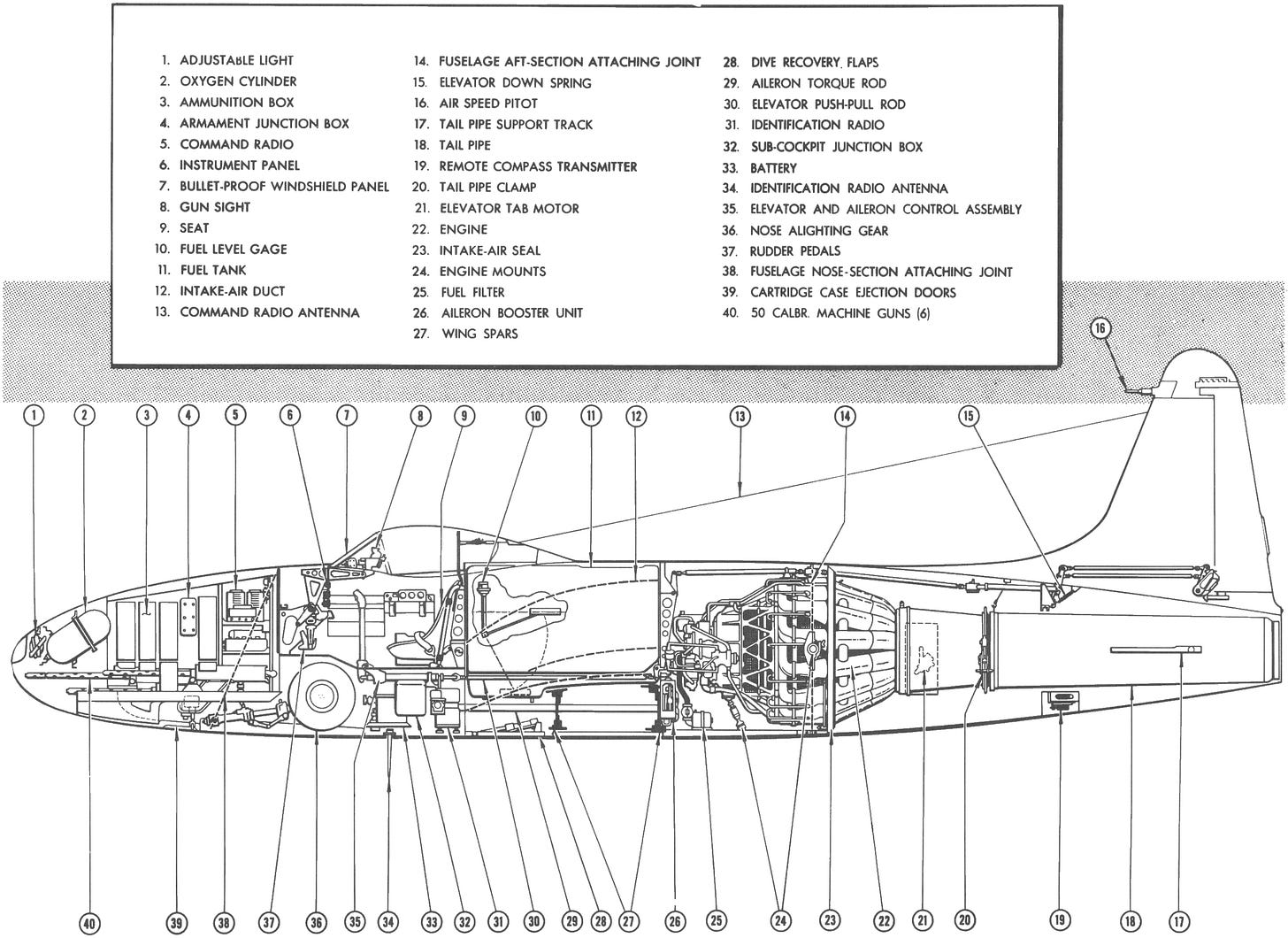
Assembly diagram of the Lockheed P80 Shooting Star, the first US jet fighter.