

Topics worth your time this issue: cracking the black magic of RF design, what 100 destroyed epoxy bonds reveal about fiberglass prep, a dynamometer test of EV range across temperatures, OpenAI's robotics division moving into Moxion's old warehouse, and more.
Interesting Presentation: Commercializing RF Black Magic
There's a running joke in electrical engineering that RF engineering is akin to "black magic." It’s hard to argue the point, especially from an outside perspective when analog RF circuitry often looks alien by nature.
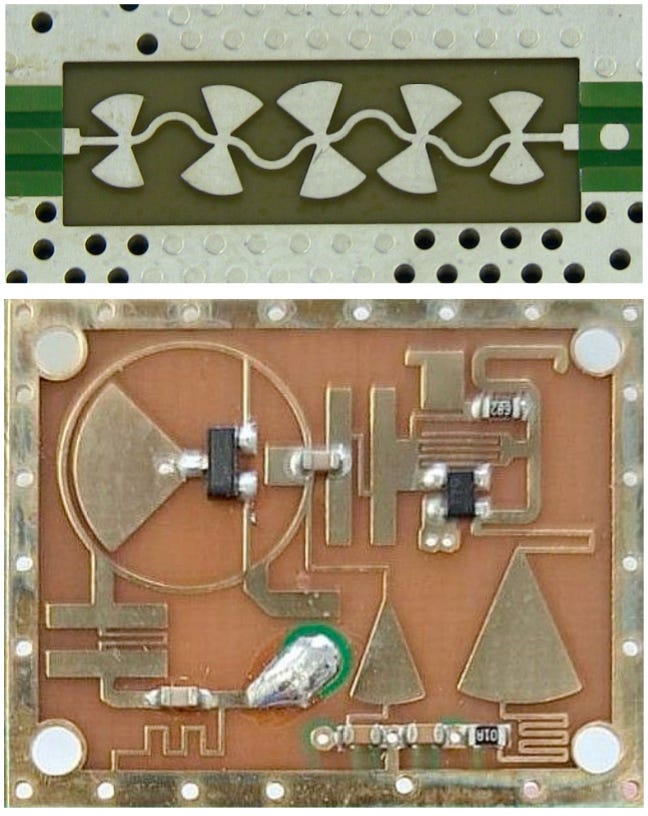
The phrase is only half-affectionate since RF designers spend years, if not decades, building intuition through fab cycles, lab measurements, and accumulated tribal knowledge. In RF design and at high frequencies especially, the schematic stops being the source of truth: every trace becomes a transmission line, every parasitic capacitance is part of the design, and a half-millimeter shift in layout can move a filter off its intended frequency behavior. It’s one of the few engineering disciplines where a simulation can look beautiful and be completely wrong, and the designer only finds out after board fabrication.
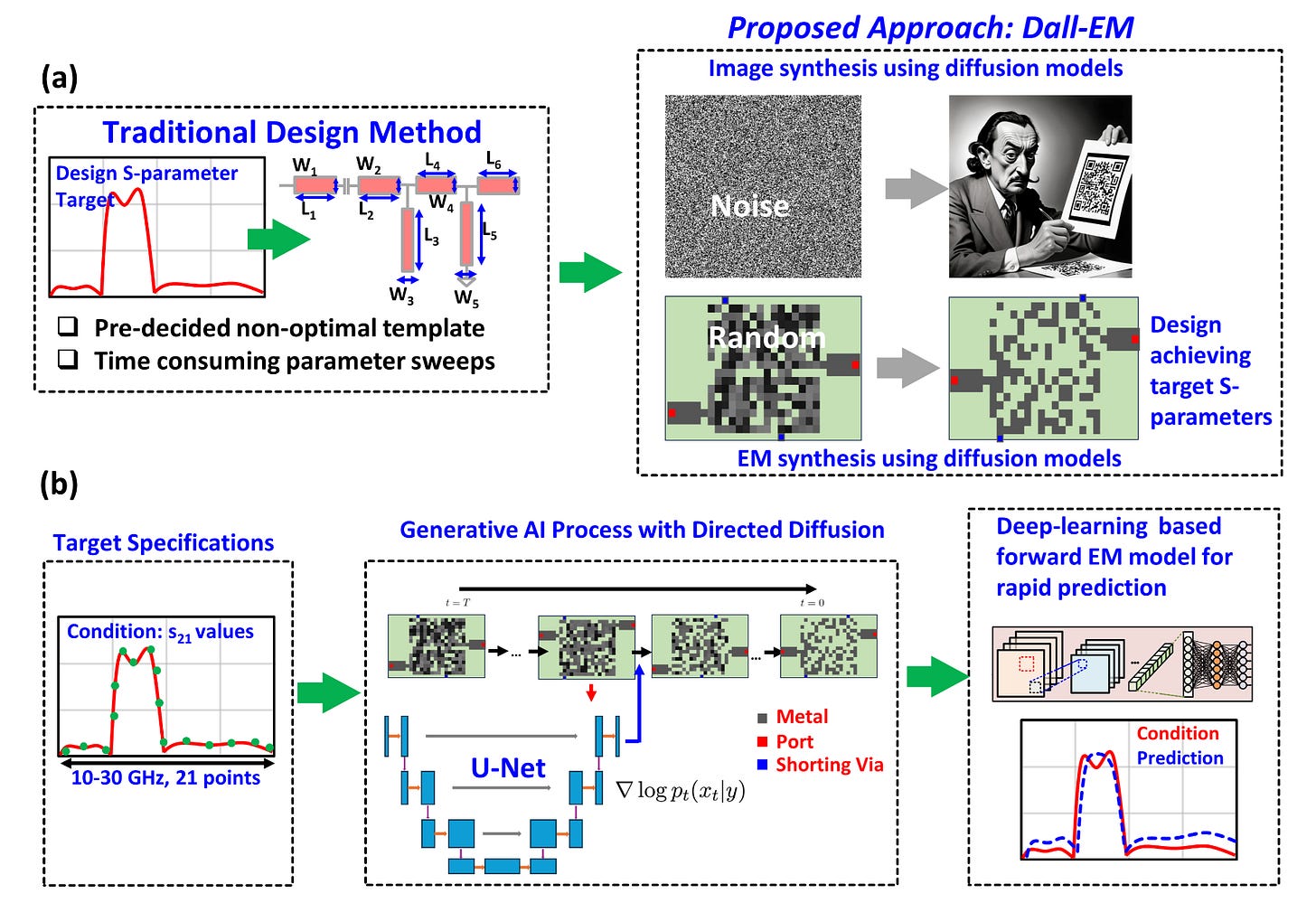
Michael Frei from Arena Physica recently gave a talk at CDFAM Barcelona that positions AI-assisted EM design as a direct response to this. His framing is sharp: humans have great physical intuition for mechanical systems because we grew up dropping things and bumping into walls, but none of us have an intuitive sense of how an electromagnetic wave propagates through a copper pattern on a circuit board. Arena Physica’s approach hinges on the idea that machines can internalize EM interactions the same way LLMs handle language, with a two-model loop for EM design. Heaviside answers the forward question: “If I draw this copper pattern, what will it do electrically?”; Marconi answers the inverse question: “If I want this frequency response, what copper pattern should I draw?”

Their approach draws directly from academic research, most notably the recent Princeton paper Dall-EM (previously shared in Issue #140), which demonstrated diffusion-based RF filter design at 10–30 GHz with roughly 25 seconds of inference time. Arena Physica’s bet is that the same idea works as a foundation model rather than a one-off demo: faster inference, trained on roughly 10 million geometries plus decades of simulation data, with lab measurements added as a third data leg to help close the sim-to-reality gap.
The honest question Frei leaves open (and worth considering here as well) is whether designers still need intuition for why one of these structures works, or whether specifying the behavior and getting back a manufacturable layout is enough. Worth watching in full if you’re curious how generative design is creeping into the historically least-automated corner of electrical engineering.
Interesting Video: I Broke 100 Epoxy Bonds to Find the Strongest
Joe Barnard from BPS.Space ran nearly a hundred destructive tests on fiberglass coupons trying to crack the code on strong, repeatable epoxy bonds for fin attachments on his high-Mach amateur rockets. For those with the time, it’s worth a watch not just for the test methodology, but as a reminder that empirical testing pairs best with tapping into the tacit knowledge of people who do this for a living. The short answer from months’ worth of epoxy stress testing data was, counterintuitively, the simplest prep configuration he tested: a 10-second acetone wipe followed by IPA on a lint-free cloth. It also happened to be a tip he got from a stranger who runs bond prep for composite structures on NSSL-certified launch vehicles.
The main lesson: stop optimizing for peak performance from a single datapoint. Consistency across samples is the spec; peak strength without repeatability is an outlier.
More From Around the Web
- Short-form application notes from applications engineers. Here’s one on the DS3232M real-time clock.
- A list of robotics startups that raised $50M+ in 2026.
- Beej’s Guide to Git is a great resource for understanding Git syntax.
- AAA tested EVs on a dyno at 20°F, 75°F, and 95°F. Heat cut range by 8.5%. Cold cut it by 39%.
- 2D simulation model of wire-arc additive manufacturing: a welding arc lays down steel layer by layer, while the model tracks where the part melts and reheats.
- BadgesBadgesBadges makes custom PCB event badges.

Manufacturing & Startup News
More leftovers from our weekly research:
- OpenAI leased a 200k+ sq-ft industrial building in Richmond, CA for its robotics expansion, taking over a site originally built for Moxion, the failed mobile battery startup.
- Commonwealth Fusion Systems became the first fusion power plant developer to request grid interconnection, applying to connect its planned 400 MW Fall Line fusion plant in Virginia to PJM’s power grid.
- JuliaHub raised $65M in Series B funding and launched its agentic AI platform for modeling, simulation, controls, and digital twins for industrial systems.
- BioOrbit, a London-based space biotech startup, raised £9.8M in seed funding to manufacture crystallized cancer drugs in orbit.