

👋 Happy Saturday! This week’s highlights include a database mapping every machine and fabrication shop in the United States, an overview of the geometric kernels that underpin CAD software, and a video decoding the bizarre unit system used in oil and gas engineering.
Interesting Database: Mapping America’s Machine Shops

An interactive map of every active machine and fabrication shop across the United States, tracking manufacturing hubs across the continental states to single-shop operations in Alaska and Hawaii. U.S. manufacturing still clusters around a few well-worn corridors, particularly in four major regions:
- Northeast Corridor: Defense and biopharma manufacturing
- Great Lakes: Automotive, steel, and now batteries
- Los Angeles Basin: Aerospace, defense, and electronics
- Texas Triangle: Energy, semiconductors, and heavy industry
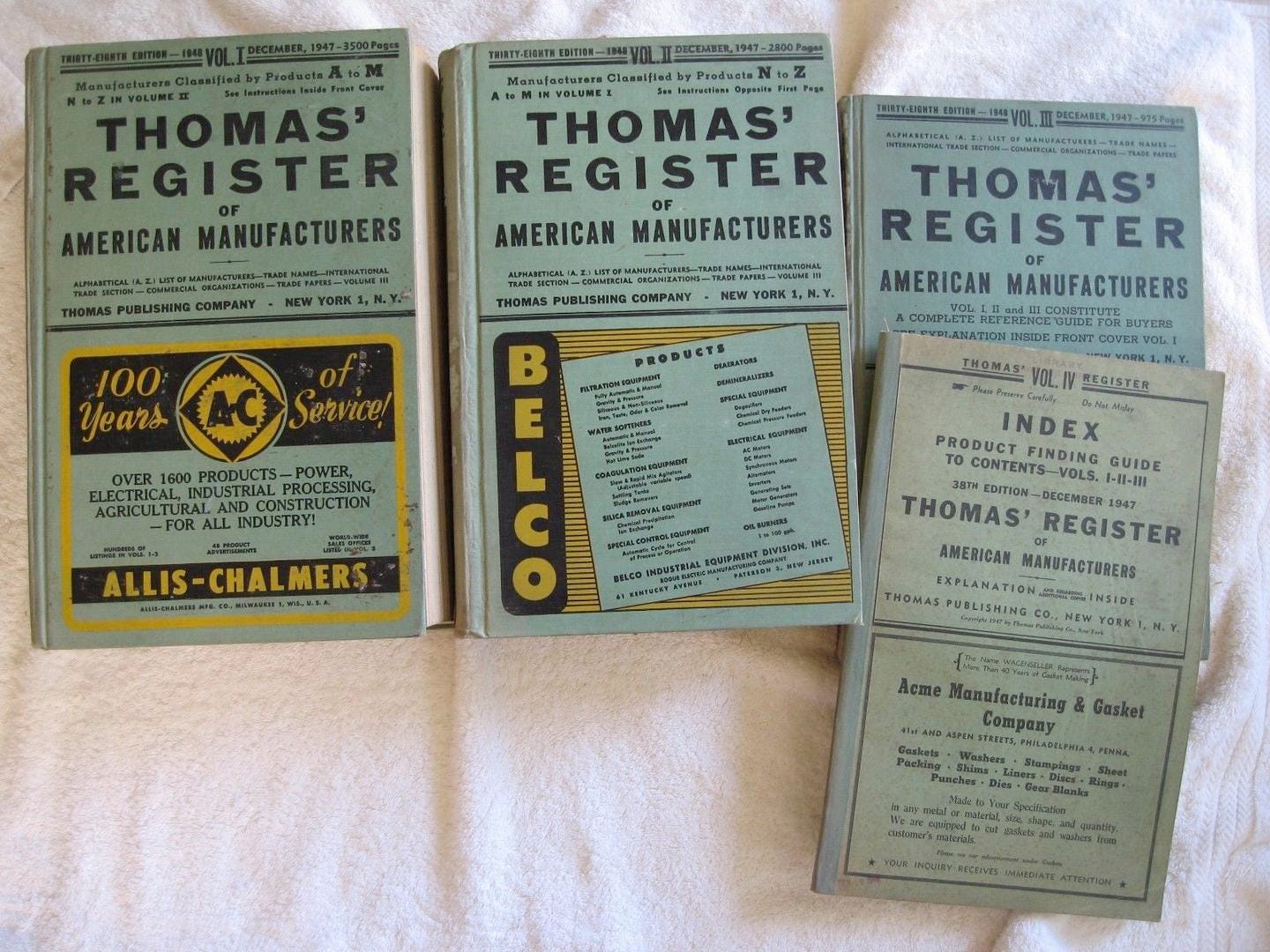
Before search engines, finding a shop meant flipping through the Thomas Register—a literal phone book of every shop in America.
Interesting Table: Geometric Kernels in CAD
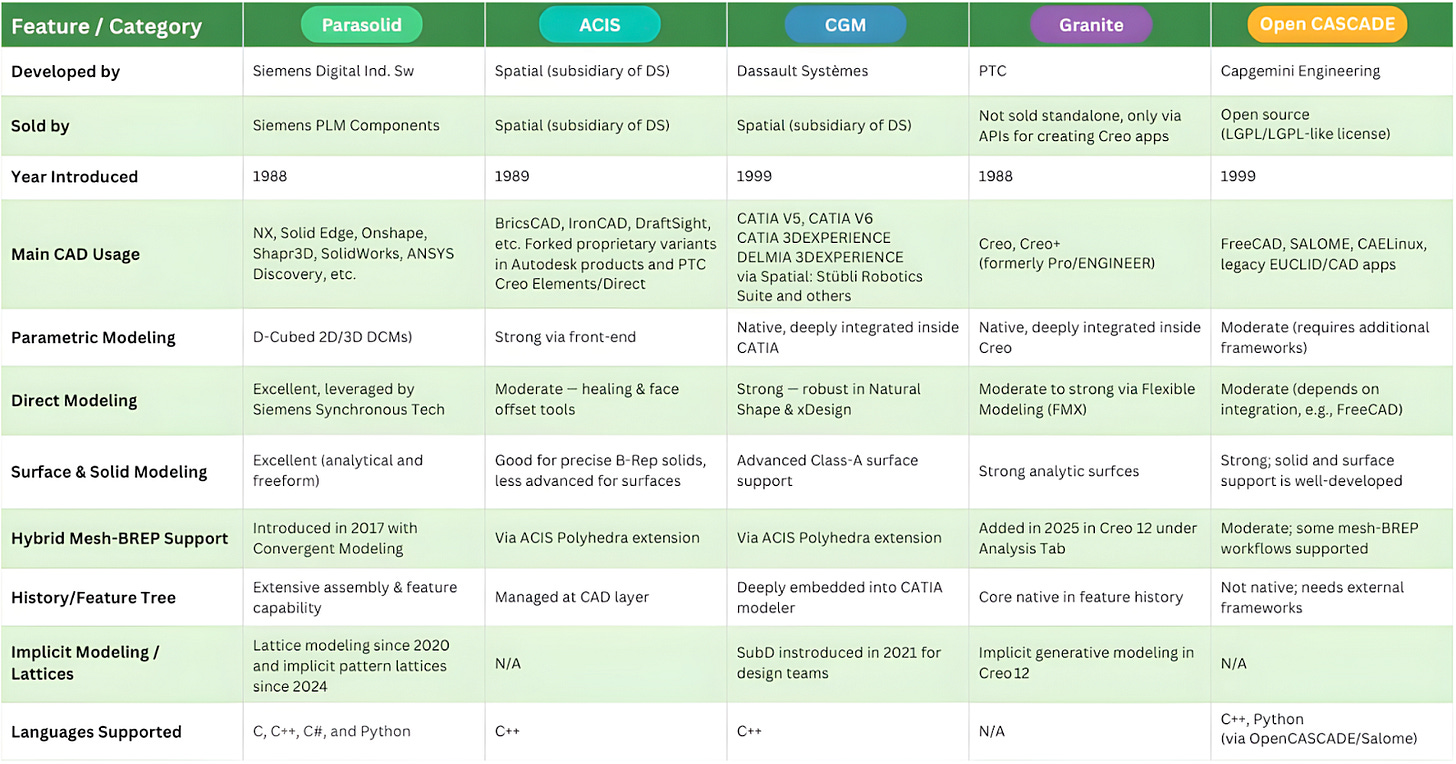
A niche topic, but one that underpins every CAD program is the geometric kernel, the math engine that defines how shapes are created, edited, and stitched together.
Most engineers unknowingly use one of four: parasolid for general mechanical design (used in NX by Siemens and licensed by SolidWorks and Onshape), CGM for high-end surfacing in aerospace and automotive (CATIA), granite for simulation-driven workflows (Creo), and Open CASCADE for open-source tools (FreeCAD, CadQuery).
Interesting Video: Oilfield Math, Explained (Sort Of)
Every industry ends up with its own logic of measurement, like a bushel from grain baskets, an acre from how far an ox could plow, or a mile from a Roman legion’s thousand paces.
Oil and gas is no different with one of the more convoluted systems around: 42-gallon barrels, tenths-of-a-foot rig tapes, and pounds-per-gallon mud weights (for fluid density).
Manufacturing & Startup News
More leftovers from our weekly research:
- Stoke Space raised $510M in Series D funding to scale production of its fully reusable Nova launch vehicle. The round was led by a a defense-focused fund called U.S. Innovative Technology, signaling how the center of gravity in the launch sector has shifted from commercial payloads to national security. Stoke was recently selected for the Space Force’s NSSL Phase 3 program, letting it compete for up to $5.6B in launch contracts over the next decade.
- Sila Nanotechnologies opened the US’s first automotive-scale silicon anode plant in Washington, a 600k sqft facility starting at 2-5 GWh capacity that replaces imported graphite with Titan Silicon to boost EV battery energy density by ~20%.
- Finnish firm ReOrbit raised €45M in Series A funding to produce sovereign European satellites for defense and civil use. The investment scales its secure platforms like Silta (communications) and Ukko (intelligence).
- Electroflow Technologies raised $10M in seed funding to produce LFP cathode materials electrochemically at 40% lower cost than Chinese producers. The process adapts electrodeposition from brine or ore feeds, skipping energy-intensive mining steps.
- Zeno Power signed a supply agreement for Americium-241, a recycled nuclear byproduct with higher power density than plutonium-238, to fuel its radioisotope generators for deep-space missions where mass and thermal efficiency are critical.
And if you’ve made it to the end: a short montage of CNC machines doing their best impression of self-destruction.