

👋 Happy Saturday! This week’s edition covers a global map of humanoid robotics startups and the infrastructure now supporting them, lecture notes from NASA on common PCB failure modes and cures, and an interview exploring the idea of the “founder collective”.
Interesting Chart: The Global Distribution of Humanoid Robotics Startups
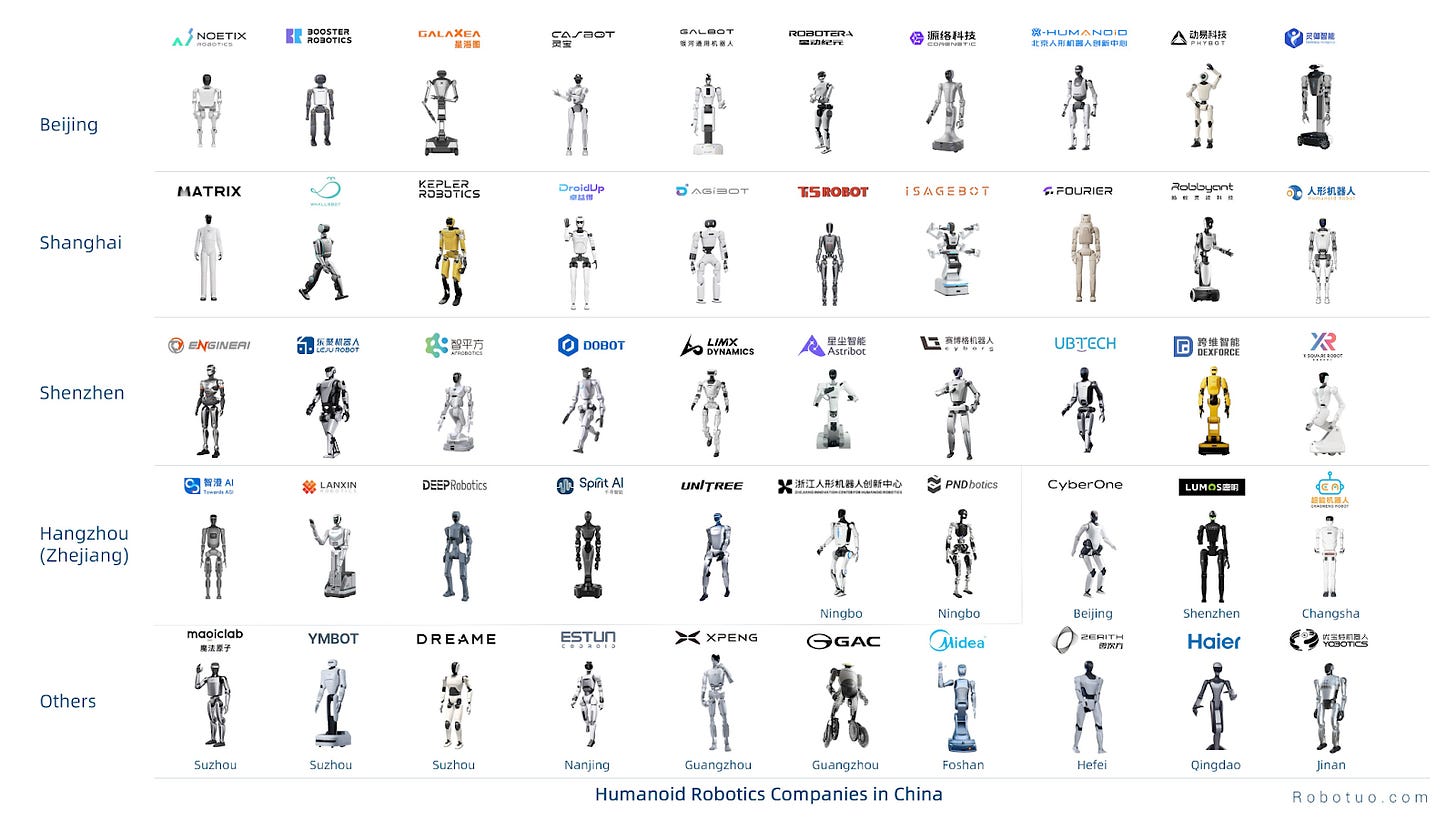
From Tuo Liu at RoboTuo: a city-level breakdown of humanoid robotics startups across the United States, Europe, and China grouped by startup density. In just four years, the industry has gone from speculative demos to a dense cluster of serious teams. (At the time, Tesla’s Bot reveal was literally a man dancing in a bodysuit.)
Predominantly, it looks like the enabling factor isn’t new ideas, but product acceleration driven by falling cost curves in electric actuation and batteries, more developed supply chains (EV-derived for major players), and substantial improvements in AI/control software.

It’s also worth anchoring this against the prior robotics wave of the 2010s, which focused on warehouse automation with autonomous mobile robots shuttling totes and pallets through fulfillment centers. Even there, category leaders like Fetch Robotics (acquired by Zebra for $290M) are now being wound down. Deployment reality and unit economics will likely determine how many of the humanoid startups shown here still exist four years from now.
Interesting Lecture Notes: PCB Failure Causes and Cures
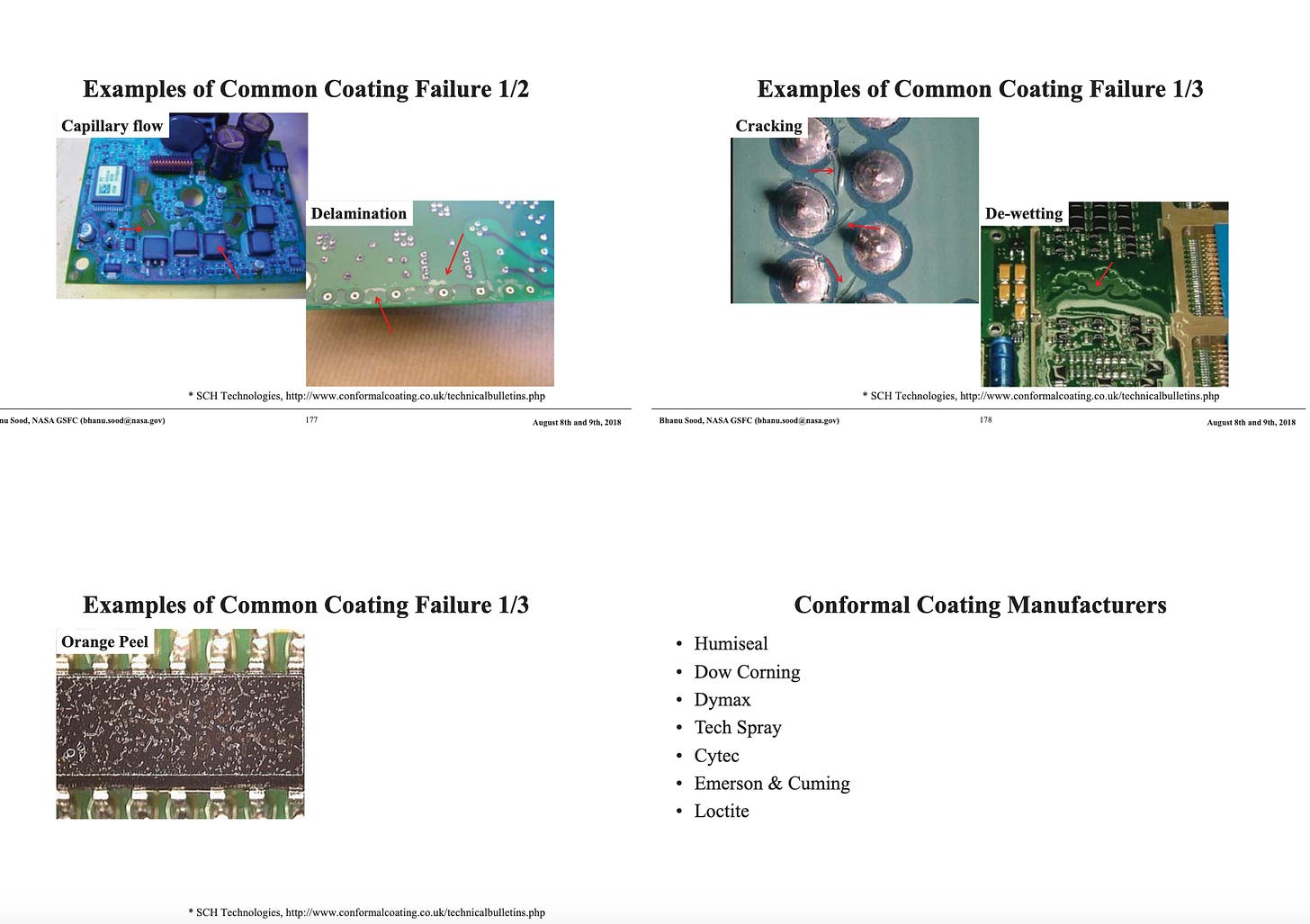
Pulled from the archives of our earliest issues, a very detailed presentation on PCB inspection and quality control from NASA, especially as it relates to failures. There’s a great walkthrough of PCB manufacturing in general with visuals and process descriptions, then connects those steps to real failure modes like overstress, wearout, moisture-driven issues, and related reliability mechanisms.

Types of conformal coating failures, plus a snapshot of the major conformal coating manufacturers:
Interesting Interview: Evaluating Talent and the Founder Collective
A bit outside our usual scope, but Ti Morse’s interview with Sequoia venture capitalist Shaun Maguire is worth listening to for two reasons: (1) how he thinks about evaluating talent, and (2) how he explains the idea of “scaling a founder.” One of his observations from working with Musk is that he isn’t operating as a single decision-maker across multiple companies, but as the center of a small, long-running group of trusted operators, which helps explain how he’s able to stay involved across multiple complex programs at once.
In spirit, it’s closer to the idea of Nicolas Bourbaki in mathematics (a collective of French mathematicians operating under one name) than the myth of a lone genius.
Manufacturing & Startup News
More leftovers from our weekly research:
- Ionic Mineral Technologies identified a large lithium, magnesium, and rare-earth deposit in Utah that could materially expand domestic supply for batteries, electronics, and defense.
- Saronic Technologies committed $300M to expand its Franklin, Louisiana shipyard for autonomous surface vessel production, adding an additional 300k sq. ft of manufacturing capacity and dedicated lines to create 1,500 new jobs.
- Zebra Technologies is shutting down its Fetch Robotics autonomous mobile robot business (acquired for $290M in 2021), and will lay off most of the roughly 200 employees by the end of 2025 amid slower-than-expected warehouse adoption.
- Eyebot, a Boston-based startup, is piloting its automated vision-testing kiosks with Walmart and Sam’s Club across 16 optical centers in Pennsylvania.
- Meta acquired AI wearable startup Limitless (formerly Rewind), shutting down its pendant hardware and consumer software as the team joins Reality Labs to support Meta’s broader push into AI-enabled wearables.