

👋 Happy Saturday! This week’s edition covers a patent describing a pyrotechnic anchoring system used in Blue Origin’s New Glenn booster, a map of the CAD ecosystem down to the underlying kernels, and a look at how skiving produces monolithic heat sinks.
Interesting Patent: Pyrotechnic Deck Anchoring
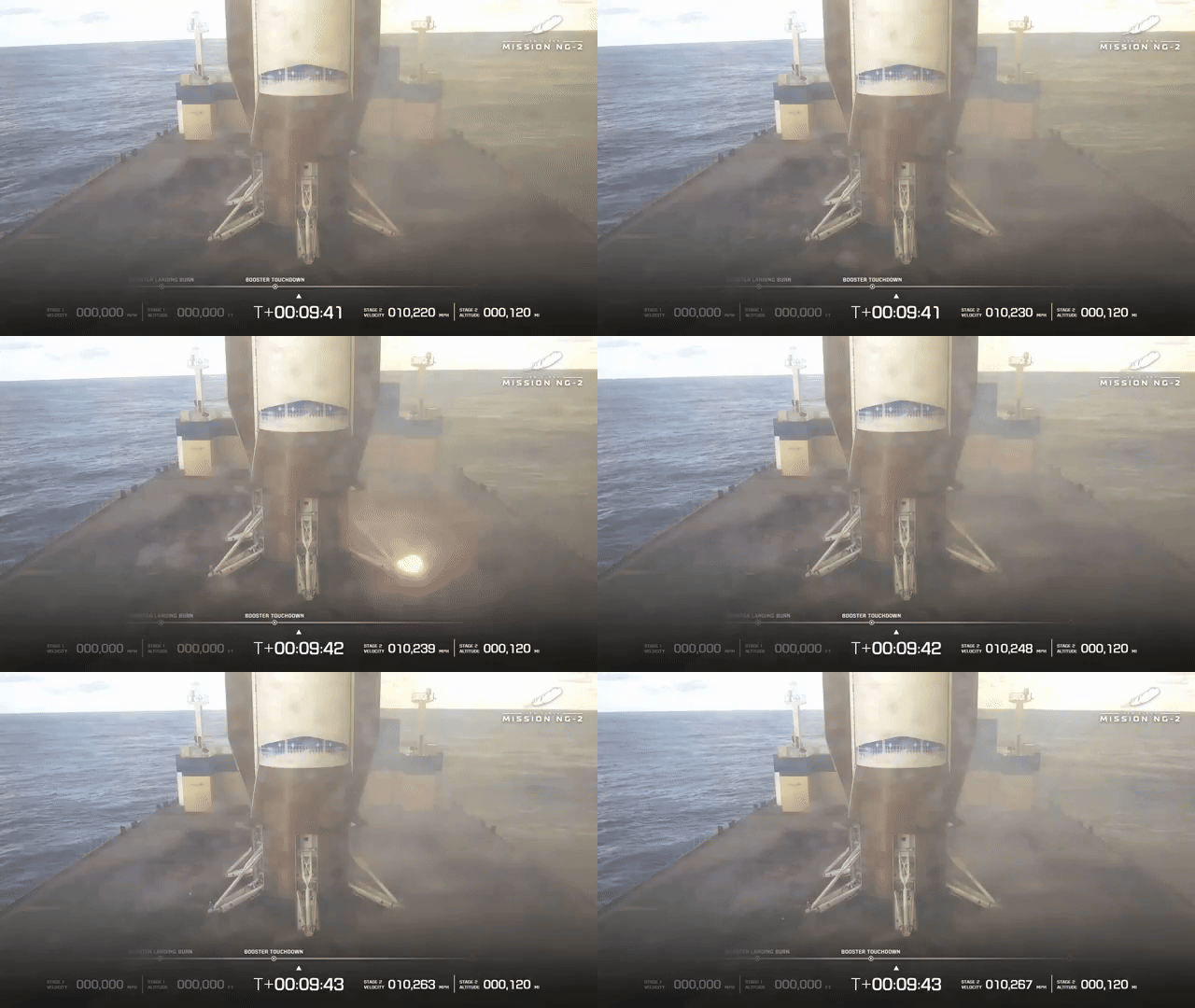
One of the more unique discoveries from Blue Origin recovering the New Glenn orbital-class booster last week was a novel mechanism used to secure the first stage to the barge using “energetic welding.”
In the era of reusable rockets, it’s easy to forget how much engineering sits between liftoff and that same booster being reusable. A recovered first stage like the New Glenn booster is ~189 feet tall, standing on a barge platform that moves in six degrees of freedom and at times faces weather conditions with enough wind force to tip the stage over. To aid post-landing stability, the approach described in Blue Origin’s filings can be best generalized as a pyrotechnic system that nails the legs to the deck.
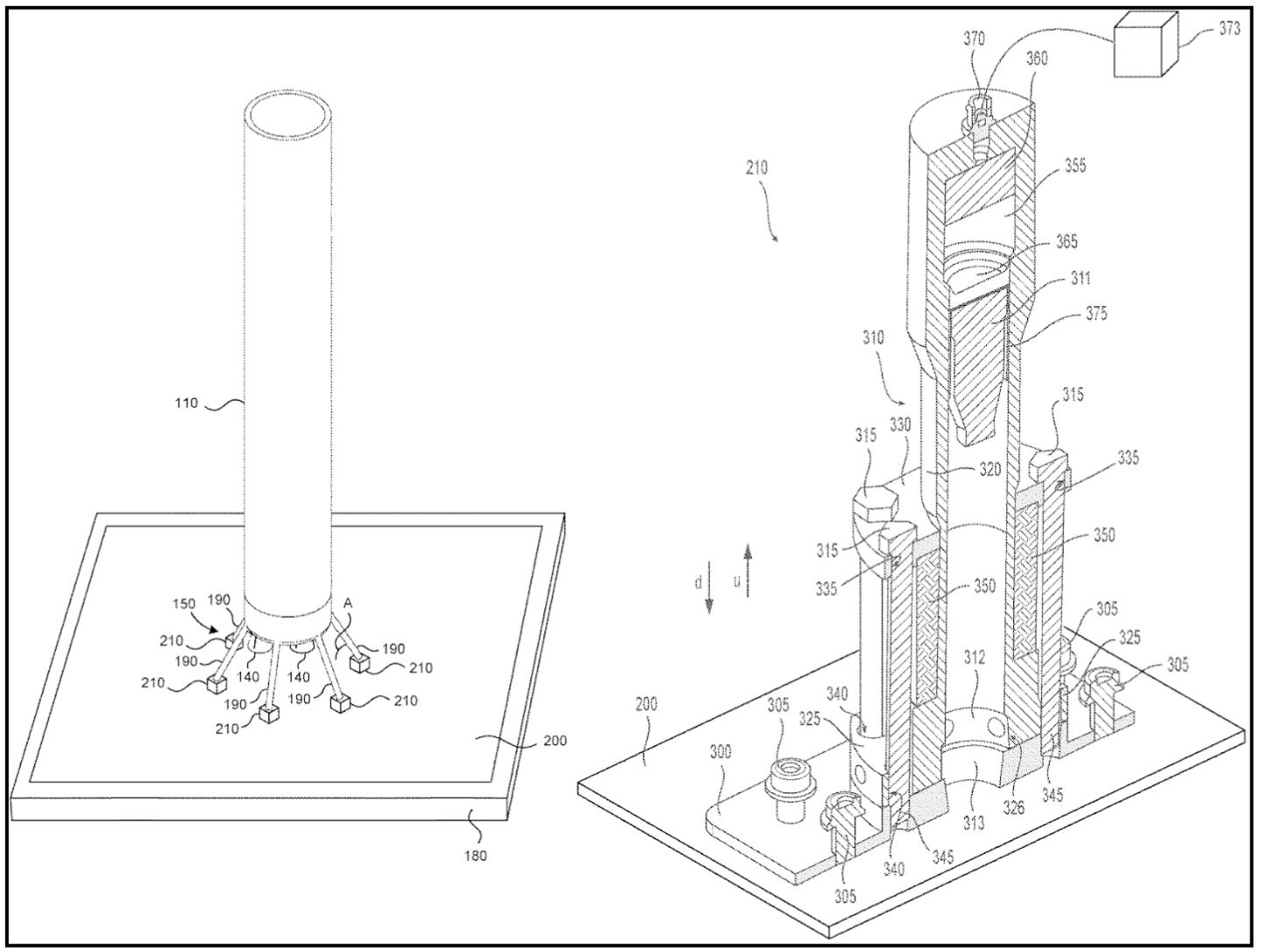
Two patents cover the idea — Stud-propelling mechanisms for securing a launch vehicle to a landing platform (US20240092508A1) and Systems for bonding objects using energetic welding (US20240124165A1). As with most patent documents, both filings are deliberately broad and written to cover a wide range of possible implementations, but still useful for contextual background.
More from the internet’s favorite rocket scientist Scott Manley who has a full breakdown of Blue Origin’s launch.
Interesting Chart: The Web of CAD Software
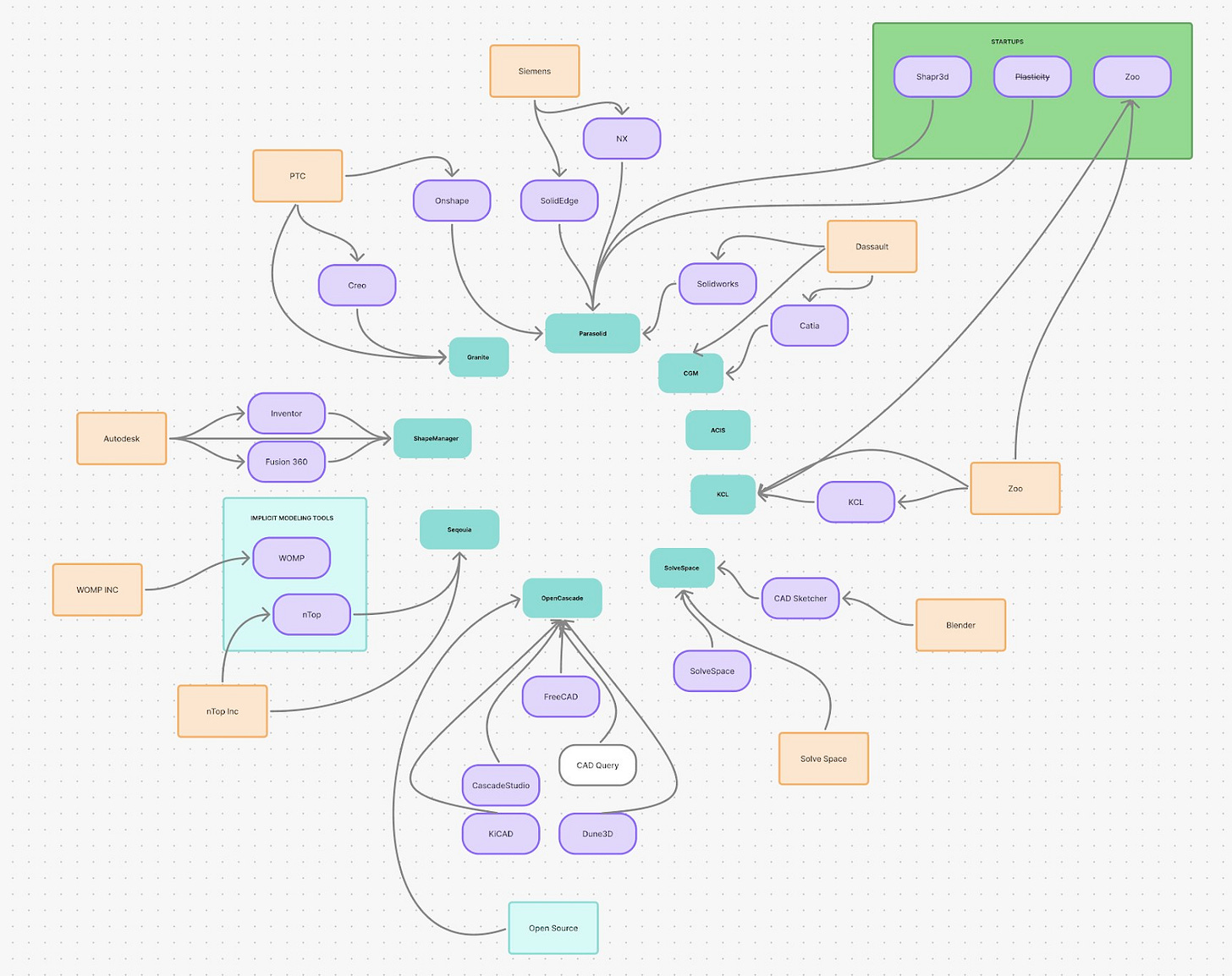
A map of CAD companies → modeling software → and underlying geometric kernels. We covered more notes on geometry kernels in Issue #157, specifically on how decades of accumulated design libraries have concentrated the industry around a few proprietary kernels. Most professional CAD software still traces back to the Parasolid kernel as its foundation.
Interesting Video: Heat Sink Manufacturing via Skiving
A look at a specialized manufacturing method called skiving, a planing process where a blade shears thin slices from a solid copper or aluminum block and forms each cut into a standing fin. Commonly used to produce dense, monolithic heat sinks without brazing or bonded layers.
Manufacturing & Startup News
More leftovers from our weekly research:
- Rainmaker launched the United States’ largest cloud-seeding effort to date, deploying atmospheric hardware to boost precipitation and support water management around the Great Salt Lake.
- Forterra has raised $238M in Series C funding to enhance its ground autonomy platform with improved communications, command-and-control, and edge-computing for defense and logistics.
- U-Space has raised $26M in Series A funding to accelerate satellite manufacturing through software upgrades and clean room expansions, targeting one satellite per week by 2027 to support streamlined production for in-orbit demonstrators and European constellations.
- Voya Energy launched with $13M in seed funding to develop off-grid power systems that convert recycled metals into clean fuel for energy-intensive hardware applications.
- Kratos Defense is acquiring Orbit Technologies, a satellite comms-tech developer, for $356.3M to bolster its microwave electronics capabilities.