Happy Thanksgiving week. We’re taking this weekend off—no newsletter, no deep dives—just time with friends, family, and a bit of rest. Enjoy the break and we’ll be back next week with our usual scheduling.
Interesting Links 🏭
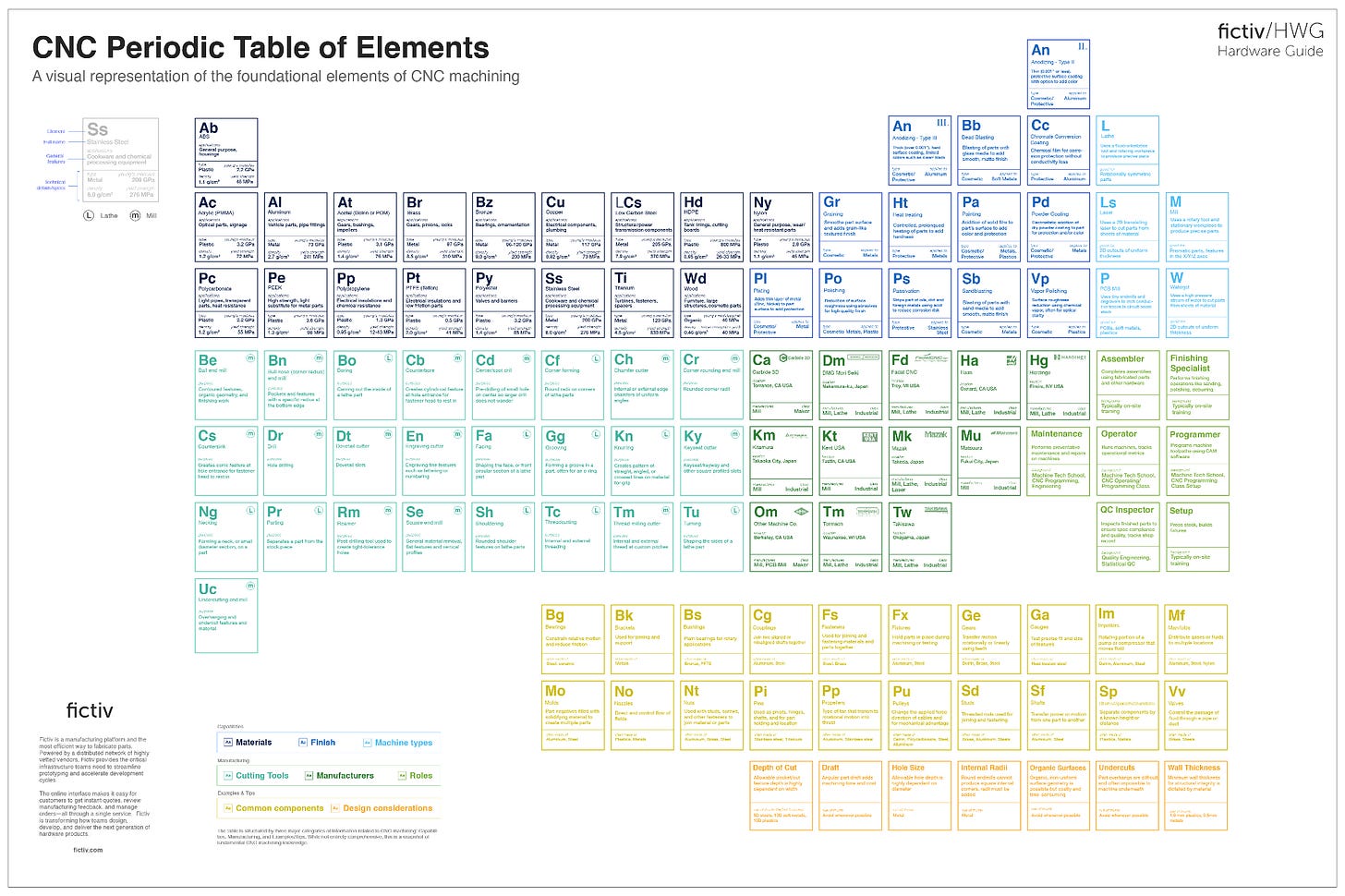
- In the spirit of the holidays, a solid desk gift or extra shop décor is the CNC Periodic Table of Elements that maps out the core elements of CNC machining. It’s laid out in three families across capabilities (materials, finishes, machine types), the manufacturing stack itself (cutting tools, machine manufacturers), and design heuristics to make more machinable parts. A useful snapshot of how the CNC ecosystem fits together in practice.

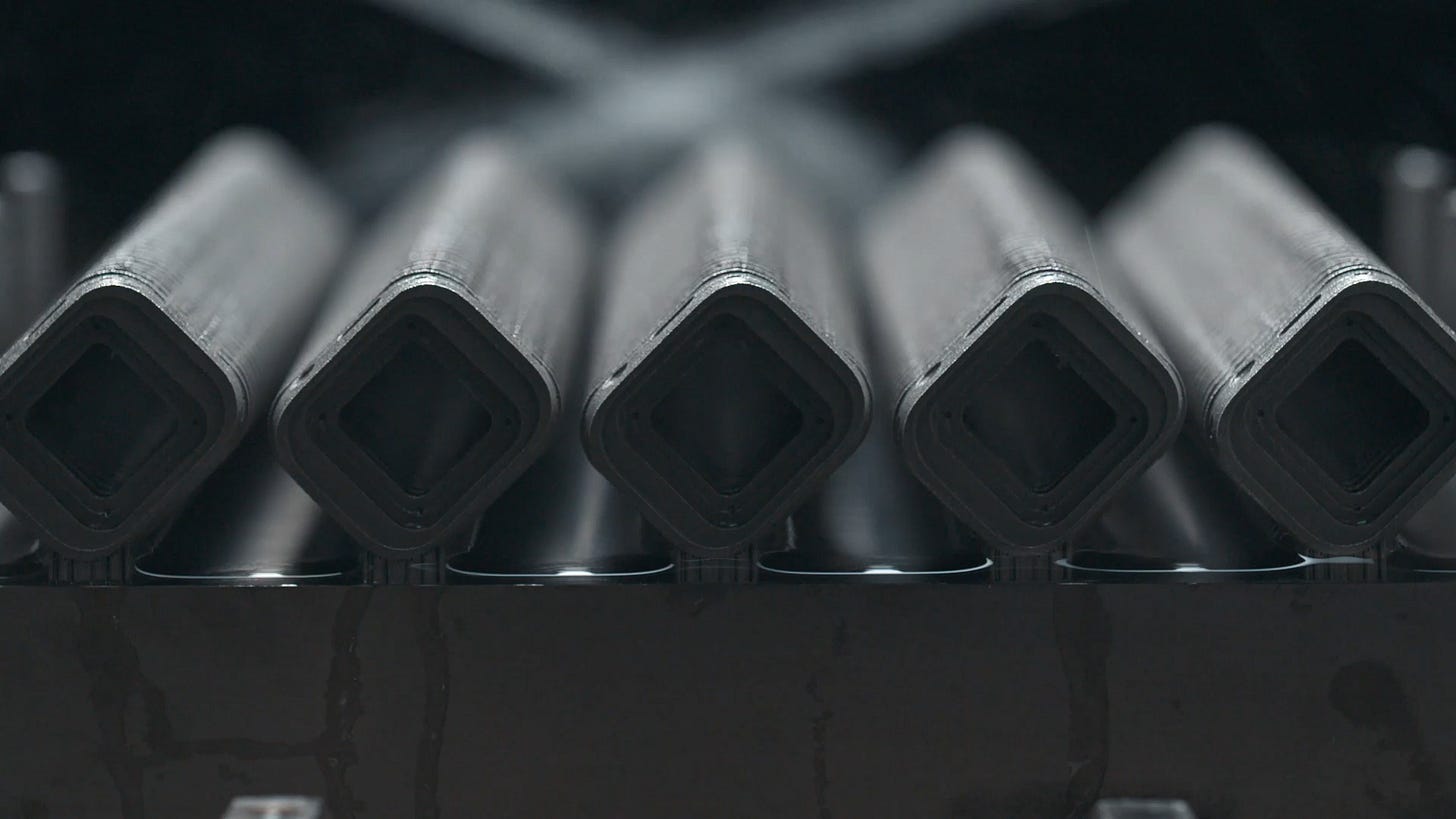
- Apple may have finally found the one corner of manufacturing where its scale makes metal 3D printing viable at mass-production volumes. This year’s Apple Watch Ultra and titanium Series 11 cases are 3D-printed from aerospace-grade titanium powder using a powder-bed fusion workflow: atomize the alloy into 50-micron grains, spread it into uniform layers, and fuse each pass with a six-laser galvanometer until the case is near-final. The printers run over 900 layers to complete a single enclosure, and it’s one of the first real examples of a boutique metal-AM process being industrialized at consumer-electronics scale. Every case still goes through a CNC cleanup because the printed surfaces and tolerances aren’t close to final spec, but near-net printing solves real pain points in forming metals like titanium by enabling complex geometry and fast iteration.
- If you want a clean signal on semiconductor news, Lithos is a live dashboard that pulls from major news outlets alongside niche technical sources and sorts everything by recency. An easy way to get a pulse on what actually moved in the last few hours. Today, in a world increasingly defined by silicon, whoever controls the chips controls the game.

- Two physics links slightly outside our usual scope, both deeply interesting:
- Ice may be slippery for a reason that has nothing to do with melting. The classic belief is that heat or pressure produces a microscopic water film that lowers friction, but new work from Saarland University shows the surface can “liquefy” through a different mechanism. Electrostatic interactions between the ice dipoles and the contacting material create low-energy zones at the interface, and sliding then disturbs the top layers into a thin, water-like film.
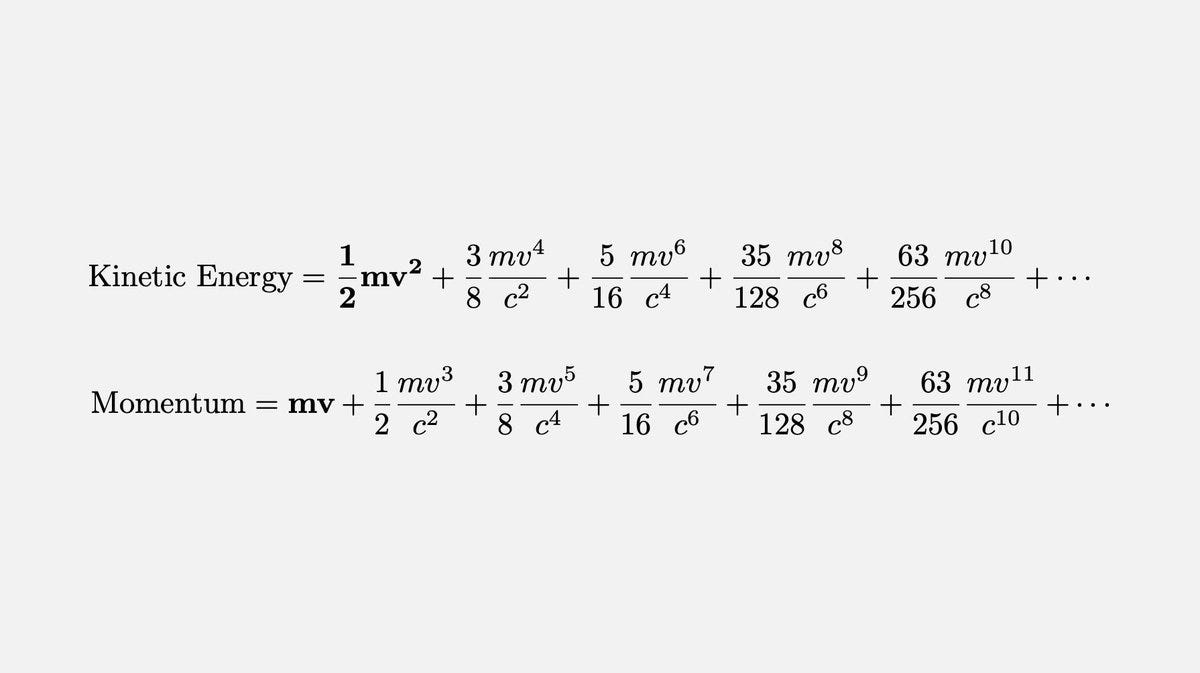
- A reminder that the classical kinetic-energy formula is only the first term of an infinite series expansion from special relativity, with higher-order corrections entering as velocities approach the speed of light. That expansion is what bridges the Newtonian expression with Einstein’s relativistic framework, and it can be ignored for most engineering analysis, but not in domains like particle accelerators or astrophysics where the classical approximation starts to break down.
- And one fun link to round out the week: Nano Banana Pro, Gemini’s text-to-image counterpart, went viral last week in part because it can generate surprisingly well-designed, high-fidelity annotated diagrams.
Startup News 🚀
- PhysicsX raised over $155M in a Series B extension to advance its AI-native engineering platform for large-scale numerical physics simulation. The platform runs traditional CAE workloads in fluid dynamics, structural analysis and other multiphysics solvers through inference models to accelerate simulation and design exploration. It’s part of a broader shift toward software-defined engineering stacks as companies try to shorten development cycles and reduce dependence on traditional solvers. The extension includes new capital from NVentures, NVIDIA’s venture capital arm.
- Reelables raised $10.4M in Series A funding to expand manufacturing of its thin-film wireless smart labels for real-time cargo and inventory tracking. The company prints active labels that combine RFID-style manufacturing with integrated radio circuits and a direct-print battery that can be produced on standard thermal barcode printers. Reelables plans to ramp production to 100M labels per year across Bluetooth and 5G variants. The round was led by Amigos Ventures.
- Ursa Major raised $100M in a Series E round alongside $50M in debt commitments to scale production of its hypersonic, in-space propulsion, and solid-rocket-motor lines. The raise adds to a broader run of nine-figure space rounds over the past few months as propulsion and spacecraft suppliers race to meet defense demand. The round was led by Eclipse.
- Extellis raised an oversubscribed $6.8M seed round to commercialize its metasurface-enabled SAR platform for high-volume, all-weather imaging. The company’s antenna tech. originally developed at Duke University through DARPA-sponsored research supports wide-area scanning and thousands of SAR images per day. The funding supports the company’s first orbital demo and early imagery services for pipelines, vegetation management, and precision agriculture. The round was led by Oval Park Capital.
Jiga raised $12M in Series A funding to streamline how hardware teams source custom parts. The platform gives engineers direct access to a vetted network of manufacturers and structures the entire RFQ workflow across drawings, specs, communication, and documentation in one place. The company’s pitch is simple: remove the weeks-long administrative drag and make custom parts procurement behave like a modern engineering workflow. The round was led by Aleph with participation from Symbol and Y Combinator.