

👋 Happy Saturday! This week’s highlights include a breakdown of how GPS jamming works in modern electronic warfare, a build tutorial of a hobbyist pendant that runs real-time fluid simulation on an LED matrix, and a visual reference of surface roughness comparators for machining and casting.
Interesting Lecture Notes: GPS Jamming in Modern Electronic Warfare
The Global Navigation Satellite System (GNSS), which in practice most people just call GPS, is actually a family of separate constellations: the United States’ GPS, European Union’s Galileo, Russia’s GLONASS, and China’s BeiDou.
Each constellation has satellites in medium Earth orbit (~20,000 km up) that continuously broadcast timing and location data. A receiver (smartphone, aircraft navigation system, etc.) picks up signals from at least four satellites, measures how long each one took to arrive, and uses those distances to calculate its position and correct its internal clock.
The challenge is that by the time those signals reach Earth, they’re incredibly faint (weaker than the background noise in the receiver), so even low-power transmitters can overpower them by broadcasting noise or structured signals on the same frequencies. This floods the receiver’s front-end, causing it to lose lock on the satellites (jamming) or accept fabricated timing and position data (spoofing).
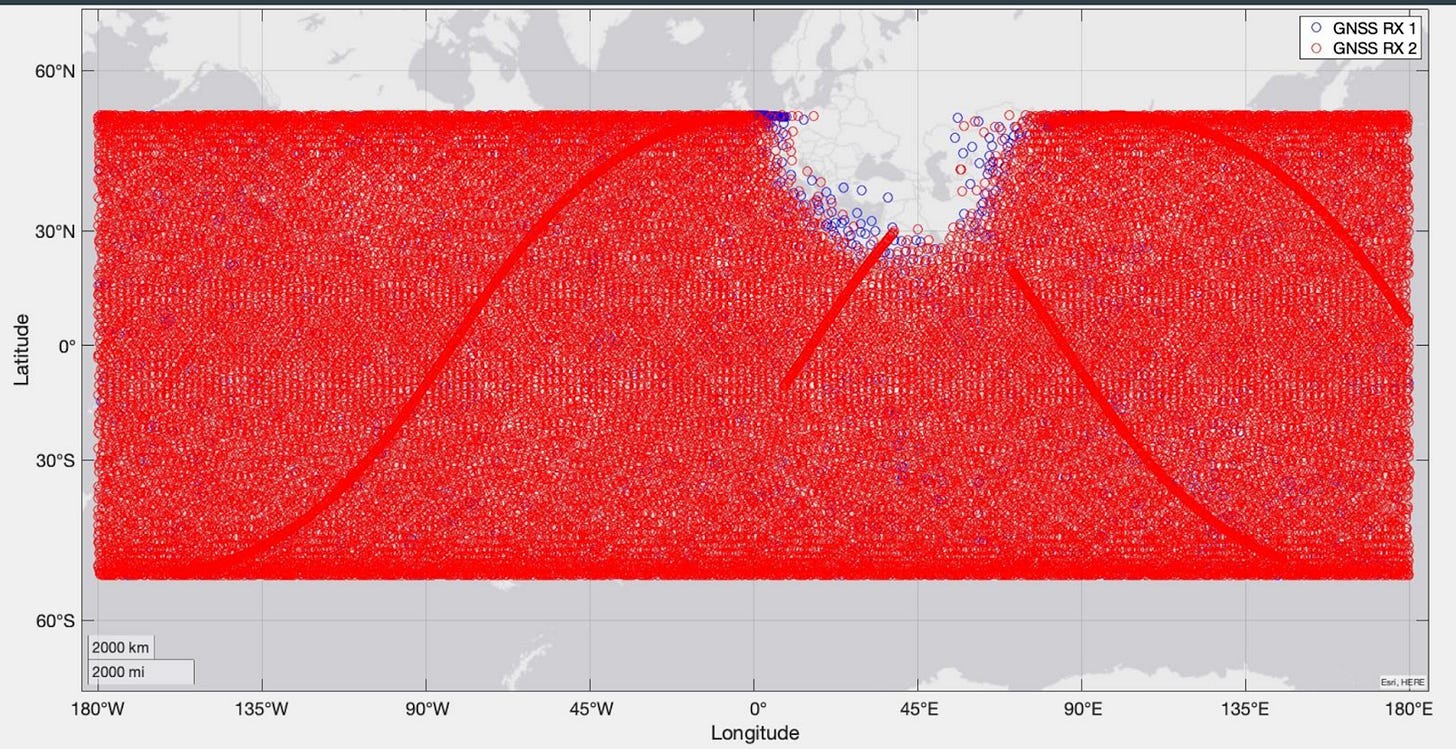
The Radio Navigation Laboratory at UT Austin studied these threats in a recent presentation across five electronic warfare domains: frequency, time, polarization (signal orientation), azimuth (horizontal angle), and elevation. If a jammer can control all five, it can deny GNSS entirely. One countermeasure is “hiding behind the O₂ line,” where atmospheric oxygen absorption limits interference range, creating a local “exclusion bubble” for trusted navigation and timing signals.

Interesting Video: A Fluid Simulation Pendant
In one of the coolest hobbyist applications of computational fluid dynamics, this is a pendant that runs real-time fluid simulation on an LED array using an Eulerian grid and particle system. It’s built on FLIP (Fluid Implicit Particle), a 1980s algorithm adapted from plasma simulation work into a low-dissipation way to model fluid flow.
The implementation uses a non-trivial algorithm (look no further than fluid dynamics and Euler equations as subjects of entire graduate-level courses) but in essence: particles move and collide, their velocities are mapped onto a grid, the grid solves for incompressibility, and the corrected velocities are blended back into the particles. The result is a believable “liquid” that responds to accelerometer input, driven by the pendant’s onboard MCU.
Mitxela’s full documentation includes a complete build guide; this source walks through how the FLIP simulation is actually written and run.

Interesting Photo: Comparing Surface Finishes in Manufacturing
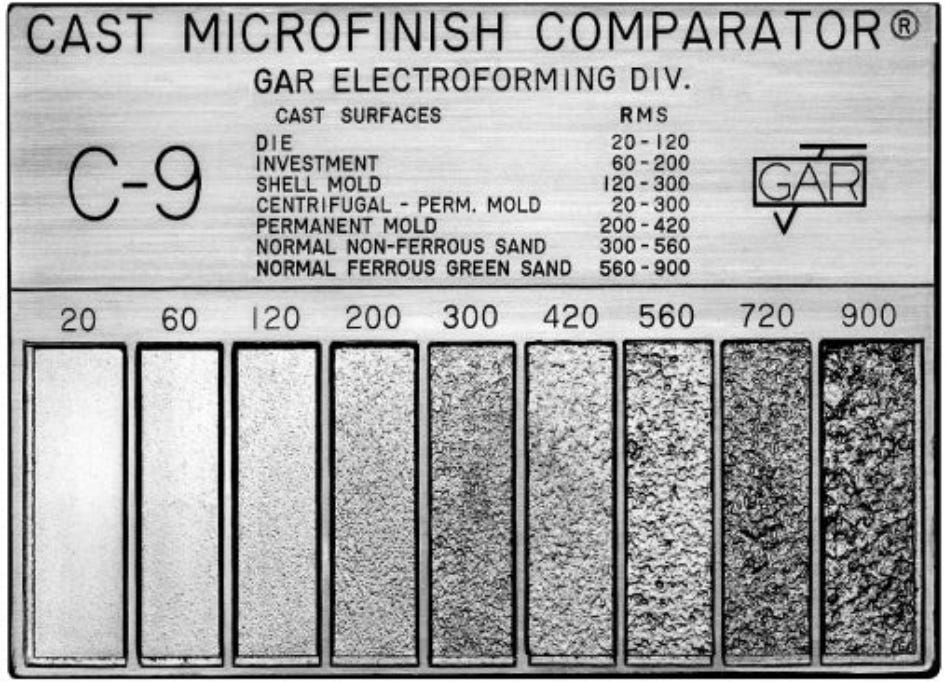
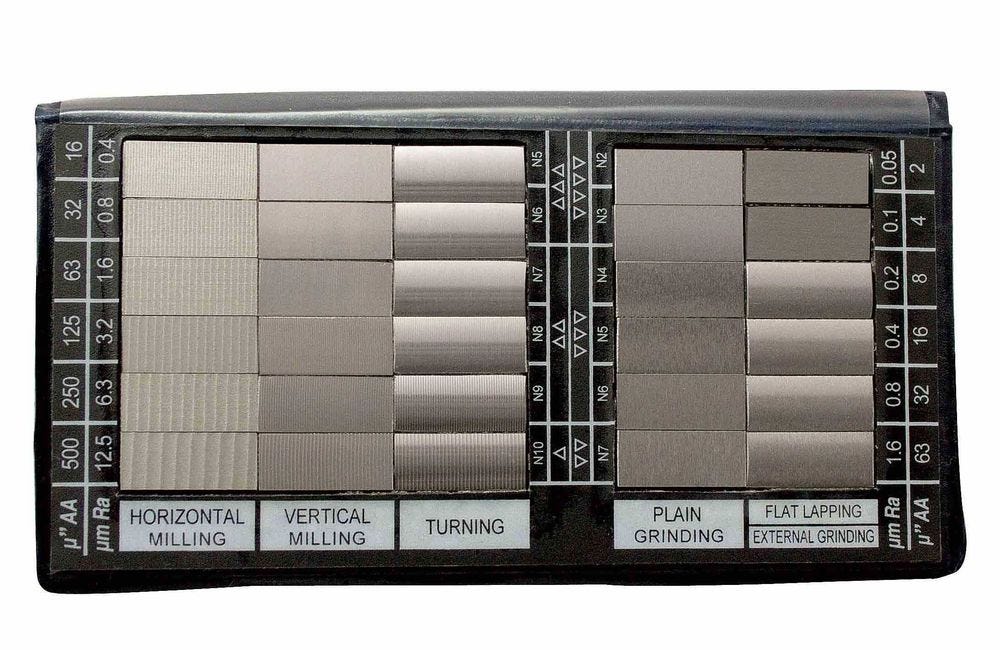
In a previous edition of the newsletter (issue #103), we shared a chart of average surface roughness ranges for machining, cutting, casting, and other common metal manufacturing methods. Turns out, you can also visualize that data in hand with surface roughness comparators that show exactly what those numbers feel like.
Manufacturing & Startup News
More leftovers from our weekly research:
- AIR raised $23M in Series A funding to scale production of 250 kg-payload eVTOLs built with carbon composites, targeting FAA certification by 2027 with over 900 pre-orders from U.S. customers.
- MagREEsource raised $25M in equity financing to upcycle rare-earth scraps into NdFeB magnets for EV motors and turbines.
- Oxide Computer Company raised $100M in Series B funding to scale integrated compute racks for high-performance computing and regulated industries.
- Still Bright raised $18.7M in seed funding for a vanadium-based electro-leach process that recovers 95% of copper without smelting, cutting CapEx by 90% for modular clean mining refineries.
- Solidec raised $2M in pre-seed funding for electro-catalytic reactors that produce hydrogen peroxide on-site from air, water, and renewable power, cutting energy use by 40% for semiconductor and wastewater applications.