

👋 Happy Saturday! This week’s highlights include lecture notes on the basics of FPGAs and how they bridge code and silicon, a chart mapping the textile and apparel supply chain, and a video on building a electronics lab for under $300.
Interesting Lecture Notes: What an FPGA Actually Is
This week’s lecture notes walk through how digital design actually gets implemented in hardware, using FPGAs as the bridge between code and silicon.
An FPGA (Field-Programmable Gate Array) sits somewhere between a PCB and a chip: instead of routing logic through external copper traces, the wiring happens inside a pre-fabricated chip. The chip is configured by loading a bitstream, a configuration file that sets multiplexers, pass-transistors and routing fabric so the device behaves like the desired digital circuit.
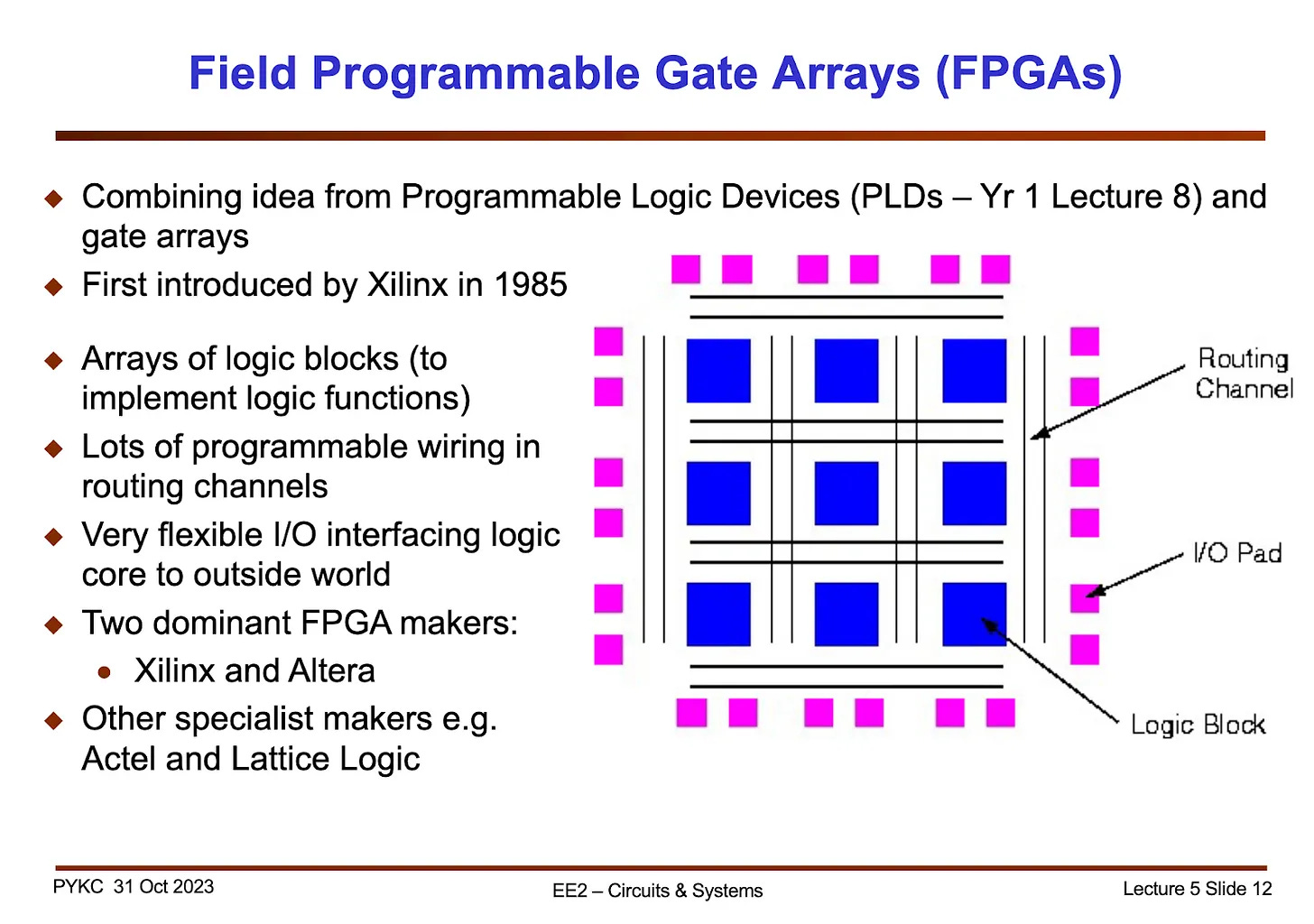
Xilinx first commercialized FPGAs in 1985 as a way to prototype complex circuits without the multimillion-dollar fabrication runs of custom silicon. Earlier methods relied on manual wiring or fixed gate arrays, which were efficient but permanent once built. FPGAs added flexibility: rewire the logic as often as needed, no fab required.
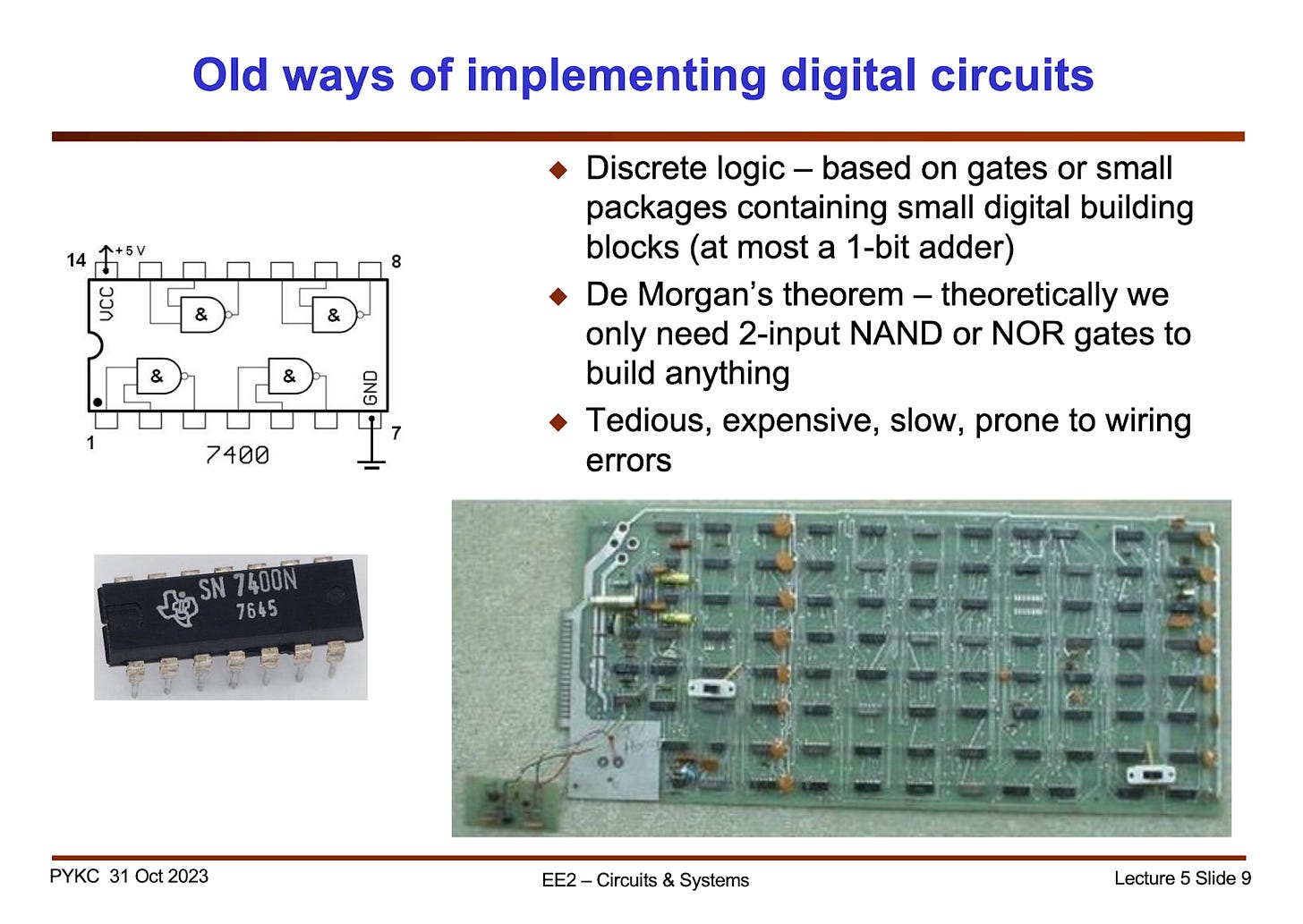
Modern FPGAs pack hundreds of thousands of logic cells into array blocks alongside on-chip memory, multipliers, phase-locked loops (PLLs), and even ADCs. Engineers write their behavior in a hardware description language (usually Verilog or VHDL) then compile it through vendor tools like Xilinx Vivado or Intel Quartus. The output is a bitstream that programs the chip’s internal wiring. Tesla’s early Autopilot hardware (HW 1.0) used FPGAs before moving to custom silicon, and defense systems still rely on them because reconfigurable logic means that engineers can change hardware behavior without a new chip.
Interesting Chart: The Textile & Apparel Manufacturing Supply Chain
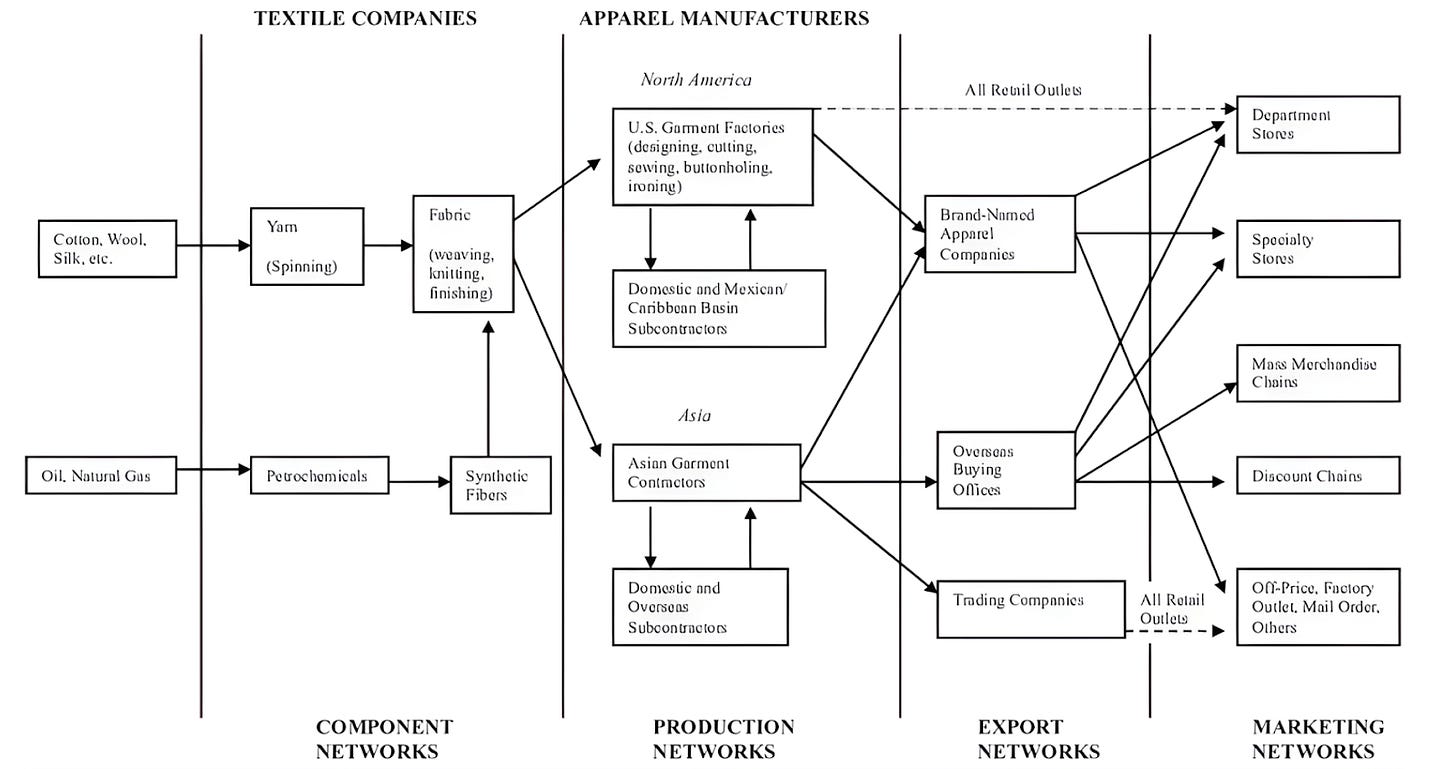
A full view of the textile and apparel manufacturing supply chain from fiber to finished garment. Everything before the needle is mostly automated; sewing is still largely human where operators still guide soft, variable fabric through the needle.
WSJ also has a good breakdown of Nike’s failed automation experiment with Flex on applying electronics-style automation to footwear (paywalled, but worth the read).
Interesting Video: Build an Electronics Lab On a Budget
EEVblog has been running since 2009, covering everything from design deep dives and teardown guides to engineering news and rants. Some of Dave’s most practical videos are about lab setups, specifically how to build a fully functional home electronics lab on a budget of ~$300.
The video dates back to 2016 and while some of the pricing is a little dated, the essentials in any solid lab are the same: a reliable multimeter, a USB oscilloscope (20 MHz-class with isolation), a 30 V / 5 A bench supply, a basic function generator, a temperature-controlled soldering iron, and a handful of breadboards and component kits.
More details and discussion on the forum.
Manufacturing & Startup News
More leftovers from our weekly research:
- Möbius Industries has raised a $3.8M pre-seed round led by Outlander VC to develop AI-driven urban mining systems using robotics and sensing to refine metals like copper and lithium from waste.
- Falcomm has raised a $5.8M Seed II round led by a strategic aerospace investor (unannounced) to advance high-efficiency RF power amplifiers for satellite communications, 5G infrastructure, and electronic warfare applications.
- Revolute Robotics has raised $1.9M to deploy hybrid mobility robots capable of flying and driving in GPS-denied and restricted environments for industrial use.
- DMR Technologies is investing $1.4M to build a 10k sqft plant in Lafayette, Louisiana for industrial drone manufacturing.
- Helsing is acquiring Blue Ocean, an Australian AUV company, to expand its maritime defense technology and underwater autonomy offerings.
- Lucid Bots has launched a new UAS for industrial painting and coating applications on building exteriors and structures.