

👋 Happy Saturday! This week’s highlights include lecture notes on SpaceX’s Starship program, a reference guide to choosing gear types based on shaft orientation, and a Carnegie Mellon paper showing how WiFi signals can be repurposed to track human motion.
Interesting Lecture Notes: Inside SpaceX’s Starship Program
From the University of Cincinnati: one of the best overviews of the SpaceX Starship program covering the Super Heavy booster, Raptor engines, and the design decisions that set Starship apart from earlier rockets.
The program began in 2012 under names like the Interplanetary Transport System (ITS) and Big Falcon Rocket (BFR), and has since evolved into one of the most ambitious aerospace programs: a fully reusable launch vehicle designed to carry up to 100 people to Mars, while also serving nearer-term missions like satellite launches, lunar landings, and cargo delivery.
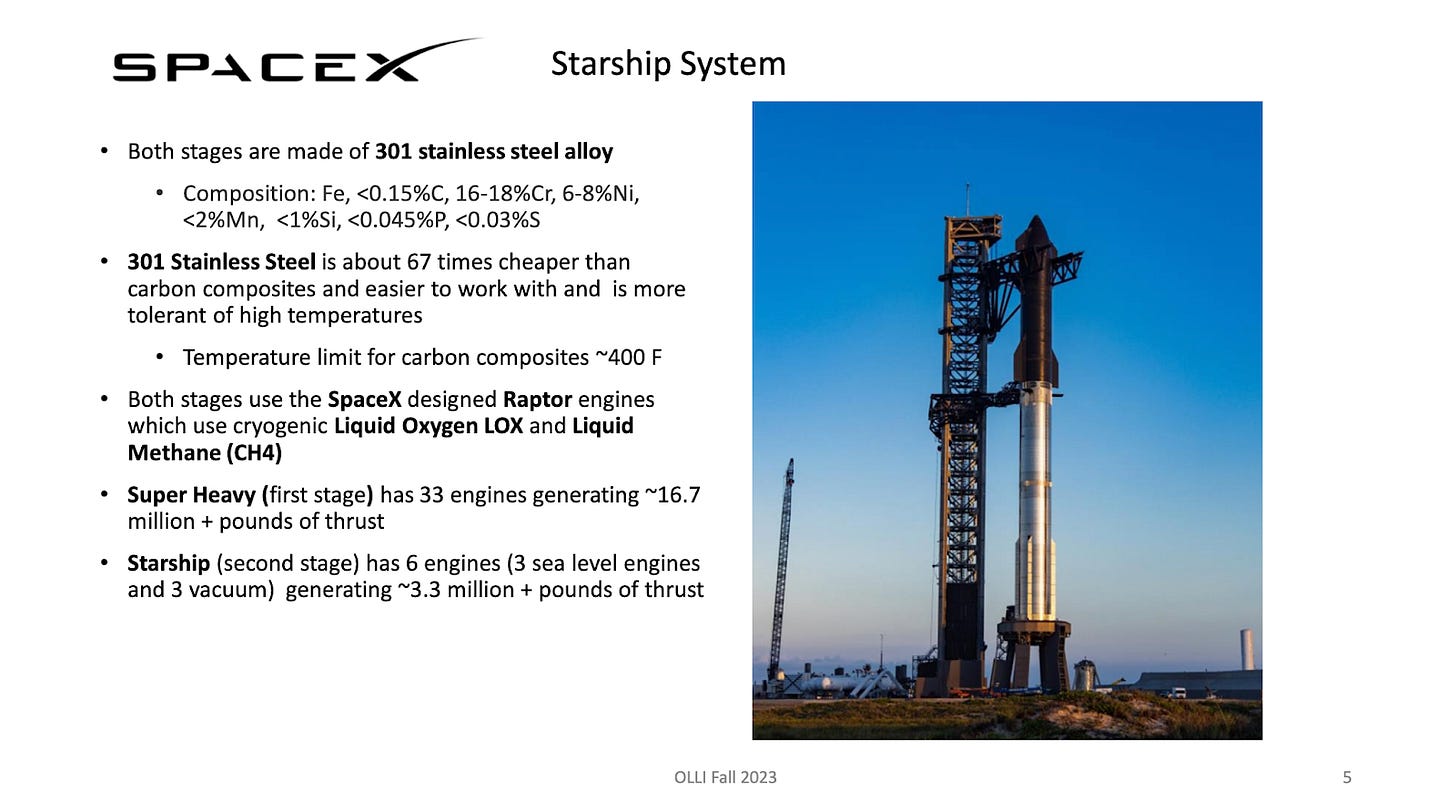
- Super Heavy (first stage): ~233 ft tall, ~30 ft diameter, 33 Raptor engines in concentric rings, ~16.7M lb thrust.
- Starship (second stage): ~160 ft tall, ~30 ft diameter, 6 Raptor engines (3 sea level, 3 vacuum), ~3.3M lb thrust.
- Payload: ~35,000 cu ft bay (56 ft tall, 26 ft wide), with a larger 72 ft variant planned.
- For satellites, a cargo door opens for deployment and reseals for reentry. Starlink launches use a slot and dispenser rack. Payloads are integrated directly into the bay and purged with clean, temperature-controlled air.

Also see pages 15–21 for a review of the Raptor engine design rationale, which uses a full-flow staged combustion cycle with liquid methane and oxygen. In short: higher efficiency, better reusability through regenerative cooling, and the ability to make fuel on Mars.
Interesting Chart: A Guide to Gear Types
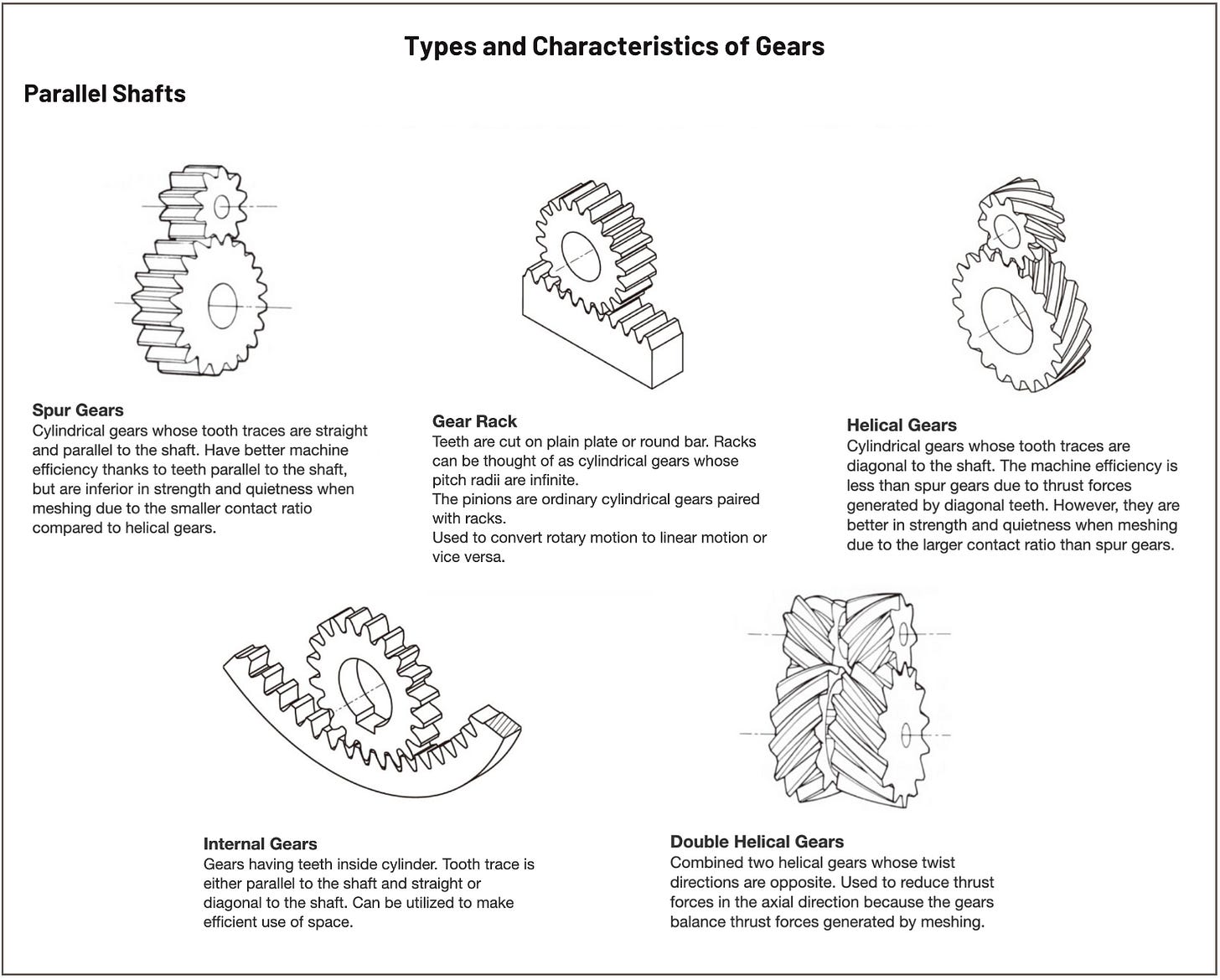
A reference for choosing gears based on shaft arrangement and application requirements (shared a snapshot of this in the last issue, but it’s too useful not to include the full version here). The general approach is to identify shaft orientation (parallel, intersecting, or skewed), select the appropriate gear type, and then refine the choice based on performance needs like speed, torque, operating conditions, and cost.

Interesting Paper: WiFi as a Motion Sensor
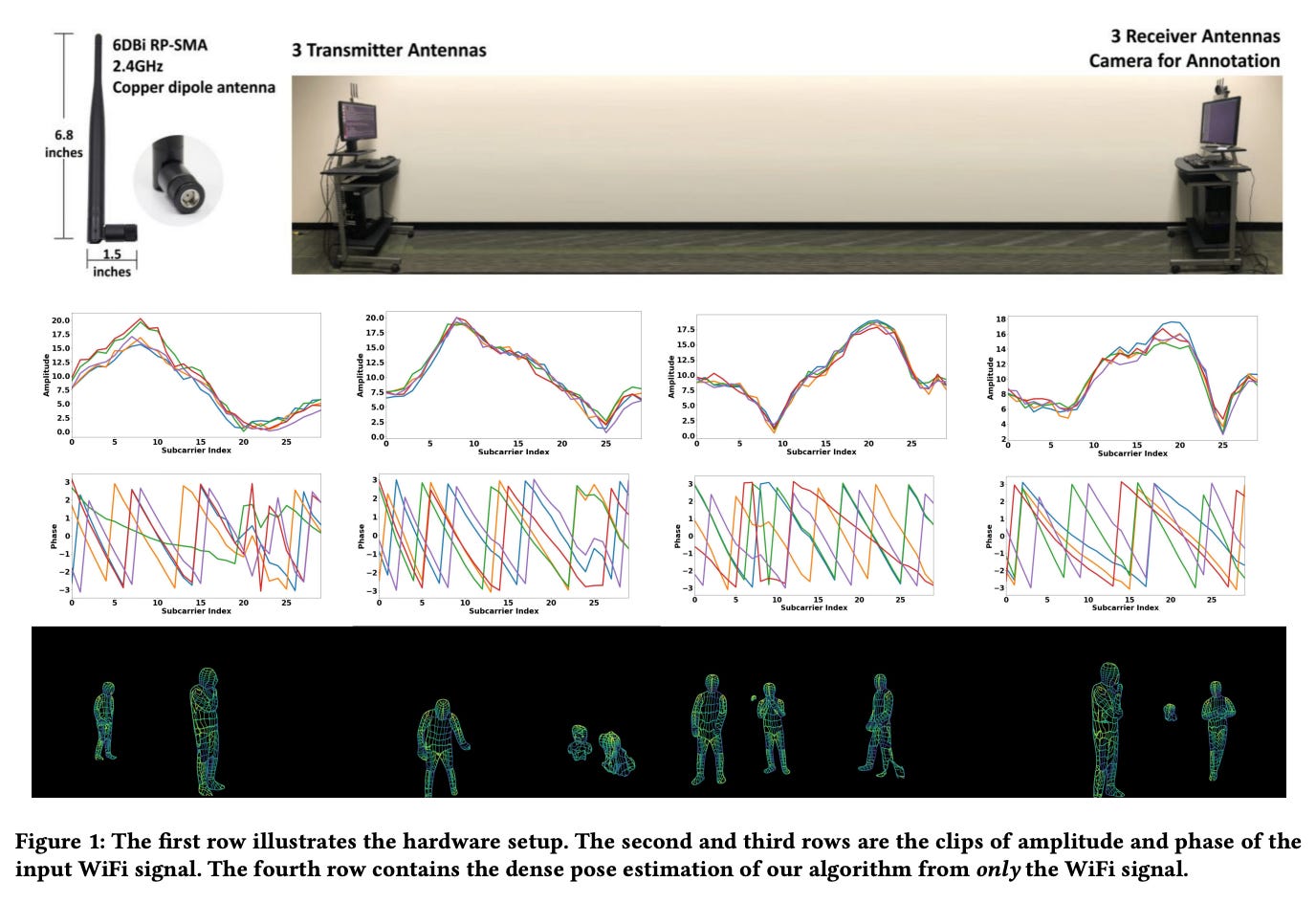
A 2023 paper out of Carnegie Mellon, DensePose From WiFi, shows that human body pose can be estimated using only WiFi signals. The setup is straightforward: three transmit and three receive antennas collect channel state information (the amplitude and phase of WiFi signals), then feed it into a model trained against DensePose labels to map out 24 body regions. The system works when people aren’t directly visible, though accuracy drops in new layouts and it remains well behind cameras.
It’s part of a broader body of work using WiFi distortions to detect human presence (see also ESPARGOS, a WiFi-based radar platform). Applications aren’t obvious—maybe automation, maybe healthcare—but it raises questions about surveillance risks of repurposing everyday infrastructure as sensors.
Manufacturing & Startup News
More leftovers from our weekly research:
- SpinLaunch raised $30M in new funding to accelerate development of its Meridian Space LEO broadband constellation, aiming for its first customer link by late 2026. Investors include Sumitomo and Airbus Ventures.
- Serve Robotics acquired Vayu Robotics to integrate its autonomy stack and sim-to-real transfer tech. Vayu’s data engine for generating corner cases will pair with Serve’s fleet ops to advance sidewalk delivery robots in unstructured environments.
- Syenta raised $8.8M in a pre-Series A to develop Localized Electrochemical Manufacturing (LEM), a lithography-free process enabling scalable, high-density interconnects for advanced chip packaging.
- Saga Robotics raised $11.2M in funding to expand its agricultural robots for strawberries and grapevines across the UK and US. The company already has 150 robots in commercial operation.
- NordSpace began the first $10M phase of its Atlantic Spaceport Complex in Newfoundland, which will host suborbital and orbital launches (46–100° inclinations) alongside 3D-printed engines like the Hadfield Mk III. The site’s first launch window opens today.