

Interesting Links 🏭
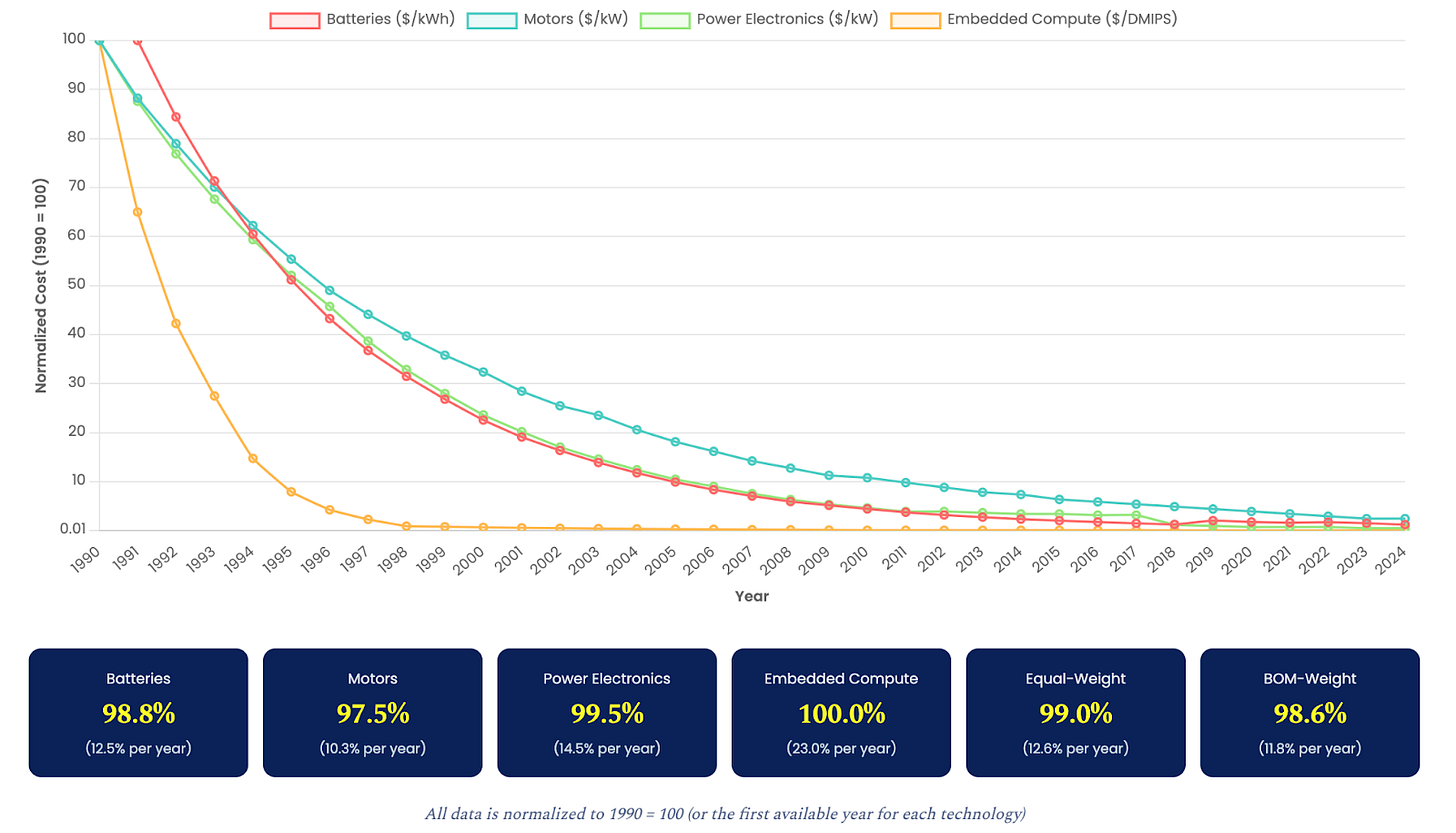
- The Electric Slide charts the four layers of the electrification stack across batteries, motors, power electronics, embedded compute, and how they collapsed in cost by ~99% since 1990. The primary reasons are the same ones that drove down semiconductors and solar: scale, learning curves, and policy tailwinds. Lithium-ion cells fell on a predictable 20–30% curve with every doubling of output, pushed faster by China’s state-backed buildout of LFP giga-factories. Permanent magnet motors got cheaper as neodymium refining consolidated and designs standardized around EV drive units. Power electronics moved from defense-grade, high-cost components to SiC and GaN devices scaled by automotive demand, and embedded compute rode Moore’s Law into cheap, powerful MCUs. The same compounding effect explains why EVs can displace ICE drivetrains, why drones are viable against rotorcraft, and why everything today now seems to be getting a battery.
- Note: The tool is part of Packy McCormick’s broader essay (The Electric Slide), which is equal parts education and manifesto on the geopolitical dynamics of electrification.
- Technologies that follow Wright’s Law follow steady learning curves, where each doubling of production cuts costs at a constant rate. In simpler terms: the more you make, the cheaper it gets. It’s often true for industries like semiconductors, solar panels, and aircraft production where unit cost decreases as cumulative production increases but there are notable caveats; when supply chains strain (e.g. raw materials like copper constrained by geology and energy costs), demand falls, or new tech resets the curve. Moore’s Law is the most famous version of this dynamic framed by time rather than output, but ultimately just a special case of Wright’s broader principle.
- A hidden gem buried in FCC filings, the Nokia 7280 (better known as the “lipstick phone”) was one of many experiments in mobile compute form factors before smartphones converged on today’s homogeneity (see int. photos here). The 7280 was a cylindrical tube styled like a lipstick case but packed with the hardware of a mid-2000s handset: a VGA (0.3 MP) camera, Bluetooth, FM radio, GPRS data, MMS, and SyncML support. Instead of a keypad it used a rotating wheel for navigation and text entry that was awkward for typing but distinctive in its charm. Limited in practicality and marketed more as a fashion accessory, the 7280 was part of the sandbox era when phone makers tried every hinge, keypad, and chassis design before the iPhone locked the form factor.

- A complete walkthrough of building financial models for physical products across retail pricing (MSRP), average selling price (ASP), channel mix, bill of materials (BOM), cost of goods sold (COGS), operating expenses, and lifetime value (LTV). It shows how MSRP gives way to the real average selling price once channel cuts, promotions, and returns are factored in. From there, the model layers in BOM costs (driven by the balance of mechanical vs. electrical components), manufacturing labor, tariffs, and shipping to get to COGS. Operating expenses typically include cloud infrastructure for IoT products, marketing, and warehouse 3PL. Fixed costs like tooling, contract manufacturer non-recurring engineering (line setup, test fixtures, process validation), and certifications sit on top of every program regardless of scale. The last piece is lifetime value per device, and also a reminder that hardware margins are thin and set early by design choices and recurring revenue as much as by unit cost.
- The Globus INK was a mechanical navigation computer for Soyuz spacecraft that used a geared globe fixed at 51.8° and driven by 1-Hz pulses to show predicted position, latitude, longitude, and day/night. Each unit was built for a specific orbit and actually remained in use until 2002 despite its limitations.

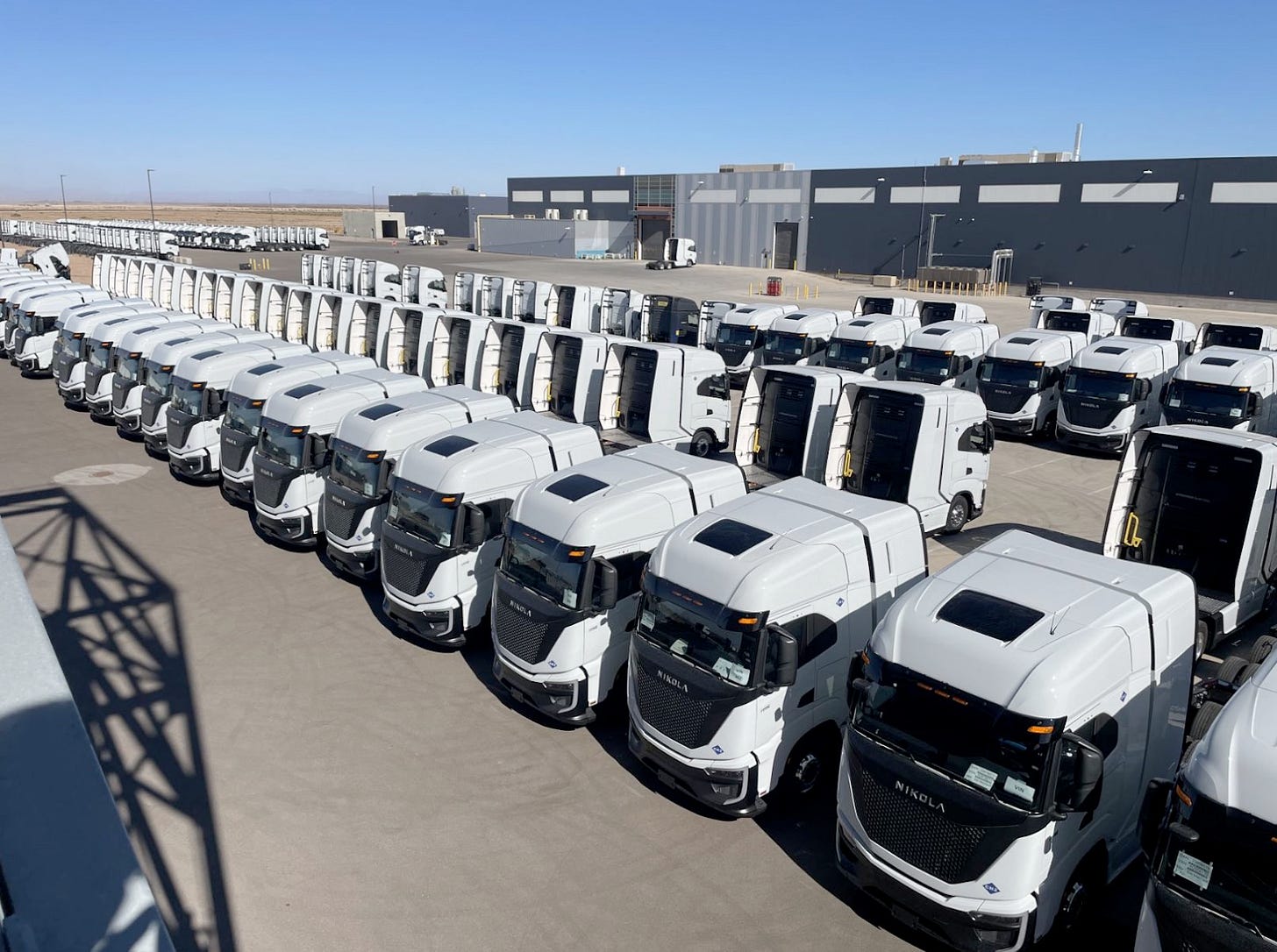
- Bidspotter is the industrial equivalent of eBay, where you can buy nearly any machine shop equipment, or in special auctions an electric semi-truck from the now bankrupt Nikola Motors.
- On the project side: NPIApps is a set of tools any new product introduction engineer wishes they had during a build. Castora is an early-stage AI co-pilot to draft and refine system requirements.
- Last week’s most-clicked link was a beer-on-a-linear-actuator demo of motion profiles.
- Zach from Doss is going on another roadshow to meet local manufacturers in the U.S. He’s hosting happy hours in Grand Rapids (9/5),Chicago (9/7), and Milwaukee(9/16).
A couple of fun links featuring projects our readers are actively exploring (if you’re working on something cool, drop us a note!):
Startup News 🚀
- Copper raised $28M in Series A funding to scale its battery-equipped induction stoves which double as distributed energy storage. The full-range units run off standard 120V outlets and target multifamily housing owners rather than individual buyers. The company has shipped ~1,000 units, signed a multiyear contract with the NYC Housing Authority for 10,000 more, and is piloting with California’s Demand Side Grid Support Program to demonstrate stoves as virtual power plants (household batteries that can feed energy back to the grid during peak demand). The round was led by Prelude Ventures.
- As far as we’re aware, battery-powered stoves are a two-company market: Copper with a full-range unit, and Impulse Labs with a stovetop.

- Eyebot raised $20M in Series A funding to expand its 90-second vision exam kiosks which generate prescriptions reviewed and verified by licensed doctors. The Boston-based startup has run 45,000 free tests since its original seed funding and is on track to exceed 500,000 annually. Eyebot kiosks are currently deployed in malls, universities, pharmacies, and airports that offer free exams while charging a fee for prescriptions and leasing units to retailers. The round was led by General Catalyst.
- Commonwealth Fusion Systems raised $863M in Series B2 funding from Nvidia, Google, Breakthrough Energy Ventures, and others, bringing total funding to nearly $3B—the most of any fusion startup. The capital will advance Sparc, its prototype tokamak using high-temperature superconducting magnets and if successful, CFS plans to begin building Arc, its first commercial fusion plant, in Virginia starting 2027–28.
- Blue Water Autonomy raised $50M in Series A funding to develop unmanned ships for the U.S. Navy. The company is building a full-sized prototype for launch next year, designed for months-long autonomous operation with integrated perception, planning, and control systems. The raise comes as U.S. shipbuilding lags China by 200x in capacity, prompting the Pentagon to accelerate unmanned surface vessel programs backed by $2.1B in new Congressional funding. The round was led by GV.
- Bucket Robotics secured $1.25M in SBIR Phase II award to adapt its AI-powered inspection platform for Air Force applications. The AI inspection platform processes and aggregates sensor data to identify defects in complex assemblies during manufacturing.