

Interesting Links 🏭
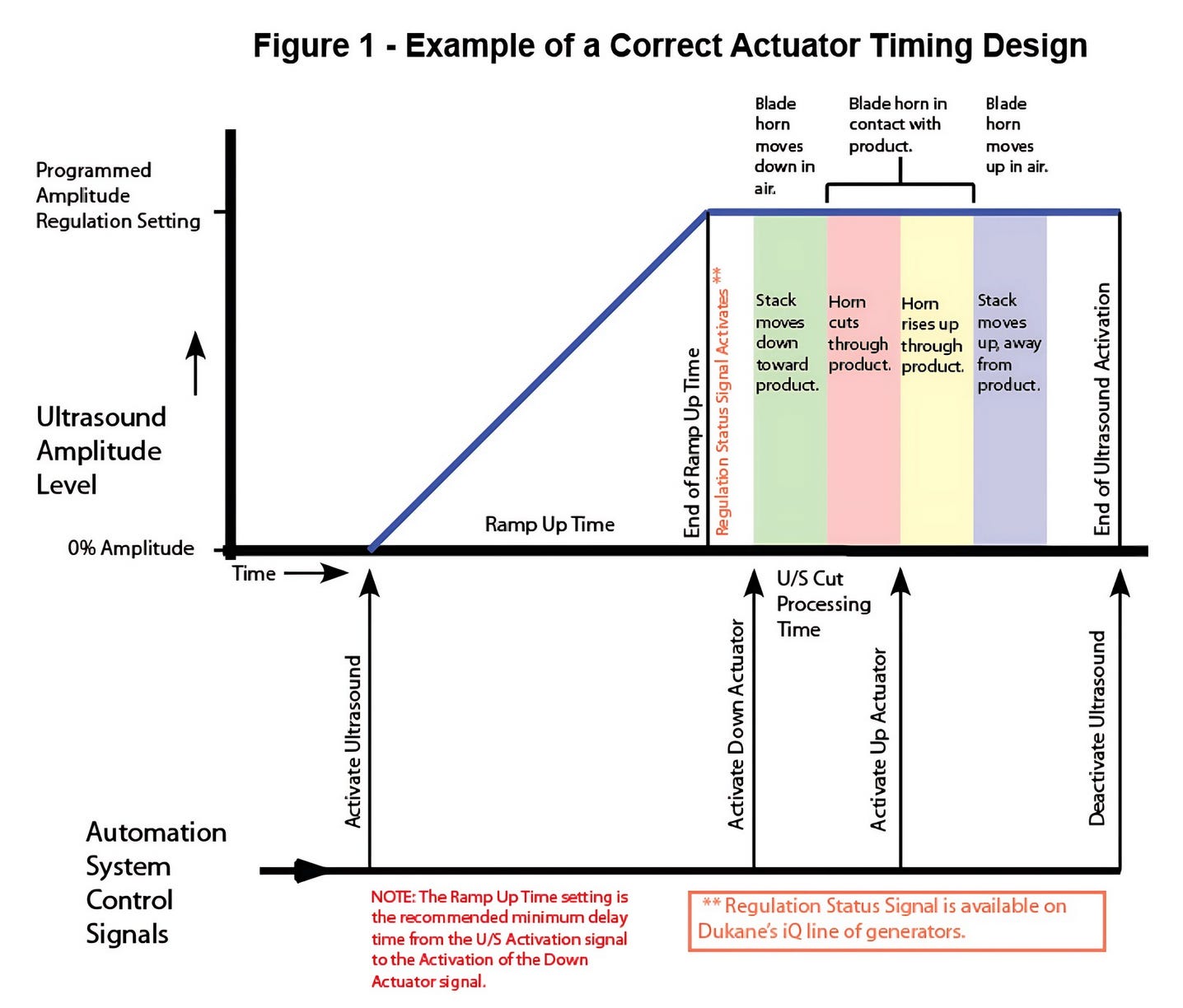
- Application notes on ultrasonic cutting, where a blade vibrating at 20–40 kHz shears material through vibration rather than brute force. A complete system often includes a power supply, a piezoelectric transducer (converts high-frequency voltage into linear vibration), an optional booster that adjusts vibration amplitude, and a tuned blade where the tip oscillates at the operating frequency. Ultrasonic cutting shows up most in industrial food lines though desktop tools like the WonderCutter bring the same tech into labs and workshops. Just as interesting is the timing control sequence: the generator has to ramp the stack to amplitude and lock onto resonance before the blade is truly “live.” Push into material too early and you’re forcing a static edge, which trips overload protection. Ramp-up times are short but non-zero (≈0.15 s at 20 kHz, ≈0.05 s at 40 kHz), so systems wait for a ready signal or, in handheld tools, you just get a beep.
- An ultrasonic chef knife was also recently released, shown off in a neat product demo.
- Fifty things you can do with a software defined radio (SDR). At its simplest, a radio is just a device that picks up electromagnetic waves and turns the input signal into something useful like sound, data, or control signals. A traditional AM/FM radio uses fixed analog hardware like oscillators, filters, and demodulators to process each signal, whereas an SDR shifts that complexity into code, digitizing the signal at the antenna before software takes over filtering, demodulating, and decoding. In practice, all you need is a simple dipole antenna: two equal conductive elements, each about 72/f (MHz) in length, pointing in opposite directions. From there an SDR can pick up AM radio stations from across the world, follow the path of weather balloons, listen in on taxi dispatchers, or even decode images from passing satellites.

- An index of exotic chip-level parts like wire-bondable components, gold-filled vias, and specialized substrates used in RF and high-power electronics. At these frequencies and power levels, packaged parts often add unwanted parasitic inductance or thermal resistance. The solution is thin-film, high-reliability microelectronics that are wire bonded: bare chips with gold pads, mounted directly on ceramic substrates like beryllium oxide (BeO) or aluminum nitride (AlN) to minimize heat and parasitics. They’re made by depositing micrometer-thin films of resistive or conductive material onto those substrates, then patterning them into precision components.
- A megathread of 1,000+ interview questions across power electronics, embedded hardware, and PCB design. Less a checklist to memorize, more a reference that shows the range of what interviewers expect and a way to map the terrain from fundamentals to board-level design. On the mechanical side, there’s also a companion list of 650 FE-style questions that, while more exam-oriented, double as a useful prep resource.
- Alchemy, the ancient pursuit of transmuting base metals into gold through mystical or early chemical means, may finally have a modern, scalable engineering counterpart as part of new revenue streams from fusion reactors. Marathon Fusion, a San Francisco–based startup, recently published a paper proposing to introduce mercury-198 into a fusion reactor, where fast neutrons convert it into mercury-197, which then decays into stable gold-197 as a side reaction. The company has raised ~$10M in private and government funding to push fusion R&D, and now suggests this side reaction could yield ~11,000 lbs of gold per GWth annually that would effectively double plant revenue without reducing power output. The caveats are big: the process isn’t peer-reviewed, isotopic impurities could leave the gold radioactive for over a decade, and fusion itself remains unproven at scale. Full paper here.
- A couple new workshops on the horizon:
- If you’re at PCB West, Summit is hosting shop tours at their Santa Clara fab facility (9/30–10/02). Sign up here!
- We’re exploring possible workshop topics around industrial operations — think how companies choose sites for data centers, factories, or chip fabs. Potential topics could include funding strategies, energy costs, or how to get cities/states to compete for new factories. Curious which one you’d be most interested in!
Event Calendar:
9/25 – Analysis for Advanced Aircraft Design Workshop (Online)
Live walkthrough of aircraft sizing, CFD, and performance analysis in a single workflow.
A get-together for engineers, founders, and procurement folks to trade notes and talk shop.
Startup News 🚀
- Two giant late-stage rounds in the news:
- Figure raised over $1B in a Series C round at a $39B valuation, bringing total funding since 2022 to nearly $2B. The company is developing humanoid robots for complex manufacturing and industrial tasks, aiming to integrate AI-driven automation into production lines. The round was led by Parkway Venture Capital.
- Oura is raising $875M in Series E funding at a ~$10.9B valuation, doubling its valuation since last November. The Finnish company has sold 5.5M health rings to date and expects revenue to surpass $1B in 2025, up from $500M in 2024. Recent growth has come from international rollouts, retail expansion, and new customers including the U.S. military.
- Atomic Industries raised $25M in Series A funding for its software that automates tool design, aiming to make tooling as fast and flexible as software. The company is targeting partnerships with OEMs to enable faster tooling and part production. MaC Venture Capital and DTX Ventures led the round.
- Icarus Robotics raised $6.1M in seed funding to develop fan-propelled drones with dual arms for cargo handling, equipment inspections, and other tasks aboard commercial space stations. The company is starting with tele-operated prototypes, aiming to reduce reliance on astronauts for routine work and cut operating costs during uncrewed periods. Soma Capital and Xtal led the round.

- InventWood raised $15M in the first close of a Series A round to commercialize ‘Superwood’, a processed timber densified with food-industry chemicals and compression. The material is stated to have 50% higher tensile strength than steel, a superior strength-to-weight ratio, and resistance to fire, rot, and pests. Initial use cases are building facades, with longer-term plans for structural beams from wood chips. The Grantham Foundation led the round.