

👋 Happy Saturday! This weekend’s edition includes a firsthand take at the realities of U.S. manufacturing, a breakdown of how production throughput varies by industry, and a look at one startup’s attempt to rebuild the engineering notebook from the ground up.
Interesting Video: Building a Mechanical Commodity in North America
Destin from Smarter Every Day set out to make a simple mechanical commodity—a chainmail barbecue scraper—using only components made in the U.S. What followed was a fascinating look at the current state of U.S. manufacturing, and where it falls short compared to international manufacturers.
A couple of interesting takeaways:
- A ¼-20 × 1" stainless bolt cost $0.09 from Asia vs $0.35–0.42 from Massachusetts (the best price sourced after months of searching).
- Almost all tooling (mold and die work for processes like injection molding) is done overseas, mainly in countries like China, Taiwan, and Vietnam, and then shipped to run on machines domestically.
- From personal experience, major tooling changes also has to be handled overseas since domestic shops can only manage minor reworks.
- The U.S. is strong in design and IP, but much of the actual manufacturing work has moved elsewhere. (Just look at the back of any Apple product: Designed by Apple in California. Assembled in China).
Interesting Chart: How Production Volume Varies by Industry
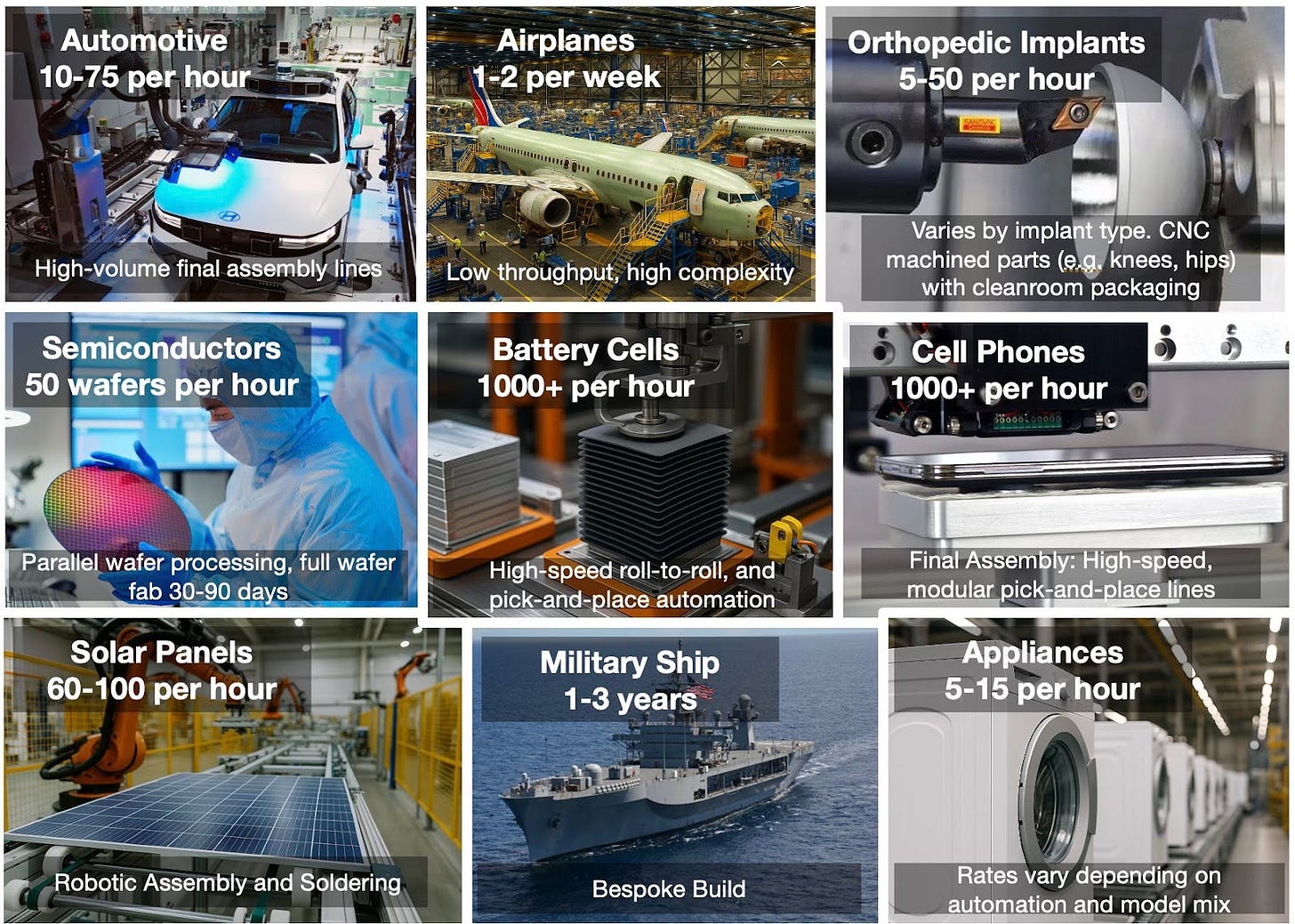
Production throughput by industry. As a rule of thumb: the more parts, customization, and supply chain depth, the lower the throughput.
Interesting Interview: Automating the Engineering Notebook
“It’s not uncommon to see teams responsible for critical systems, from aircraft components to automotive safety features, still doing calculations on TI-83s or paper notebooks. … In essence, we're developing an 'agentic notebook' where professionals maintain calculations, notes, datasets, and external references while collaborating with AI models on their engineering analysis.”
We recently spoke with Nabeel Allana, the Co-Founder & CEO at Dystr. The above is a peek into how he thinks about building tools for technical teams. Read the full interview here.
Manufacturing & Startup News
More leftovers from our weekly research:
- Applied Computing raised a $12.2M seed round to scale its Orbital AI platform, to help oil, gas, and petrochemical plants optimize yields, reduce emissions, and prevent failures using real-time ops data.
- Saeki raised a $6.7M seed round to build autonomous factories that combine large-format 3D printing, CNC machining, and in-process inspection into autonomous cells. The goal is to shorten composite and metal part lead times for aerospace and automotive customers.
- Beacon raised $1.6M for a far-UVC ceiling-mounted disinfection device that continuously kills viruses and bacteria in air and on surfaces—targeting schools, offices, and public buildings.
- 3DBioFibR raised $3M to scale its dry-spun biopolymer fiber platform, producing medical-grade fibers for tissue scaffolds and industrial use. Funds will go toward ISO 13485 certification and clean room build-out.
- Kumulus Water raised $3.5M to expand deployment of its solar-powered atmospheric water generators, which extract 20–30 liters of drinking water per day from humid air—built for off-grid use in water-scarce regions.