

👋 Happy Saturday! This weekend’s highlights include lecture notes on bolted joints, how to design mold cavities for a plastic spoon, and a cool startup developing graphene-based electrodes for brain-computer interfaces.
Interesting Lecture Notes: A Look at Bolts & Bolted Joints 📝
Bolted joints do more than just hold things together—they influence stiffness, vibration, and load capacity across the entire system. Recent automotive recalls show why proper screw and bolt fastening still matters. Tesla recalled 3,470 Model Y vehicles in 2023 for loose bolts that risked seat belt failure. In 2024, GMC recalled the Canyon due to a loose seat belt buckle bolt, and Volkswagen flagged a loose airbag inflator screw in the ID4. Small fastening issues, big safety consequences.
This lecture series by Kyle Shropshire covers the anatomy of a bolt, bolt failure modes, and the engineering fundamentals behind bolted joints.


Interesting Video: Designing Mold Cavities for a Plastic Spoon
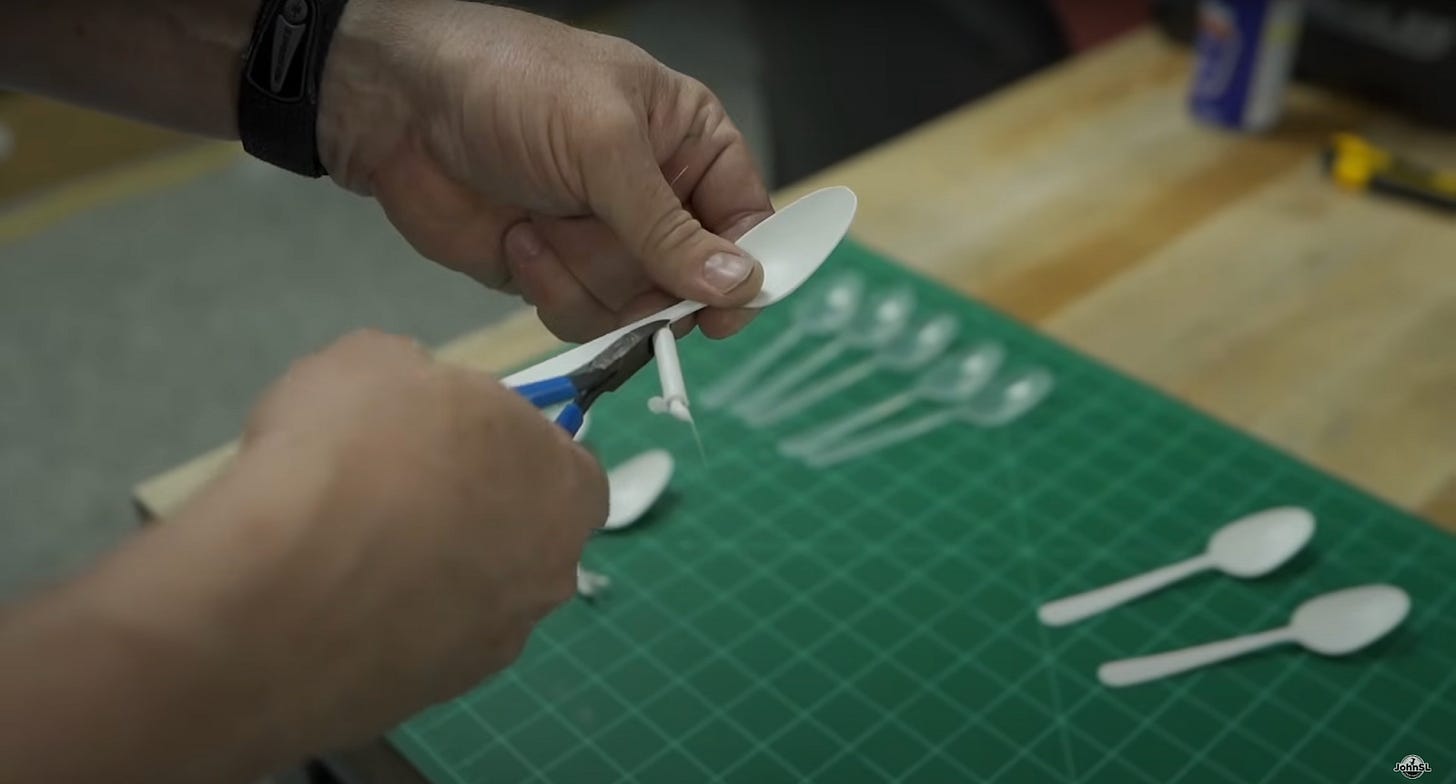
An over-the-shoulder tutorial on designing a plastic injection molded spoon. For many engineers (ourselves included!), plastic part design feels like a black box. You hand off a design to a manufacturer, and weeks later, samples show up just like magic. This tutorial reveals the full process: designing the part in CAD with manufacturing considerations in mind, milling the mold halves, and molding test samples.
💈A thread of lessons:
- Design the mold cavities with air vents, typically 0.025mm pockets, at the extremes of the part to allow air to escape during the injection process while avoiding flash.
- Start from large to small ball-end mills to machine curved surfaces on the mold: use larger end mills for roughing and broad features, and smaller end mills for fine details.
- Close toolpath spacing minimizes cusp height—small ridges left between cutting tool passes.
- An easy way to remove tool marks from a mold is by using 4,000-grit polishing sticks or Scotch Brite pads.


Startup Highlight: INBRAIN Neuroelectronics
INBRAIN Neuroelectronics, a neurotech startup from Spain, uses graphene-based electrodes in implantable devices to record neural signals. Unlike traditional systems that penetrate the brain to access neurons, their electrodes sit on the cortical surface, capturing higher-level signals from broader regions of the brain.

Earlier this week, the company announced a $50M Series B, backed by the EIC Fund and existing investors Asabys Partners and Aliath Bioventures. A talk from CEO and Co-Founder Christina Aguilar explaining more details around their core technology.