

👋 Happy Saturday! This week’s edition digs into Nat Bullard’s annual decarbonization presentation, a chart on the EV demand paradox, and a rapid-fire electronics tier list that’s both oddly compelling and enlightening.
Interesting Presentation: A Year in Decarbonization
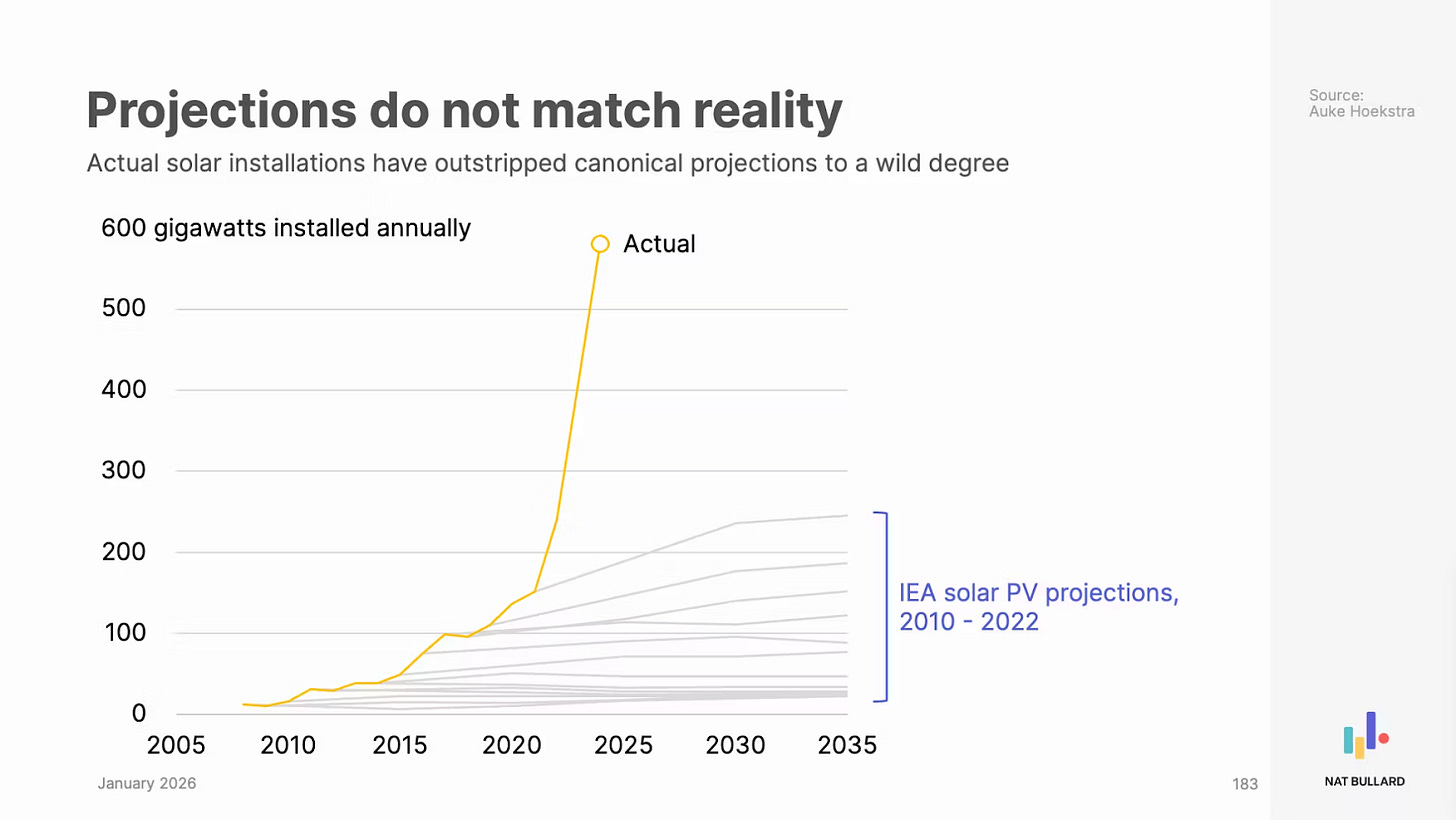
Nat Bullard’s annual decarbonization year-in-review deck is out. 200 slides of pure goodness, spanning electrification, critical minerals, energy investment flows, industrial and economic policy, data center expansion, and more. It’s one of the best single hubs of sources for understanding where capital is actually going, and where progress is real across energy technologies in the U.S. and abroad, including a few unbelievable charts of China’s rapid advances.
As with everything we share, go read the source! There’s far more in the deck than we can do justice to here. What follows is just what we pulled out as worth highlighting.
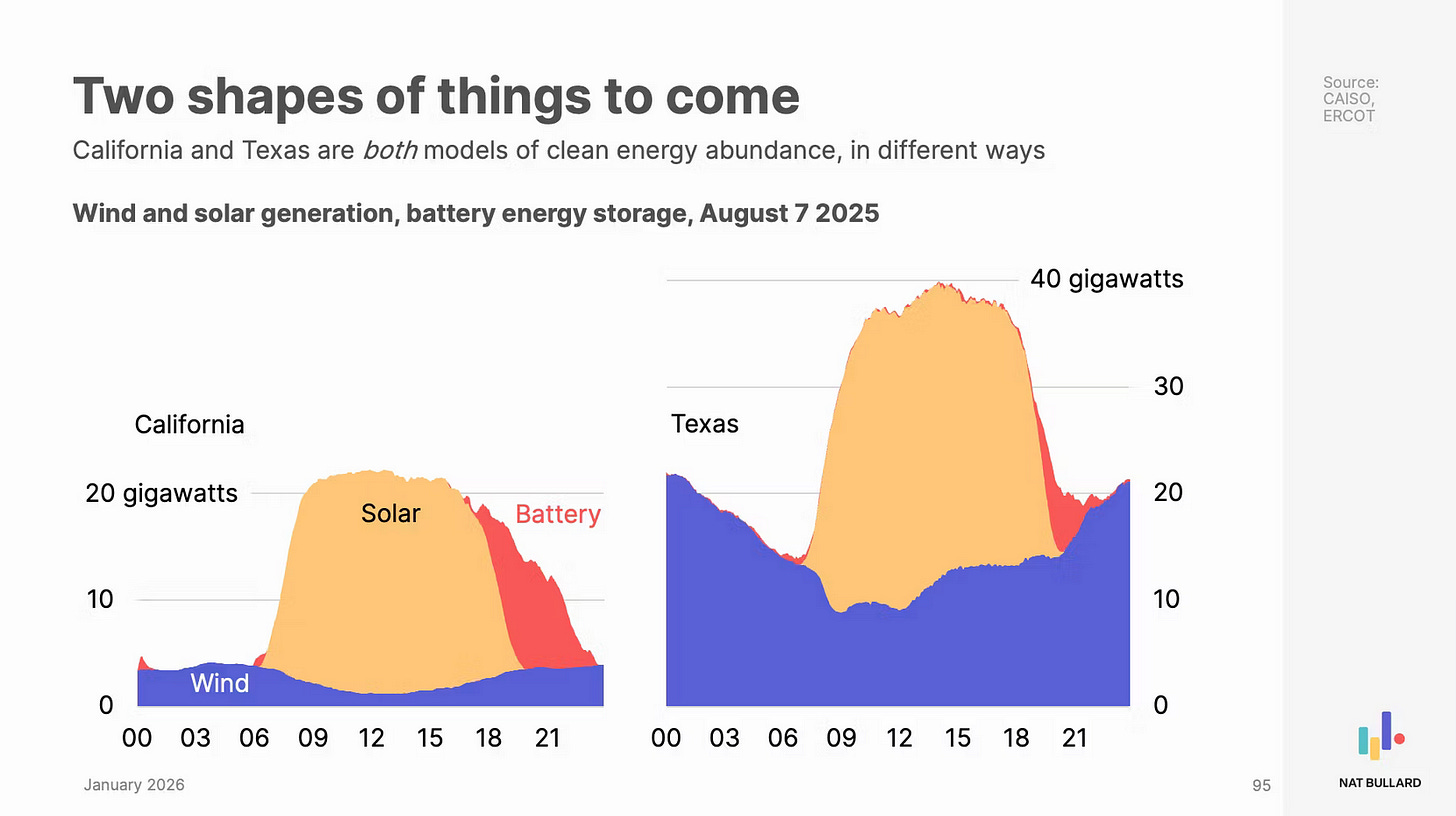
First on our radar: solar and battery storage are now showing up as real, load-bearing grid infrastructure. The standout comparison in his deck is California versus Texas; two states that you’d expect to have opposite energy philosophies, yet both have built credible (and different) models of clean-energy abundance.
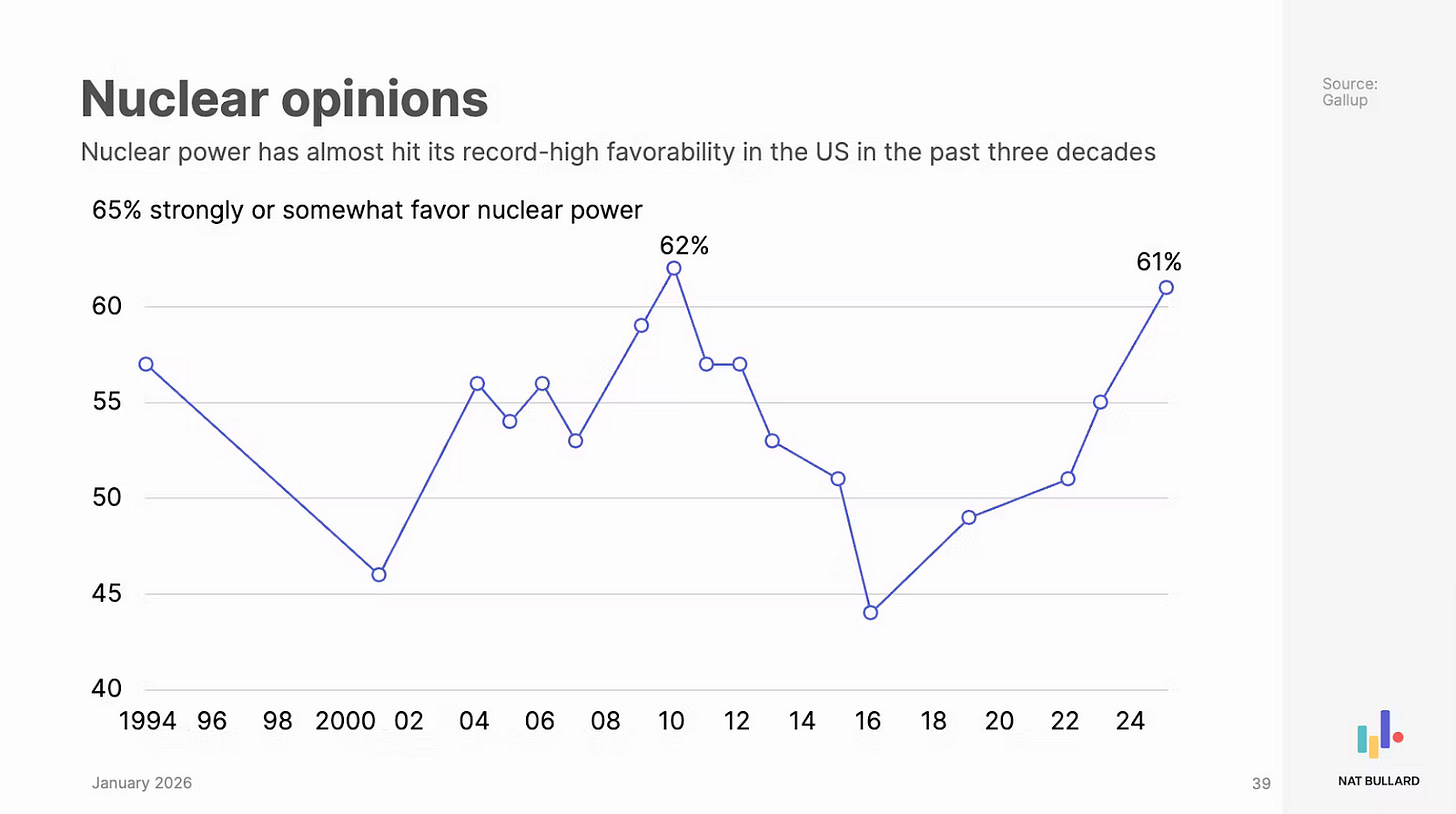
Also worth noting: nuclear power is back near record-high favorability in the U.S. after three decades. Rising electricity demand from data centers, AI workloads, and electrification has collided with the reality that the grid still needs large amounts of consistent, zero-carbon power. In many ways, policymakers and investors are treating nuclear less as a legacy technology and more as a practical grid asset; check out our market map for a snapshot of new-age nuclear startups.
For the points above (and it’s really just two observations), it’s interesting to see how terms like ESG and climate tech were the investment zeitgeist of the early 2020s, and have significantly fallen out of public favor. The retreat in language hasn’t meant a retreat in deployment though. More projects are moving forward, now framed in terms of energy security, grid reliability, and resilience.
(Shared in a previous issue, but worth repeating: real-time electricity generation by source is publicly trackable here to go deep in the weeds on data).
Interesting Chart: The Electric Vehicle Demand Paradox
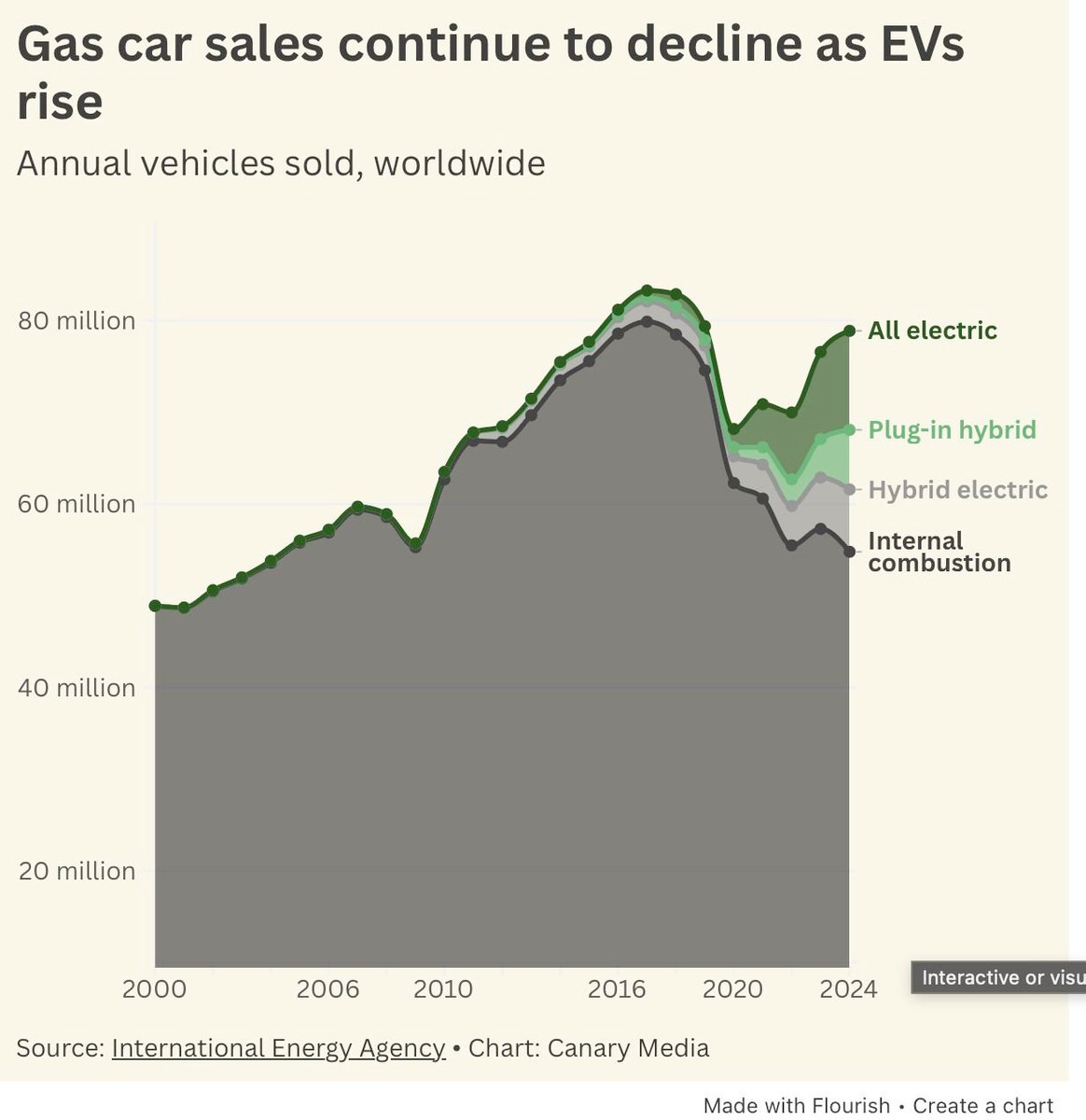
A bit of a narrative violation: while headlines say EV demand is cooling, gas continues to lose share in annual vehicle sales with internal combustion engine sales steadily declining. At the same time, automakers are also making real adjustments—GM taking a ~$6B EV write-off, Ford scaling down F-150 Lightning production—as demand comes in below forecasts and federal tax credits have expired.
Are we moving to fully electric cars? As with most questions that matter, it depends. The emerging playbook looks like: (1) scale back unprofitable EV lines, (2) shift the near-term mix toward hybrids and higher-margin ICE vehicles, and (3) keep the option to ramp EVs again later in the decade if pricing, policy, and demand improve.

Interesting Video: Electronics, Tier-Listed
A rapid-fire tier list ranking common electronic components. Somewhat useful, and also strangely compelling. The TikTokification of electronics intuition on full display.
Manufacturing & Startup News
More leftovers from our weekly research:
- Unbox Robotics, an India-based robotics startup, raised a $28M Series B round to scale its modular warehouse robotics systems, with capital going toward engineering, new products, and international expansion.
- Vestaboard, a consumer hardware company known for its split-flap mechanical displays, announced it brought its newest product into production in under nine months, with pre-orders nearing $5M.
- Serve Robotics, a developer of sidewalk delivery robots, is acquiring hospital logistics startup Diligent Robotics for $29M. Diligent’s Moxi robots operate inside hospitals performing supply and delivery tasks, a category Serve has not previously worked in.
- Defense Unicorns raised a $136M Series B round at a valuation north of $1B. The company focuses on deploying and updating software on air-gapped military systems that operate without internet connectivity.
- And to round out the week: cool footage from Rainmaker showing what cloud seeding looks like at 10,000 feet.