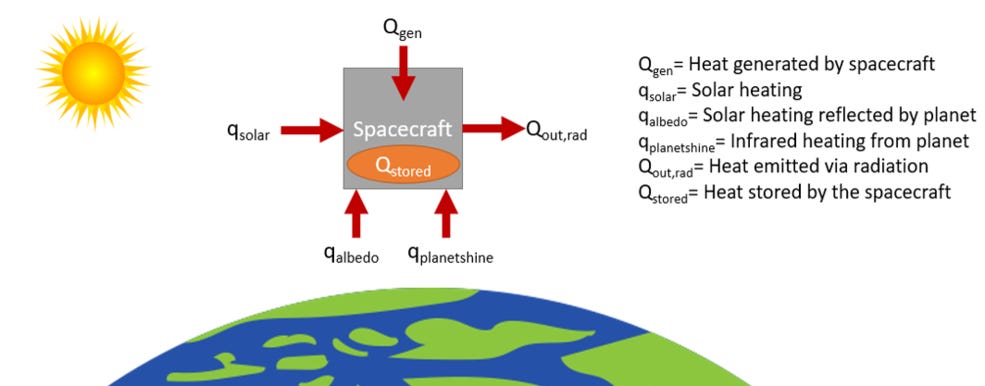
An excellent review on passive and active thermal control methods for small spacecraft, from NASA. All components have specific operating temperature ranges, but designing spacecraft components to stay within these limits is challenging due to the unique environmental factors in space like solar heating and radiative heat loss. Traditional passive thermal management methods like paints, coatings, and multi-layer insulation continue to dominate due to low mass, volume, and power requirements. However, there is a growing trend towards incorporating advanced active thermal control systems like cryocoolers (miniature refrigeration system) and fluid loops (system that circulates a working fluid through the spacecraft to a heat sink).
The review is from a chapter in NASA’s annual state-of-the-art report on small spacecraft. The full 350 page+ report has detailed technical information on in-space propulsion, spacecraft material selection, avionics, and more!
Orbiting Spacecraft Heating Overview
Optimizing heat transfer (or lack thereof) is as important in spacecraft design as it is in corrugated fiberboard for food packaging. For products like butter and meat, which are packaged prior to freezing, a high packaging resistance (low thermal conductivity) can increase freezing times by up to 25%! This paper measures the thermal conductivity of different types of paper and cardboard packaging, and develops a finite element model of expected heat transfer in fiberboard materials and thickness. The results showed that the bulk of the heat flow occurs through the medium paper in the fluted region.
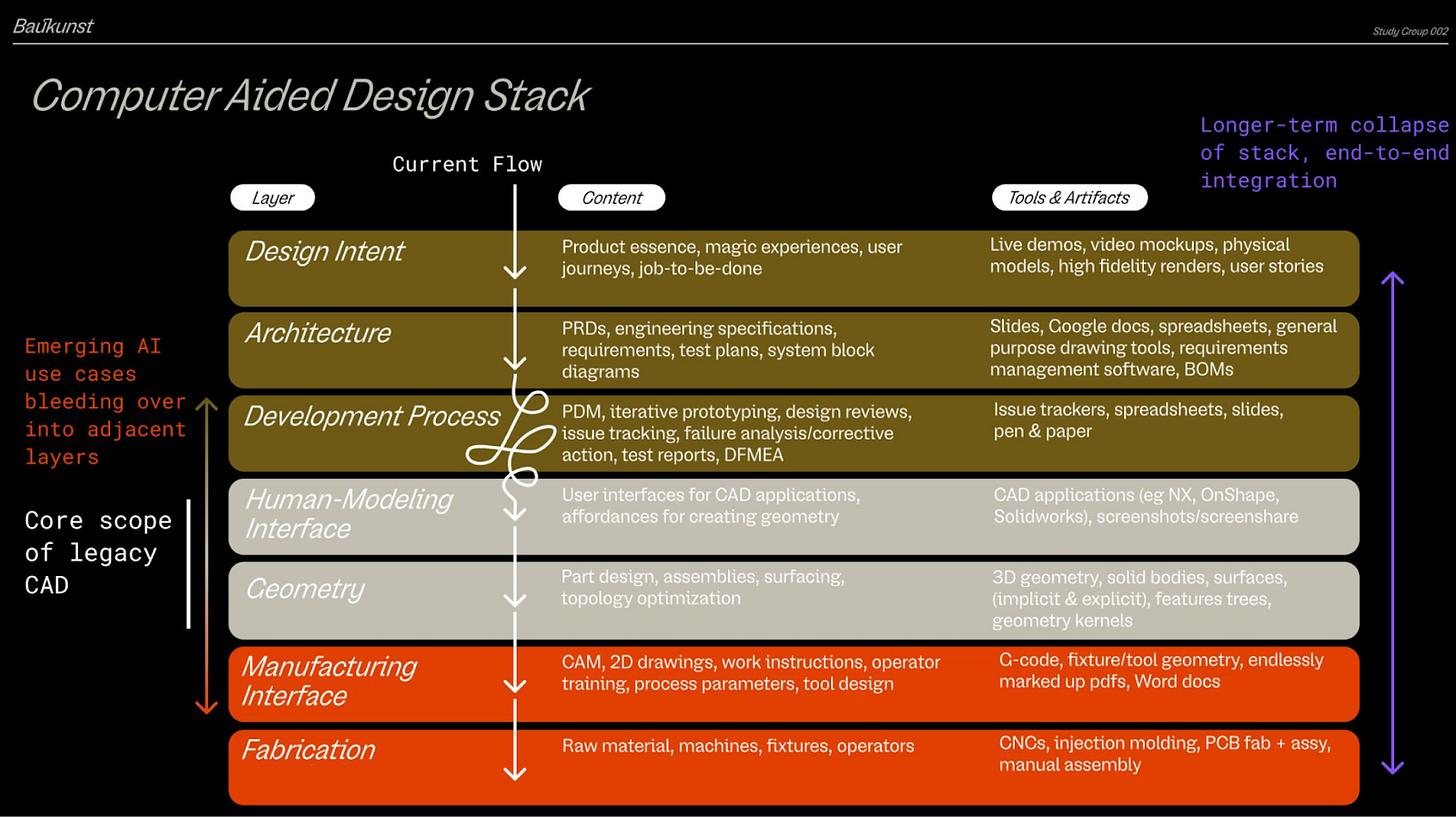
This week Baukunst releasedContours of CAD and AI, a report exploring how emerging AI and machine learning techniques will shape the way we design and build the world around us. Contributors include founders/execs from startups and established players like Autodesk, PTC, nTop, Onshape, and more.
We see AI in hardware currently used in two ways: 1) as copilots for development tasks like automating schematic designs (JITX, Flux) and 2D drawings (Drafter); and 2) in agentic engineering environments, where "intelligent workers" can independently complete single or multi-step processes, such as tracking suppliers, vendors, or coordinating with external partners (Sygma, Dystr, etc.)
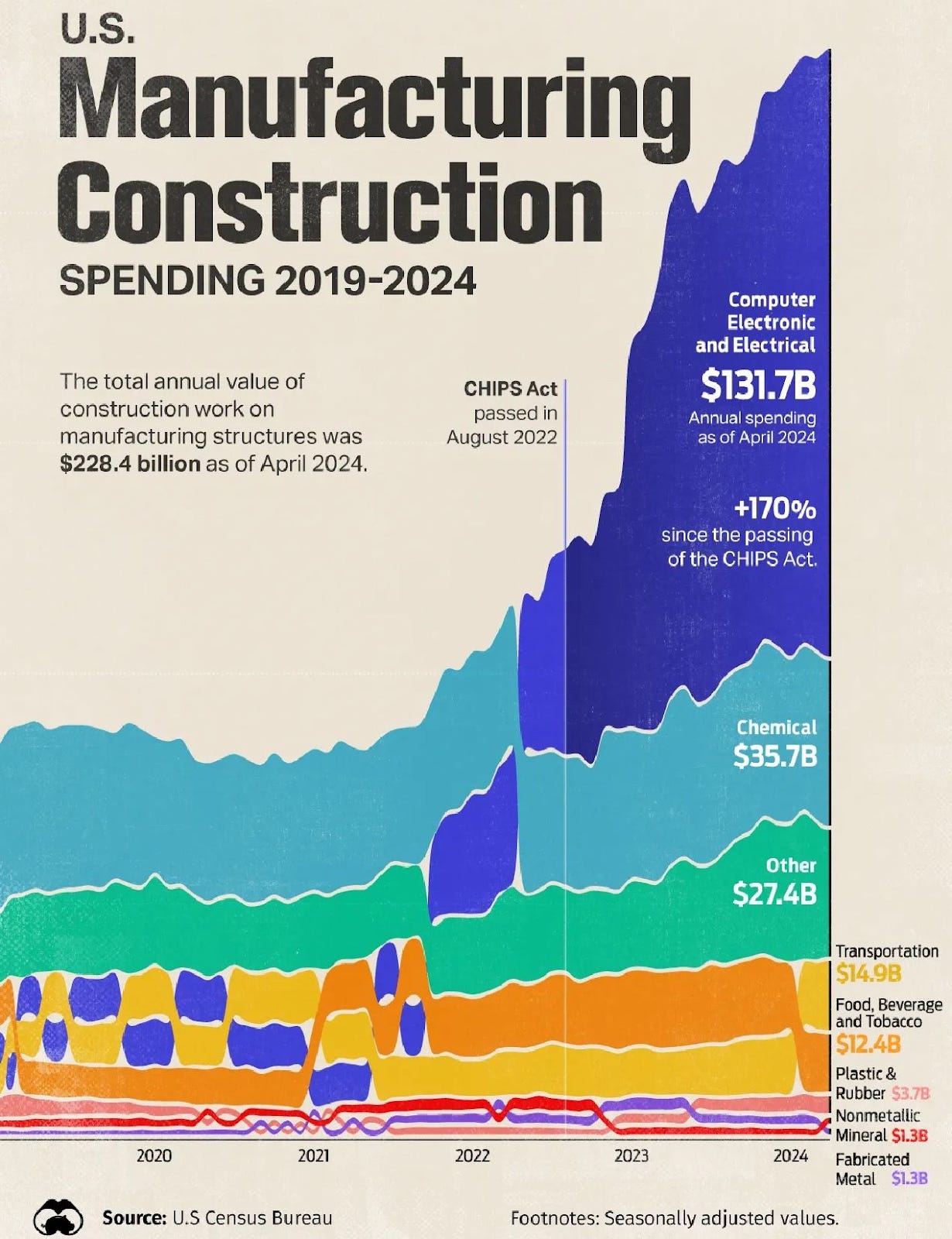
Here’s an overview of U.S. manufacturing construction spending over the past five years. Annual spending on semiconductor fabs and manufacturing facilities has reached $132 billion since the CHIPS Act was passed in 2022. Companies have pledged $300 billion of private investment to US based semiconductor manufacturing since the CHIPS Act, dwarfing the original $39 billion. TSMC secured a $6.6 billion subsidy for its Arizona chip production, but encountered challenges scaling the factory.
Startup News 🚀
TuSimple, a once-promising autonomous vehicle startup founded in 2015 and backed by significant Chinese and U.S. investments, is pivoting from autonomous trucks to animation & gaming in a startling turn of events. Upon IPO’ing in 2021 at a post-money valuation of $8.5 billion, the company's stock plummeted leading to its delisting in 2024. With their remaining capital, TuSimple China pivoted to animation and gaming and has raised concerns among shareholders and U.S. regulators, particularly due to the founder’s connections with other private businesses and the lack of disclosure around the new direction.
A neat Kickstarter campaign: Mola is a modular construction system that simulates structural behavior, helping architects and engineers build intuitive knowledge of building design.
Reverion has raised a $62M Series A to advance its renewable fuel cell-based biogas power systems. Their technology enables biogas plants to operate like traditional peaker turbines, but with a twist: when renewable energy is plentiful, the plant can reverse its cycle, storing excess energy as green hydrogen. The round was led by Energy Impact Partners (EIP).
Kairos Power's Hermes reactor has become the first non-light water nuclear reactor in the U.S. to receive a construction license from the Nuclear Regulatory Commission (NRC) in over 50 years. This fluoride salt-cooled, high-temperature reactor represents a major advancement in molten salt technology where liquid salts are used as a coolant and sometimes as a fuel carrier, allowing for higher operating temperatures and increased efficiency.