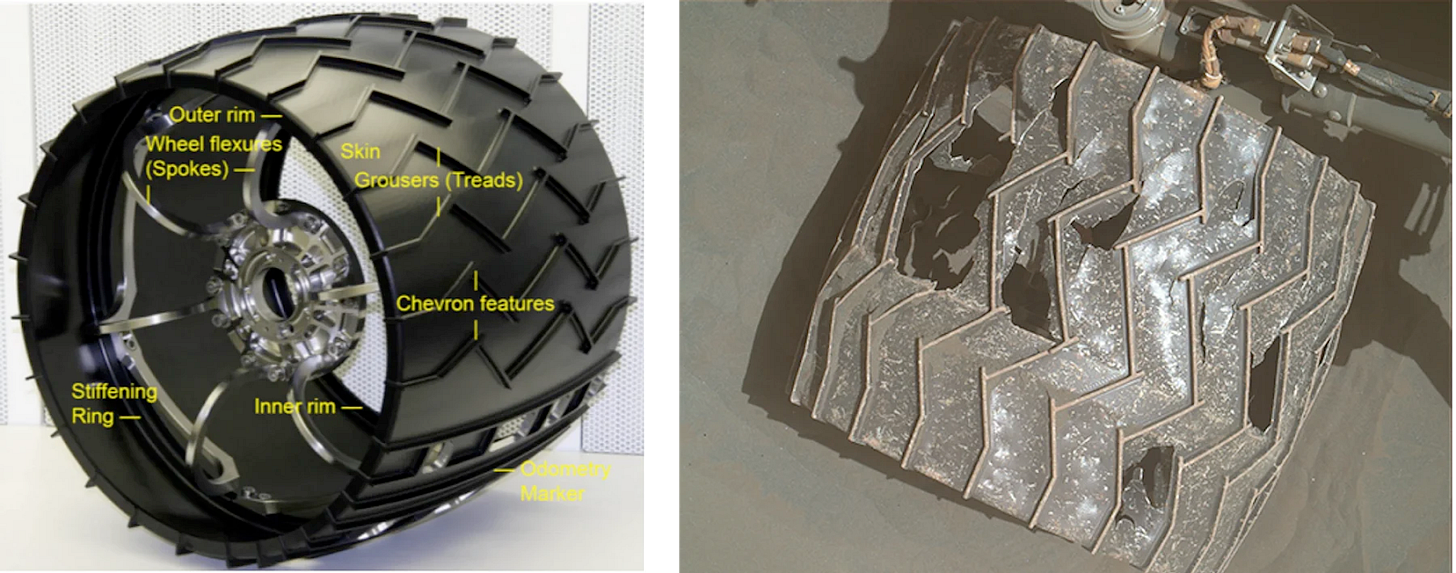
Curiosity Rover Tread Wear & US Defense Supply Chain
|No. 108|
Interesting Links 🏭
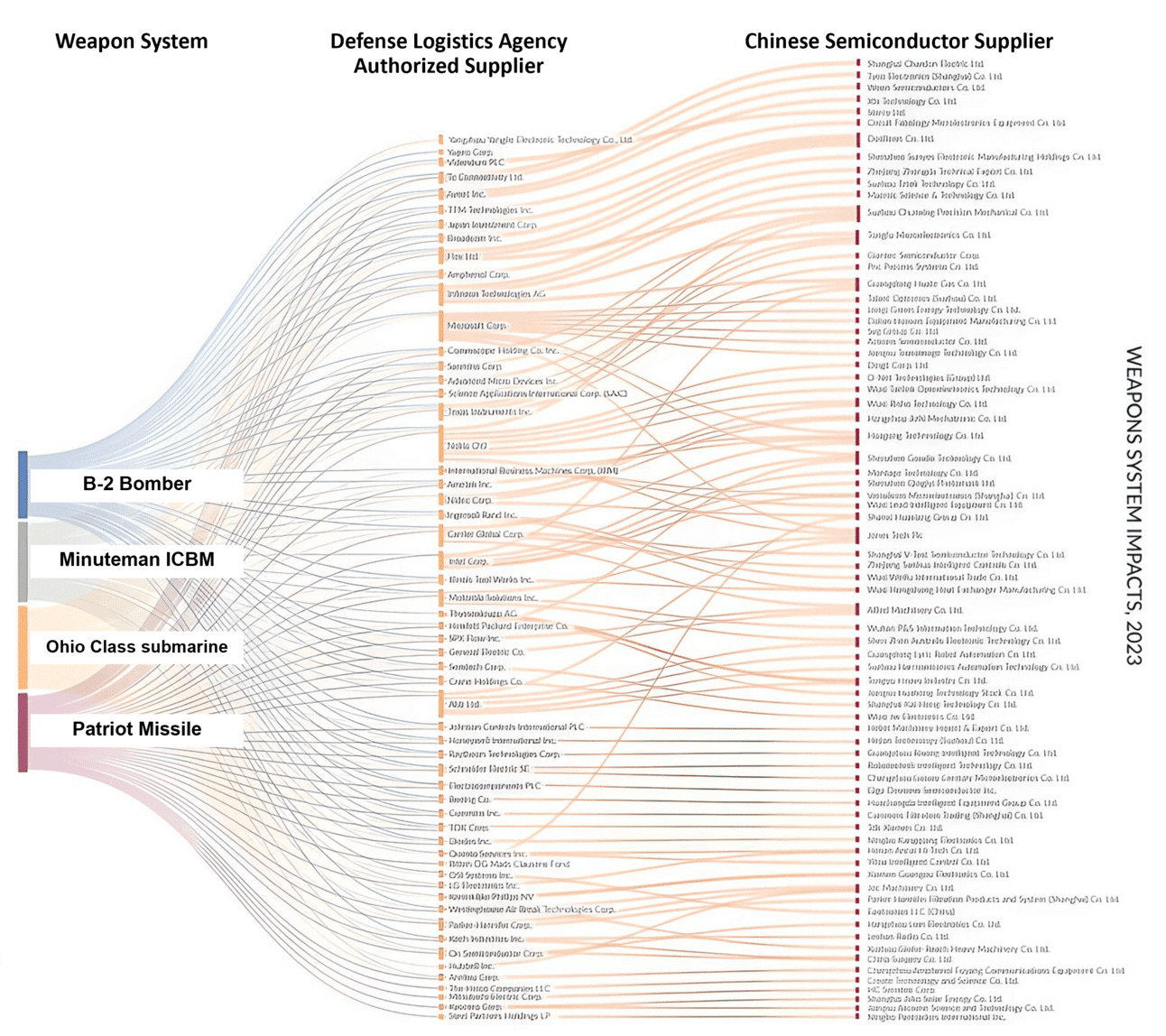
US defense products are inextricably linked to Chinese semiconductor suppliers. A recent report from Govini states that reliance on Chinese semiconductors increased 600% between 2014 and 2022. 41% of US defense systems depend on China-controlled semiconductors, with the newest aircraft carrier containing more than 5000 at-risk chips.
The world's first green ammonia plant has opened in Denmark, capable of producing 5,000 tons annually using only solar and wind energy. Green ammonia is ammonia produced using renewable energy sources and green hydrogen, primarily used for fertilizers, industrial applications, and potentially as a clean fuel. This is important because it offers a carbon-free alternative to conventional "gray" ammonia that is currently produced using fossil fuels and accounts for about 1.3% of global CO2 emissions.
South Korean researchers have developed a low-temperature refrigeration system using air as a refrigerant, achieving temperatures as low as -150°C (-238°F) without the need for harmful refrigerants or cryogenic fluids. Air is non-toxic and non-flammable, making it inherently safer than many synthetic refrigerants currently in use. This system, which operates on a reverse Brayton cycle and uses a turbo-expander, is a more cost-effective alternative for ultra-low cooling applications, such as superconducting devices and hydrogen liquefaction.
Northrop Grumman subsidiary Scaled Composites has unveiled its M437 Vanguard drone. The unmanned, stealth aircraft uniquely includes an optional cockpit for manned flight, offering greater flexibility in testing, certification, and operational use. After completion of envelope expansion, the M437 Vanguard will have a range of approximately 3,000 nautical miles and an endurance of 6 hours. The aircraft can carry up to 2,000 pounds of payload in multiple locations.
Researchers at EPFL have developed a Miniaturized Brain-Machine Interface (MiBMI) that can convert thoughts of handwriting into text with 91% accuracy, using two small chips with a total area of 8mm². This breakthrough integrates a 192-channel neural recording system with a 512-channel neural decoder on a single chip. Power consumption is just 883 uW, and with 65nm fabrication this device could become widely integrated. Full paper here.
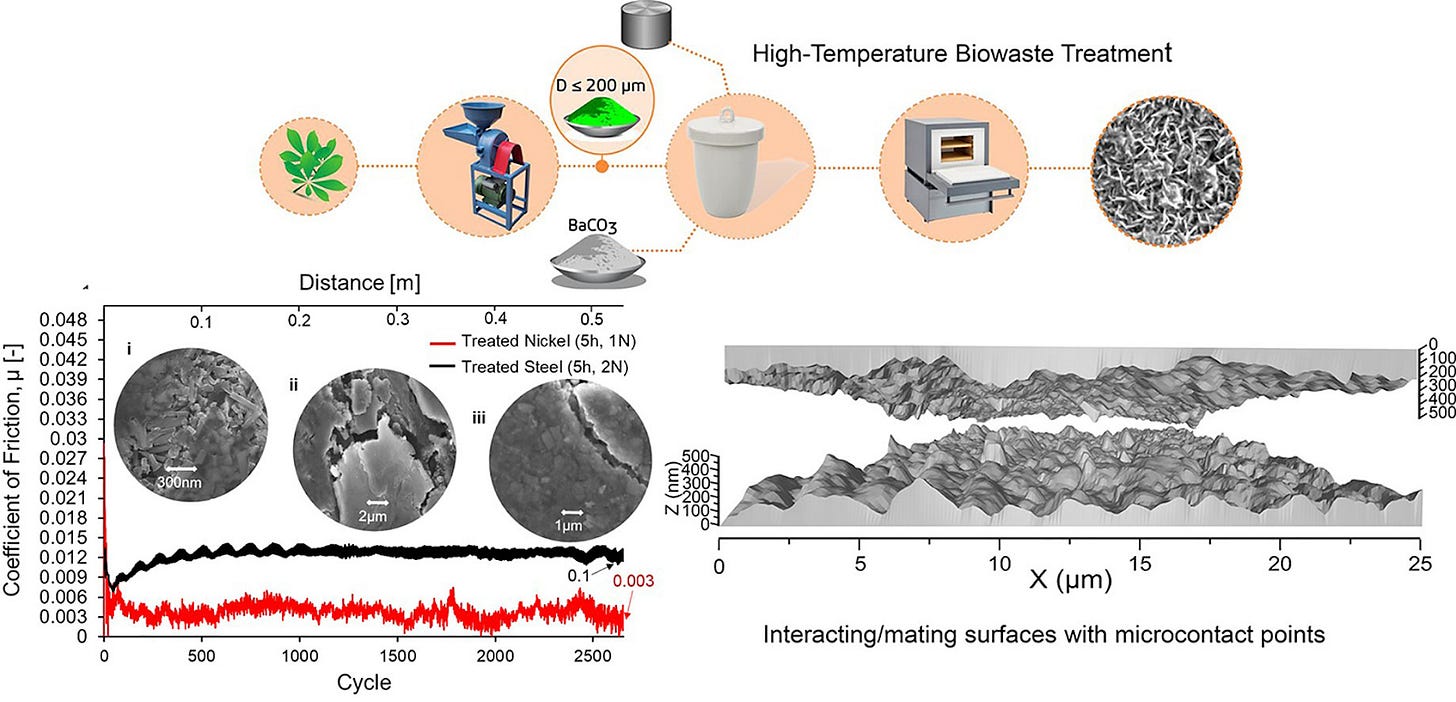
Scientists havedeveloped a coating derived from cassava plant biowaste where they attained coefficients of friction as low as ~0.003 and lubricity was sustained for more than 150,000 cycles before failure. This coating, made by depositing carbon from cassava plants onto metal surfaces, forms a graphene-like layer that fills in wear-induced grooves, resulting in nearly frictionless contact points. Tests show that this coating on steel and nickel substrates remains effective for about 150,000 cycles under normal conditions. Reducing friction is a key lever on energy consumption, where it’s estimated 30% of fuel used in automobiles is just in overcoming friction at the transmission, tires, brakes, and engine!Full paper here.
An overview of 31 new space startups backed by Y Combinator. From recent news in the vertical such as AstroForge last week to well established names such as Relativity Space and Astranis (both in the W2016 batch). YC has been an active space investor especially in recent years where space is a top 20 category in the most recent W25 batch.
Startup News 🚀
Twelve has secured $45M in debt financing to begin production of the company’s sustainable aviation fuel. The fuel will be sold to customers like Alaska Airlines, replacing kerosene jet fuel as early as next year. The synthetic fuel (tradenamed E-Jet) is made by converting CO2 into essential chemicals and materials used in fuel production. The debt package was provided by Fundamental Renewables and Sumitomo Mitsui Banking Corp.
Amidst cost-cutting measures, Intel is shutting down its global startup accelerator program, Intel Ignite. The program launched in 2019 and has supported 176 companies, will officially close in November after its ninth and final cohort. Unlike traditional venture capital or government grants, the program was structured to support startups by offering resources and guidance without directly investing money or taking ownership.
Sunswap has raised $22.7M from BGF to accelerate the rollout of its zero-emission transport refrigeration technology across the UK and Europe. The company improves the efficiency and total cost of ownership for truck-based diesel refrigeration by using solar generation and batteries to run the refrigeration system.
WATTALPS has raised a $12M Series A round to expand manufacturing capacity for the company's high performance lithium ion batteries. The company, which specializes in solutions for heavy-duty vehicles, plans to expand manufacturing at its Grenoble, France facility by eightfold.