This Week’s Highlights
- Apple’s Ingress Protection Testing 🌊
- Voyager-1 Photon Transmission ⚛
- RF Black Magic via Rotman Lenses 🔍
Interesting Links 🏭
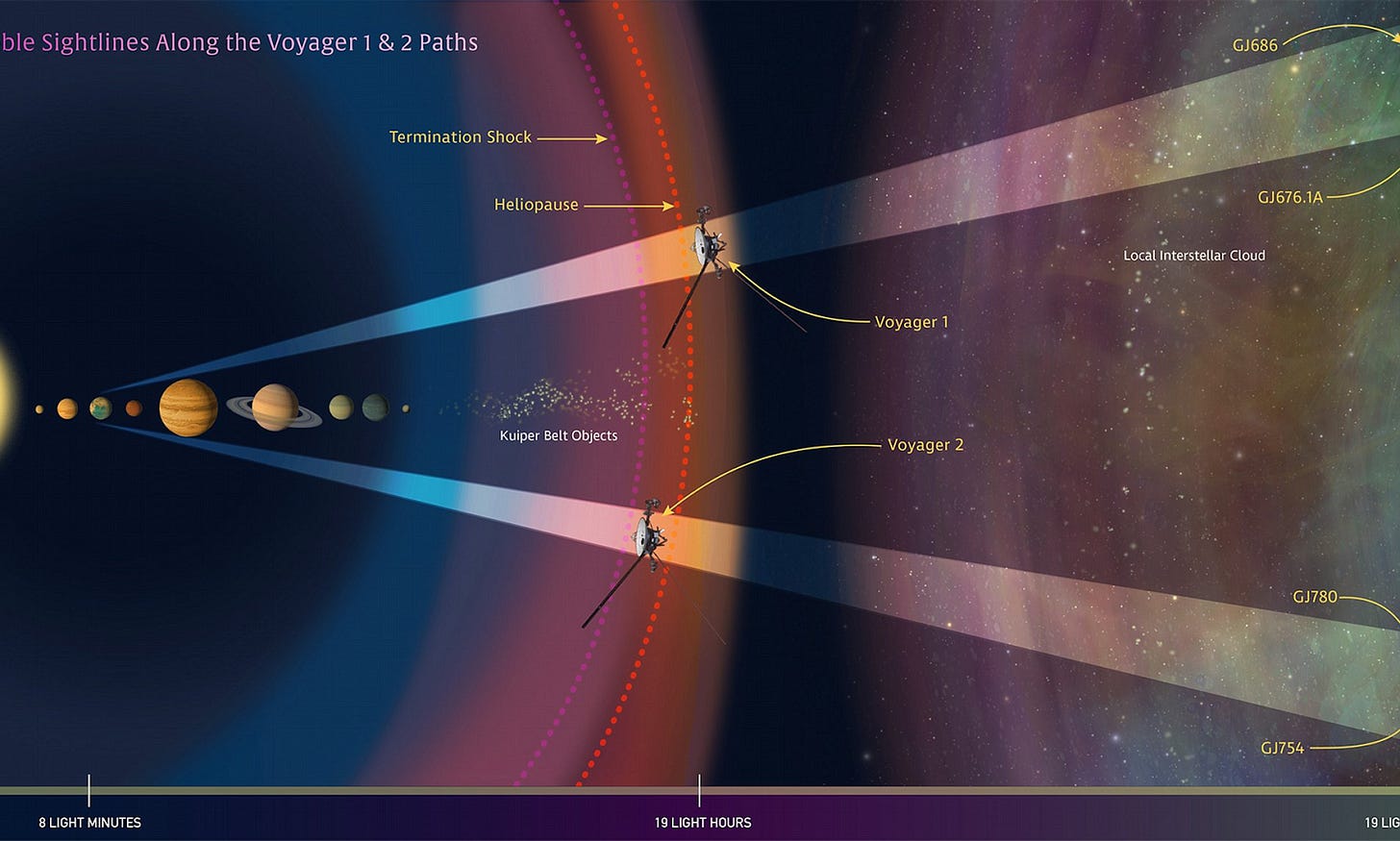
- With Voyager-1, the most distant space probe from Earth, a full light-day away, it’s interesting to wonder how many photons are currently making it back to Earth when the spacecraft transmits a bit of data. The fact that we can still receive data from Voyager 1, even with just a few hundred photons per bit, is a remarkable technological achievement thanks to advanced signal processing techniques like aperture arraying, matched filtering, and RFI mitigation.
- Calculating the transmission power at Voyager's 23.5 billion-km distance from Earth, a (massive) 70-meter dish will only collect 415 photons/bit. To put this into perspective, a single ray of sunlight hitting the Earth contains around 10^18 (a quintillion) photons per second. Even a dim LED bulb emits billions of photons per second!
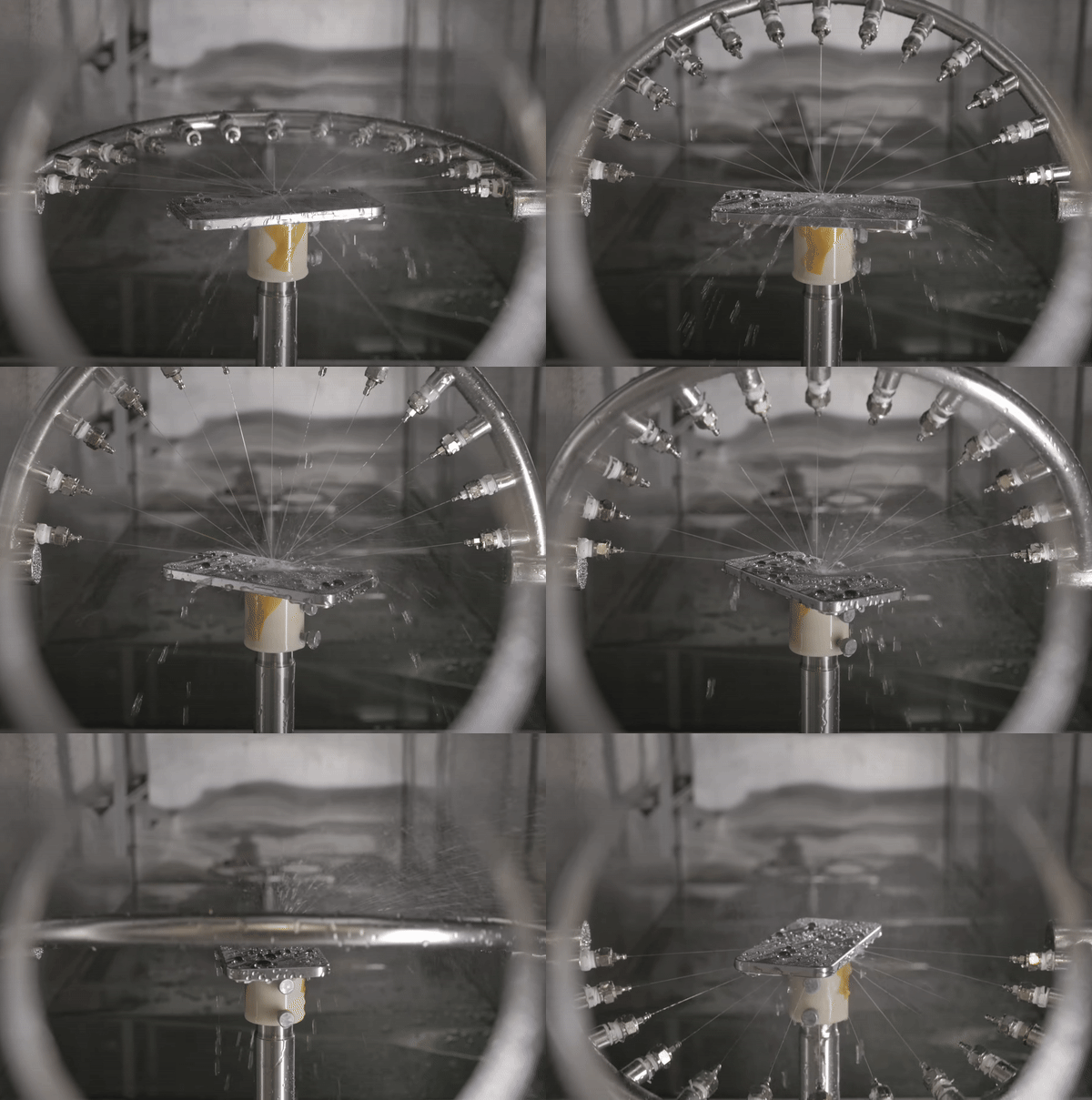
Apple recently gave a tour of their reliability testing lab to Marques Brownlee (MKBHD), showcasing common test equipment used in water ingress, drop, and vibration testing. During the tour, John Ternus, Apple's head of hardware engineering, sparked an interesting and slightly controversial discussion by suggesting that repairability and durability are on a sliding scale: a product that never fails is objectively better than one that fails but is extremely easy to repair.
- A viral animation of a Rotman lens simulation. A Rotman lens is a beam forming device which allows a beam to be formed in multiple directions without having to change the direction of the antenna. The different ports of the Rotman lens represent the different beam angles which can be transmitted and received through it. The original Rotman lens patent here.
- Quilter CEO Sergiy Nesterenko appeared on an podcast to break down the way the company uses reinforcement learning to automate PCB design. There are two key parameters for AI PCB design: combinatorics, and physics. Combinatorics is the number of components and nets that have to be connected, and physics is the signal integrity, EMC, etc of all those signals. While AI PCB design is not capable of end-to-end design today, it is an especially useful tool for iterating on design concepts like different form-factors.
- An easy to follow lecture series on the design of fixtures, jigs, cutting tools, stamping dies, as well as inspection tooling like limit gauges and inspection gauges for manufacturing. Fictiv provides a neat introduction on the topic along with common types of fixtures and jigs.
- A video overviewing the fabrication process of a large steel reactor pressure vessel. Massive ingots of steel are heated and rolled into rings before becoming welded together with a cap to form a large tank. Great techno. soundtrack and Tron-style Russian animagraphics to match!
- Detailed lecture slides on electronics manufacturing from MIT Manufacturing, covering IC through PCB fabrication and assembly. Interesting: resistors are manufactured by sputtering a thin-film resistive layer (vacuum deposition) onto a ceramic base. The resistance value is established by photolithography and wet etching/laser trimming.
Disney Imagineers designed a rocket-propelled landing system which uses water to stop a robot mid-fall with four ducted fans to control its descent. The rocket uses water as its propellant and is ejected at pressure prior to landing. Like many intriguing projects from Disney, these innovations will be used in special effects, though no immediate applications are lined up.
Startup News 🚀
- Neros has raised a $10.9M seed round from Sequoia Capital to accelerate production of their unmanned, small drone technologies. As hardware operations have grown over the last year, the company works with Cofactr to save time on supply chain issues and scale hardware operations.
- Eyebot has raised a $6M Seed round to boost product development of its self-serve vision kiosks which can provide an optical prescription in only 90 seconds. AlleyCorp and Ubiquity Ventures led with participation from Humba Ventures, Susa Ventures, Village Global, Baukunst, Ravelin and Spacecadet.
- ZeroMark has raised a $7M seed round from Ground Up Ventures and A16Z. The startup is developing a ‘fire control system’ that can be fitted to standard infantry rifles as counter-drone measures.
- Quilt, a start-up designing ductless heat pumps, launched in North America after raising a $33M Series A last month. The system is designed to be purchased as a set of heat pumps for the entire household and equipped with a suite of sensors like millimeter-wave radar for occupancy detection.
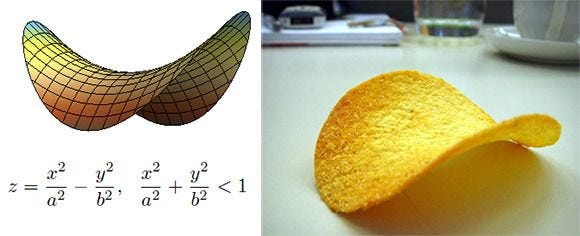
Pringles are shaped as a hyperbolic paraboloid.