Highlights this week: 🏭 semi equipment shortage, 📺 roku's founding story, and 🚀 nasa's take on pcb inspection and qc.
🔗 Last week’s most-clicked link: Reverse engineering and hacking a Model 3 keyfob.
⚡️ Analog Interview: Mihir Shah on the embedded.fm podcast!
- Elecia White and Chris White from embedded.fm interviewed Mihir (yes, same Mihir from this newsletter) last week on all things hardware, electronics manufacturing, ventures, and newsletters. Listen to the episode here.
Startup News 🚀💰:
- Terra Drone, a Japanese commercial drone services startup, raised $70 million in a Series B led by Mitsui Corporation.
- Span, a startup building smart electrical panels, raised a $90M Series B led by Fifth Wall Climate Tech along with Angeleno Group, Robert Downey Jr.'s FootPrint Coalition, Van Jones’ Obsidian Investment Partners, A/O PropTech, and all existing board members.
- Rugged Robotics, developers of a robot that prints building layouts on the floor of construction sites raised $9.4 million in a Series A led by BOLD Capital Partners.
- Ozmo, a robotic system designed to clean the sides of skyscrapers raised $6.5 million in pre-Series A funding led by Skyline Standard Holdings.
- Pixxel, which seeks to launch a constellation of satellites that will provide hyperspectral imagery of the Earth, raised $25 million in a Series A led by Radical Ventures.
- Sourceful, a startup fixed on reducing environmental impact by packaging, has raised $20 million in a Series A round led by Index Ventures.
Interesting Links 🔗:
- Chipmakers face two-year shortage of critical equipment. ASML CEO says they’re going to “ship more machines this year than last year, more machines next year than this year… but it will not be enough if we look at the demand curve. We really need to step up our capacity significantly more than 50 per cent”.
- MANGO (MAAANGO) -- the semiconductor FAANG. Bank of America has created a new grouping of popular semiconductor stocks -- Marvell, AMD, Analog Devices, Broadcom (AVGO), Nvidia, GlobalFoundries, and Onsemi.
- Roku originally started as an internal project at Netflix. Ultimately, Netflix wanted to be streamed on the Playstation, Xbox and Apple TV -- meaning they couldn’t build their own hardware and risk losing out on large streaming deals due to competitive hardware. So Roku spins out as a separate company with some key Netflix employees, and Netflix gets to own 15% of the company. That stake is worth many billions today.
- A very detailed presentation on PCB inspection and quality control from NASA, especially as it relates to failures. There is also a really great walkthrough of PCB manufacturing in general with great visuals and descriptions.
- A great list of books that serve as primers into the semiconductor industry. Including a history of Fairchild Semiconductor, the Intel Trinity, Texas Instruments, and the start of the Taiwanese and Korean semiconductor industries.
- A paper looked at construction costs for hundreds of nuclear reactors built in the US, France, Canada, Japan, German, India, and South Korea between 1960 and 2010. The paper’s findings suggest that there is no inherent cost escalation trend associated with nuclear technology, despite costs in the US spiraling out of control since the 80s. South Korea actually drove nuclear costs down, at a rate similar to that of solar.
- An EPROM, or erasable programmable read-only memory, is a type of programmable read-only memory chip that retains its data when its power supply is switched off. Once programmed, an EPROM can be erased by exposing it to strong ultraviolet light source. Here’s a story from Intel on the invention of EPROM.
- A general (yet comprehensive) intro to what investors look for in hardware startups.
- Incredible story about (ex) Apple Engineers sneaking into the facility to work on unofficial projects. "I asked my friend Greg Robbins to help me. His contract in another division at Apple had just ended, so he told his manager that he would start reporting to me. She didn't ask who I was and let him keep his office and badge. In turn, I told people that I was reporting to him. Since that left no managers in the loop, we had no meetings and could be extremely productive. We worked twelve hours a day, seven days a week."
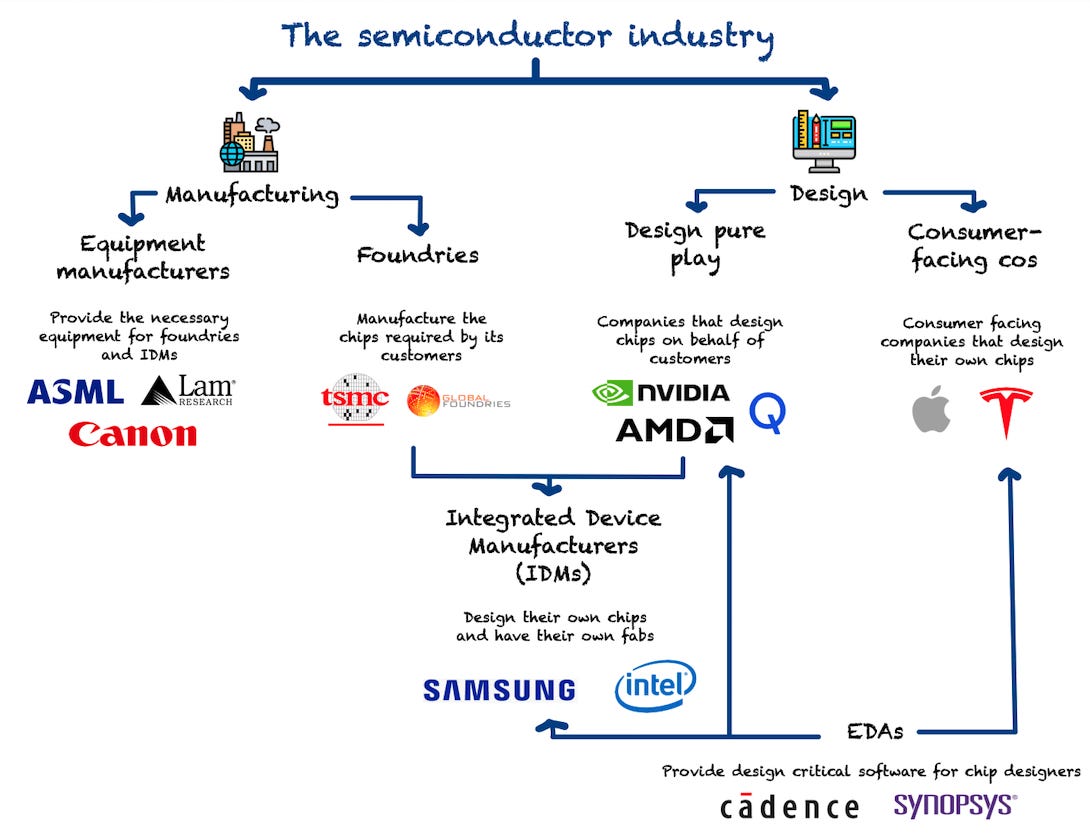
One Interesting Picture 📸: industry 🕸