Highlights this week: 🦅 airplane bird strikes, 🏭 chinese manufacturing under mao, and 🚢 building giant ships.
🔗 Last week’s most-clicked link: A compilation of application notes on troubleshooting Analog IC’s.
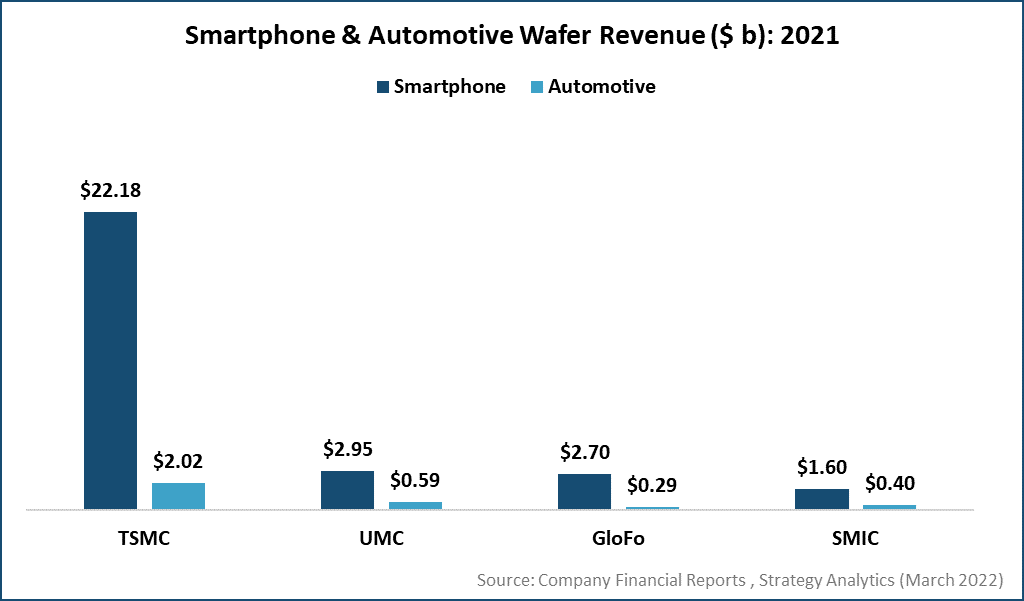
⚡️ Analog Insights: TSMC gets 11x more revenue from smartphones vs automotive.
Startup News 🚀💰:
- Bear Robotics, a company filling the restaurant staff shortage with autonomous waiters, has raised $81 million in a Series B led by IMM.
- Solo AVT, a company seeking to build autonomous heavy freight vehicles, raised $7 million in a seed round led by Trucks VC.
- Clockwork.io, a startup synchronizing clocks across multiple networks within 5 nanoseconds, raised $21 million in a Series A round led by NEA.
- Gama, developer of new solar sail technology, has raised $2 million in funding from the French Public Investment Bank
- Planetary Technologies, the Canadian company that harvests carbon directly from the ocean while producing a fuel source, has raised $3.3 million in a seed round led by Innovacorp.
Interesting Links 🔗:
- The repair cost to airframes after hitting birds totals over $1.2 billion annually in the United States alone. Various testing facilities will launch real or simulated birds at airframe parts at speeds up to 400 mph. Here’s a video of a bird actually striking a large jetliner.
- Really great paper from 3M on how touchscreens work. Projected capacitive technologies detect touch by measuring the capacitance at each addressable electrode. When a finger or a conductive stylus approaches an electrode, it disturbs the electromagnetic field and alters the capacitance. This change in capacitance can be measured by the electronics and then converted into X,Y locations that the system can use to detect touch.
- Reverse engineering and hacking a Tesla Model 3 keyfob, which includes a TI CC2640R2F microcontroller. The twitter post has some more visuals. Post originally seen on the latest episode of The Amp Hour.
- PCB cross-sectional examination reveals the solder grain structure, intermetallic boundary conditions between the solder and a conductor pad, cracks and voids, and even the composition of a tiny inclusion. Study of these details helps to quickly determine the root cause of a failure.
- A detailed study on Chinese manufacturing in the Mao era (1950’s, 60’s). During the embryonic stage of communist centralization, the productivity of manufacturing sectors more than doubled. However, this manufacturing growth is largely obtained by the exploitation from agriculture and low compensation for workers.
- Scientists at the University of Copenhagen have trained an algorithm to decode pig grunt using AI. The goal is to distinguish calls linked to positive emotions from those linked to negative emotions. The researchers found that there were more high-pitched squeals in negative situations. Meanwhile, low-pitched grunts and barks were heard across the board, regardless of their predicament.
- In 1910, the airship (~blimp) America made the first attempt in history to cross the Atlantic Ocean by air. The airship was 228 feet in length and 52 feet in diameter, with a volume of 345,000 cubic feet; the envelope was three layers of fabric — silk and cotton — bonded together with a rubber emulsion to prevent gas leakage. Really great breakdown of the actual structure and some of the engineering decisions made in this writeup.
- Writeup on how giant ships are built (specifically, the Matsonia). Today, more than 90 percent of global shipbuilding takes place in just three countries: China, South Korea and Japan. The last 124 remaining American shipyards contribute more than $37 billion in annual economic output and support about 400,000 jobs.
- Deep in the wikipedia archives is this pretty comprehensive list of industrial disasters.
One Interesting Picture 📸: true