Designing Snap Fit Joints & Terahertz Imaging Tech
|No. 130|
Interesting Links 🏭
The definitive guide on designing snap fit joints for plastics. All types of snap joints have the same operating principle: a protruding part of one component deflects briefly during joining and catches in an undercut for the mating component. Four common types of snap fits with design guidelines listed in the guide:
Cantilever: A simple beam that deflects to secure components, carries a flexural load
U-Shaped: Variation of the cantilever snap fit, used commonly in battery door compartments for remote
Torsion: Rotational motion to secure parts together where shear stresses carry the load. Used in hinged lids for containers
Annular: A ring-shaped snap fit, used for circular parts like pen caps or container lids
A simple cantilever snap fit joint
A few months ago we covered the basics of investment casting, a process that uses a wax pattern coated in a ceramic shell to produce metal parts by pouring molten metal into the hardened ceramic mold (re: issue #86). It’s a personal favorite because it produces parts with exceptional surface finish and strength. The catch though is the tooling costs for wax patterns—usually injection molded—are high which makes it impractical for prototyping or low volume component production. We recently came across two startups that are exploring rapid prototyping of wax patterns for investment casting. Full paper on manufacturing developments here.
Rangeview is a supplier of aerospace grade investment cast parts, where they’ve stated to have cut 8 steps out of the traditionally 18 step process (i.e. 3D printing molds).
Fabri recently raised a $5M seed round to leverage additive manufacturing methods for mold production in investment casting.
Simplified Investment Casting Process
Brett Adcock, the founder of Archer Aviation and Figure, recently shared an update on his latest venture: Cover. Cover is an AI-driven security company that uses advanced terahertz imaging to detect concealed weapons through clothing and bags. The company is currently developing a scanner (~310 to 350 GHz, stand-off distance of 4 meters) for public venues like schools. The idea itself is actually licensed intellectual property from NASA JPL related to high frequency terahertz imaging. In 2011, NASA researchers explored "Terahertz Radar Imaging for Standoff Personnel Screening," using 675 GHz radar to achieve high-resolution 3D spatial imaging and generate digital maps of targets. Back then, the authors conceded that realizing a useful THz imaging radar from lab settings would require substantial work. It’s cool to see a company taking early research and pushing it toward practical real-world applications. You can find the authors' presentation here.
EPFL released a video of an interesting avian inspired drone this week. RAVEN is a small avian drone that has actuated legs it can use to jump into flight. The jumping motion builds on the principle of avian-inspired design, using more degrees of freedom and a higher range of motion to gain an advantage over typical drones. In this case, the advantage is more specific to takeoff and landing. Rotor wing drones displace too much air to meet all takeoff scenarios, and fixed wing drones need too much space unless they are launched. RAVEN weighs just 620g, can clear a 12 cm horizontal gap, and stand on a 26cm box by jumping.
Topology of the actuated legs on an avian inspired drone
Some planned downtime:
A timelapse of the portable 1MW microreactor Kaleidos from Radiant Nuclear.
AMP Robotics has raised a $91M Series D to scale their fully automated smart sortation facilities. Founded in 2014, their first products were a series of high-speed robotic sorting arms built OTS by ABB and Omron used to identify and sort recyclable materials on conveyor belts. Now, the company is building fully automated facilities targeting municipal scale waste, with pilots in Virginia and Colorado. The round was led by Congruent Ventures.
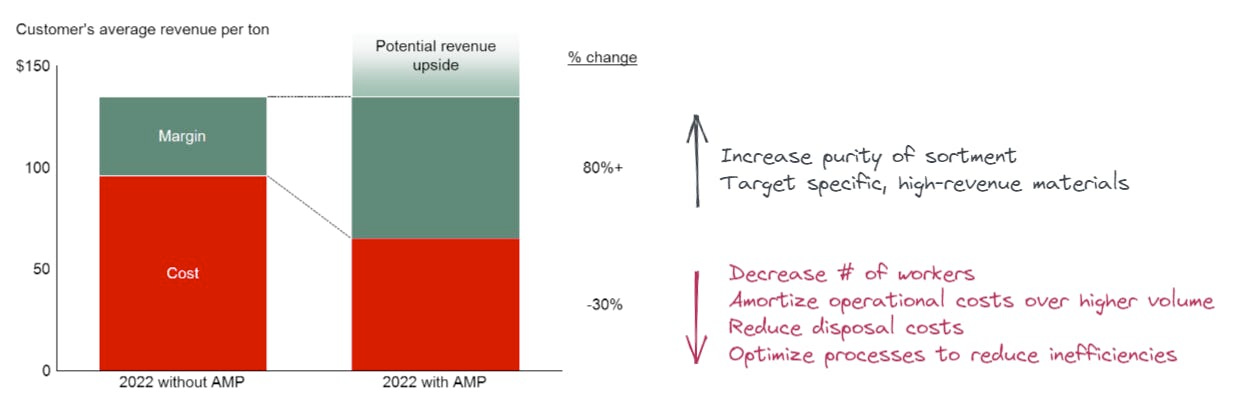
Insights on their business model from a case study: AMP Robotics' sorting arm ($300K/unit in 2020 or leased at $6K monthly) was stated to be capable of replacing 4 workers, picking 80+ items/min vs. 30-40 items/min from manual labor. With labor costs at ~$30-50K annually, facilities could theoretically save ~$120-200K/year. Recycling laborers have a ~50% turnover every three months.
Average Revenue Per Ton
Four Growers has raised a $9M Series A round to scale production of its flagship GR-100 robotic harvester. The system uses a robotic arm calibrated with eight stereo cameras that can detect ripeness of individual produce and provide real-time yield forecasting. To start, Four Growers is targeting greenhouse tomatoes which account for 50% of all fresh tomatoes consumed in the US, with plans to expand to more produce like peppers and cucumbers. The round was led by Bassett Capital.
Tractian, an Atlanta-based manufacturing AI company, raised $120M in a Series C funding round to scale its predictive maintenance platform and expand its industrial AI solutions. The company's core offering is an "Industrial Copilot" that combines hardware sensors, maintenance software, and AI for a data-driven approach to predictive maintenance. The round was led by Sapphire Ventures with participation from General Catalyst among others.
SpinLaunch, known for its kinetic launch system, has raised $11.5 million in a funding round according to a regulatory filing. The company last raised a Series B round in 2022, and comes after a reported attempt earlier this year to raise $350M at a $2B valuation! We haven’t heard much from the company for a few years, but recently they released a video detailing how they spun a Portland State CubeSat using OTS hardware to 10,000 Gs. The company was last conducting suborbital tests using a smaller version of their orbital accelerator in New Mexico.