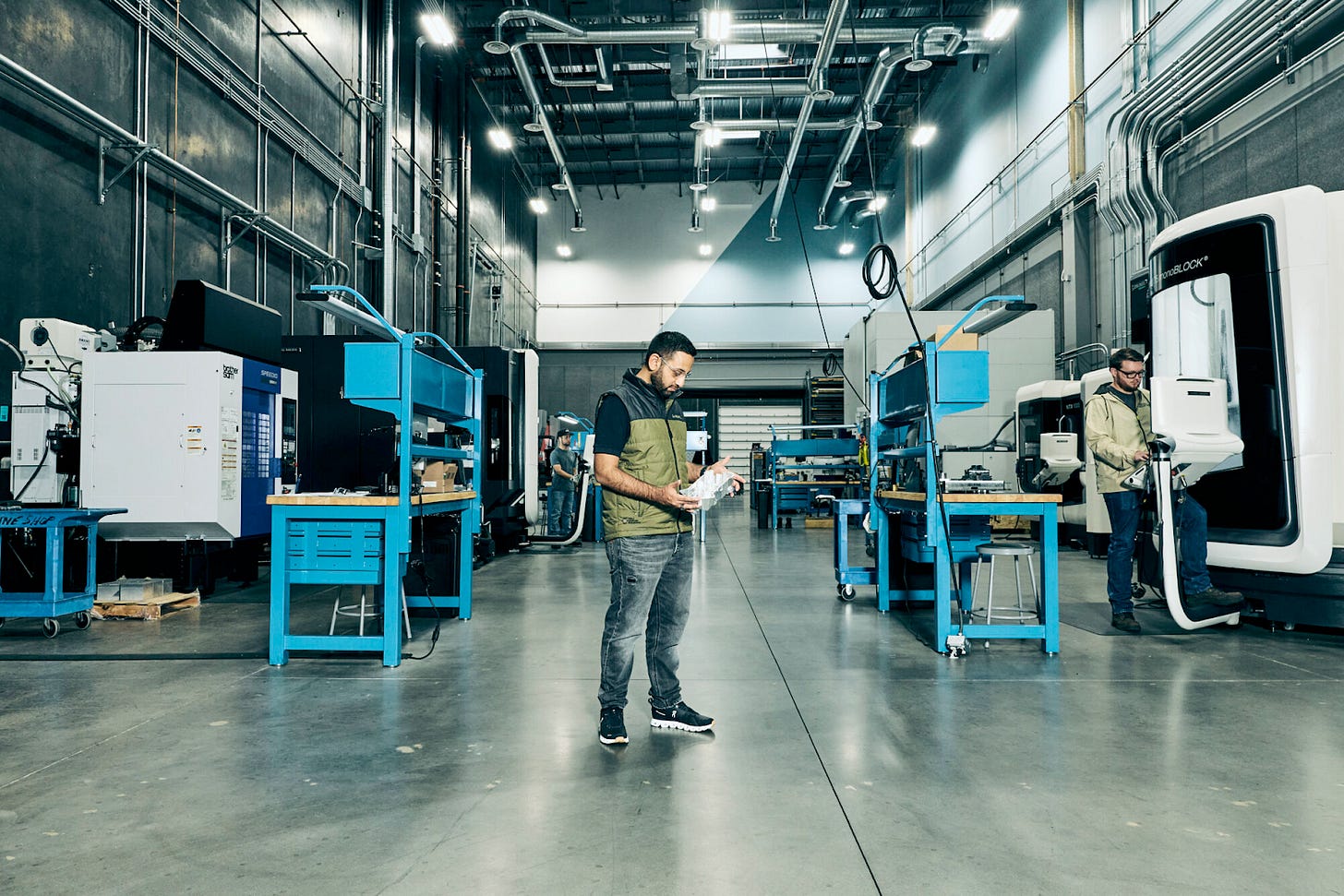
In his retrospective The Amusement Park for Engineers, Adnan Esmail (Anduril employee #20) pulls back the curtain on how a handful of engineers in a Costa Mesa warehouse managed to run circles around a trillion-dollar defense ecosystem. What comes through most clearly is how much of Anduril’s zero-to-one was driven by a small set of shared mental models around how to pick the right problems, move faster than incumbents with 100× the headcount, and design organizations that bias toward action instead of process. We recommend a deep dive into the full article, but a few ideas are broadly useful for anyone building under asymmetric constraints:
Hardware Pareto: Identify the 20% of features that deliver 80% of the deployable value.
Treat speed as a weapon: if the schedule is long, it’s wrong; if it’s tight, it’s right.
Optimize for mission, not requirements. Understand what the customer needs to accomplish, and be willing to question what they think they want if it doesn’t serve the mission.
Keep technical credibility at the core. Great engineers follow leaders they respect technically; orgs fail when engineering judgment is replaced by process.
Design for deployment. Build systems that can be mass-produced and widely deployed, not bespoke programs optimized for contracts and maintenance.
Get to a minimum viable demonstrator, something that creates end-to-end capability, then iterate ruthlessly. By then I understood that Anduril would be the fastest, most intense environment I’d ever experienced. Each product therefore had to embody our chief working principles: move fast with purpose; question everything; take ownership; keep it simple; hold high standards; and design with deployment in mind.
The author, now co-founder of Physical Intelligence and Emeritus SVP Engineering at Anduril.
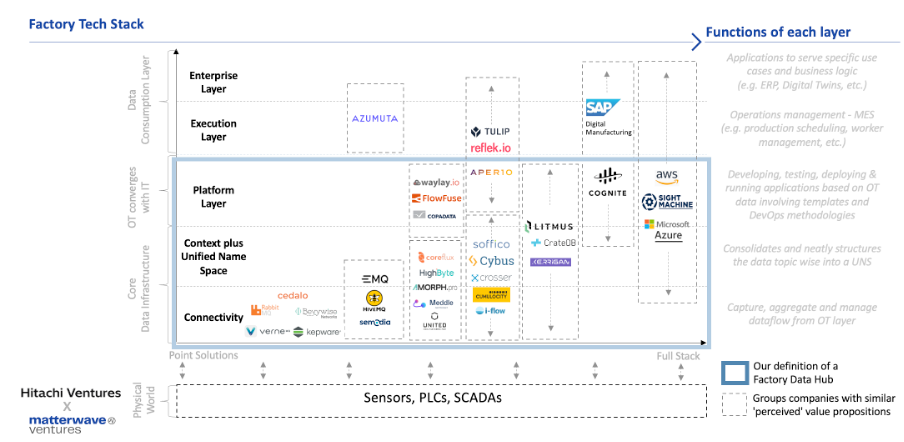
In this piece, Matterwave Ventures explores why the 70-year-old promise of the self-optimizing factory remains unfulfilled. While the current hype cycle focuses on “Agentic AI,” the real barrier is the unglamorous reality of Interoperability—most factories remain a “complex patchwork” of isolated legacy systems with no common language. The most practical insight here is organizational rather than technical: high-value infrastructure projects often die due to the IT/OT disconnect. (In layman’s terms, the people who run the software and the people who run the machines rarely own the problem together.) Information technology (IT) runs systems like ERP, cloud platforms, and analytics; operational technology (OT) runs systems like PLCs, robots, and production lines, each evolving to solve different problems under different constraints.
TL;DR: Interoperability is the real bottleneck, and the disconnect between corporate IT and plant-level OT stalls the deployment of foundational data layers needed for smart factories.
For early career engineers, it’s often unclear how to chart a long-term course or imagine the twists and turns of a full career in deep tech. In Ken Bogursky’s reflection, he outlines his path from an entry-level mechanical design engineer in 2000 to Director of Quality & Hardware Testing at ASML today. Lots of interesting threads here around what career progression looks like in a highly advanced field — transitioning from an individual contributor to leadership, how to mentor the next gen of engineers, and how in his specific experience, management progression didn’t mean moving away from engineering so much as moving up the stack. Now instead of a dozen hands, I had a hundred.
From a reader (thanks, Sanjiv!): an overview of ASML’s EUV machine, often described as the most complex machine on Earth. The Zeiss mirrors that focus and steer the EUV beam are among the smoothest surfaces ever manufactured.
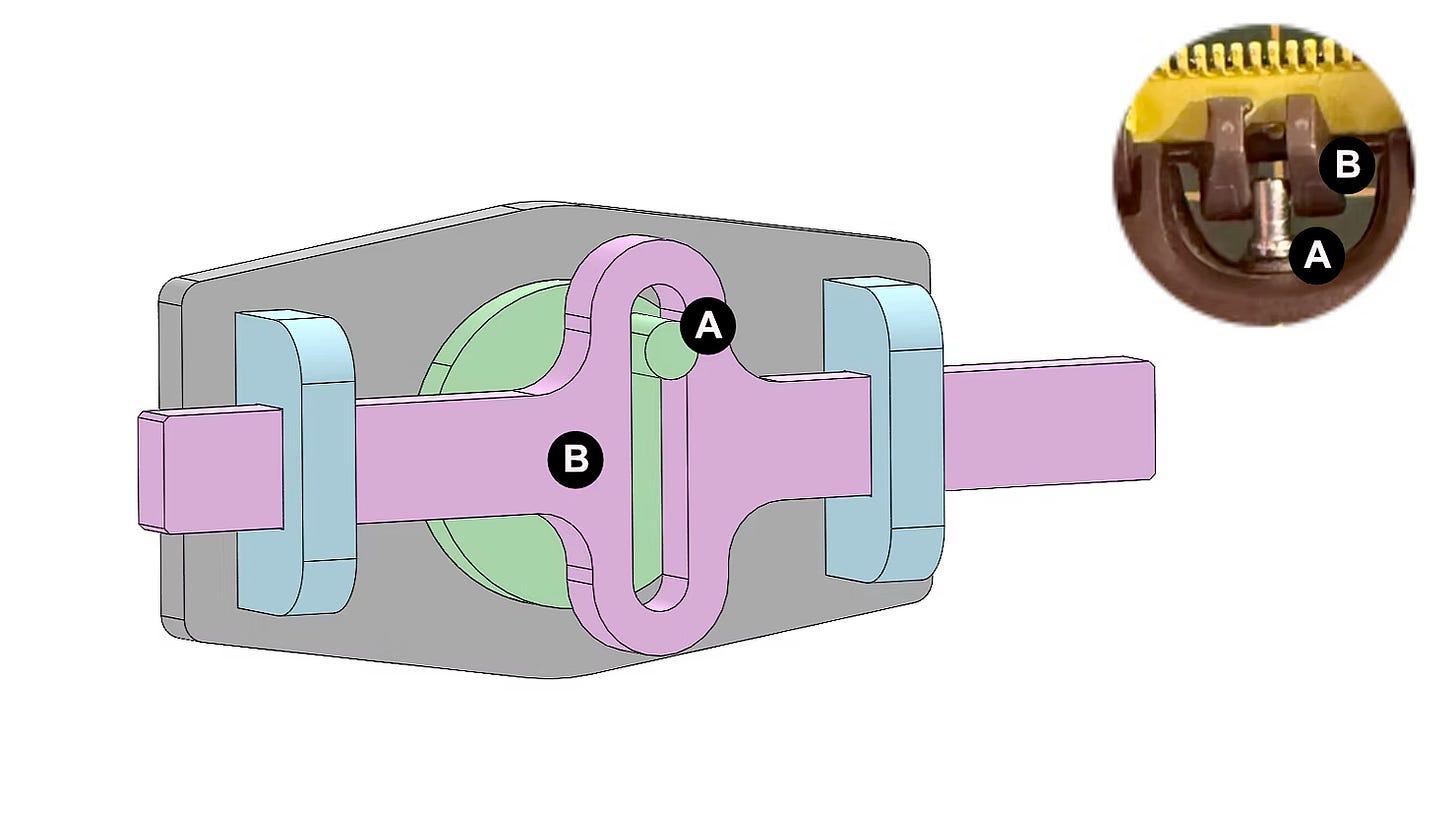
Zaid McAllister’s teardown of the Philips OneBlade 360 is really a lesson in reconstructing design intent, not just taking parts apart for cataloging. He goes component by component, framing the teardown around core mechanisms, how they’re implemented, and the manufacturing decisions behind them. One of the more interesting discoveries is the tooling complexity required for the injection-molded crank frame. The design leans into thin, delicate features to eliminate fasteners and secondary operations downstream. Not recommended, but you can also learn a lot by burning plastic and paying attention to how it behaves. In this case, it points to a glass-filled nylon chosen for the crank frame.
The OneBlade uses a Scotch-yoke mechanism to turn the motor’s rotary output into the oscillating blade motion used for cutting.
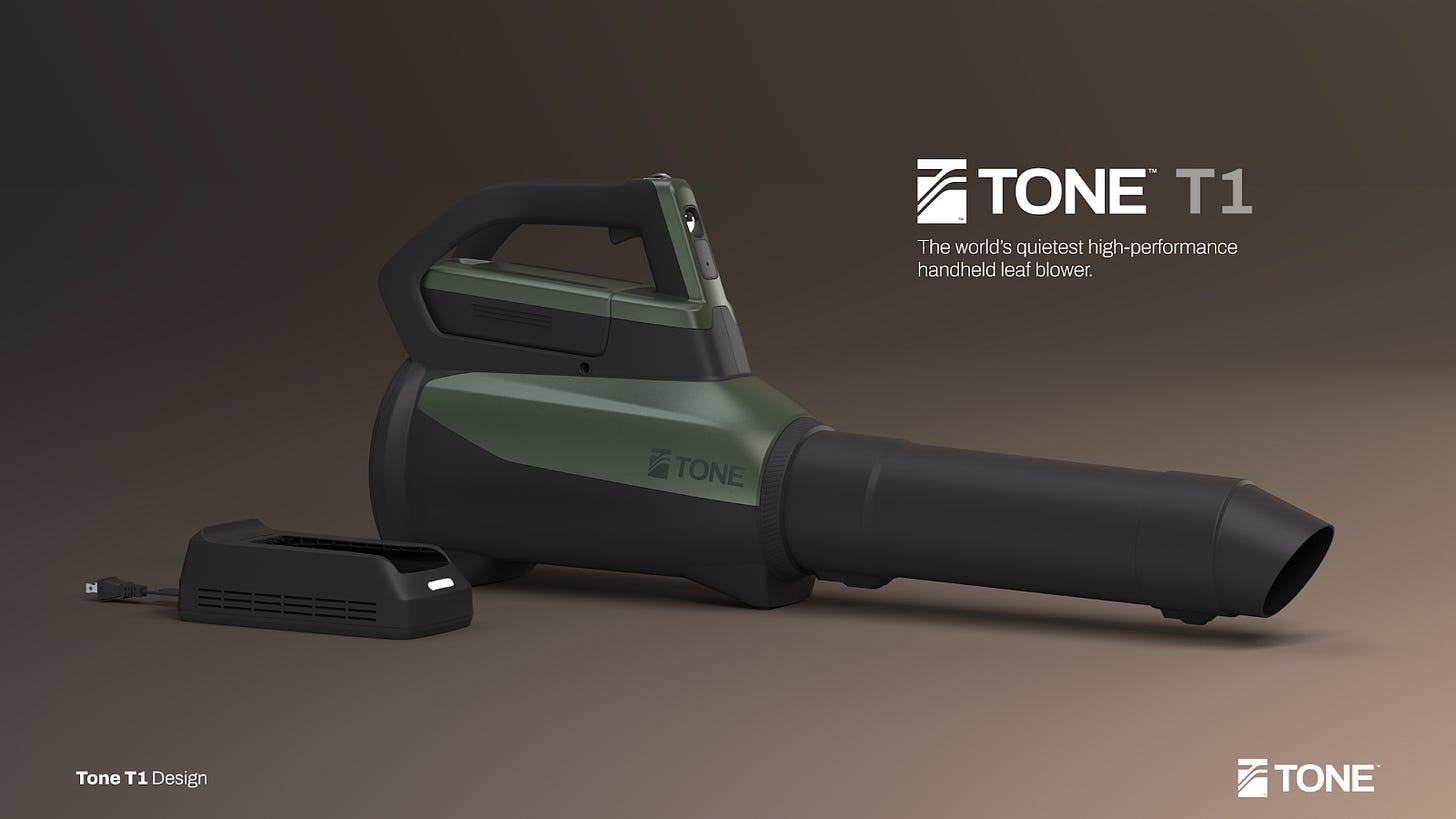
If you’ve ever wanted a leaf blower sporting a cutting-edge electric jet engine, get ready. Whisper Aero has published shipping timelines for the Tone 1, a low-noise electric leaf blower built on the same propulsion architecture they’ve been developing for aviation and defense. It’s essentially a repackaging of their electric jet platform into a consumer tool, tuned for low acoustic signature and efficiency rather than thrust. This strategy echoes a sentiment from Dan Wang’s Breakneck regarding the agility of Chinese manufacturing. Wang notes that while American companies debate “core competence,” Chinese companies decide that “making money is their core competence” - producing whatever the market demands. It’s the same mindset that saw giants like Foxconn, BYD, and JD.com retool production lines overnight to make masks, or Huawei expand from telecom infrastructure into smartphones and electric vehicles.
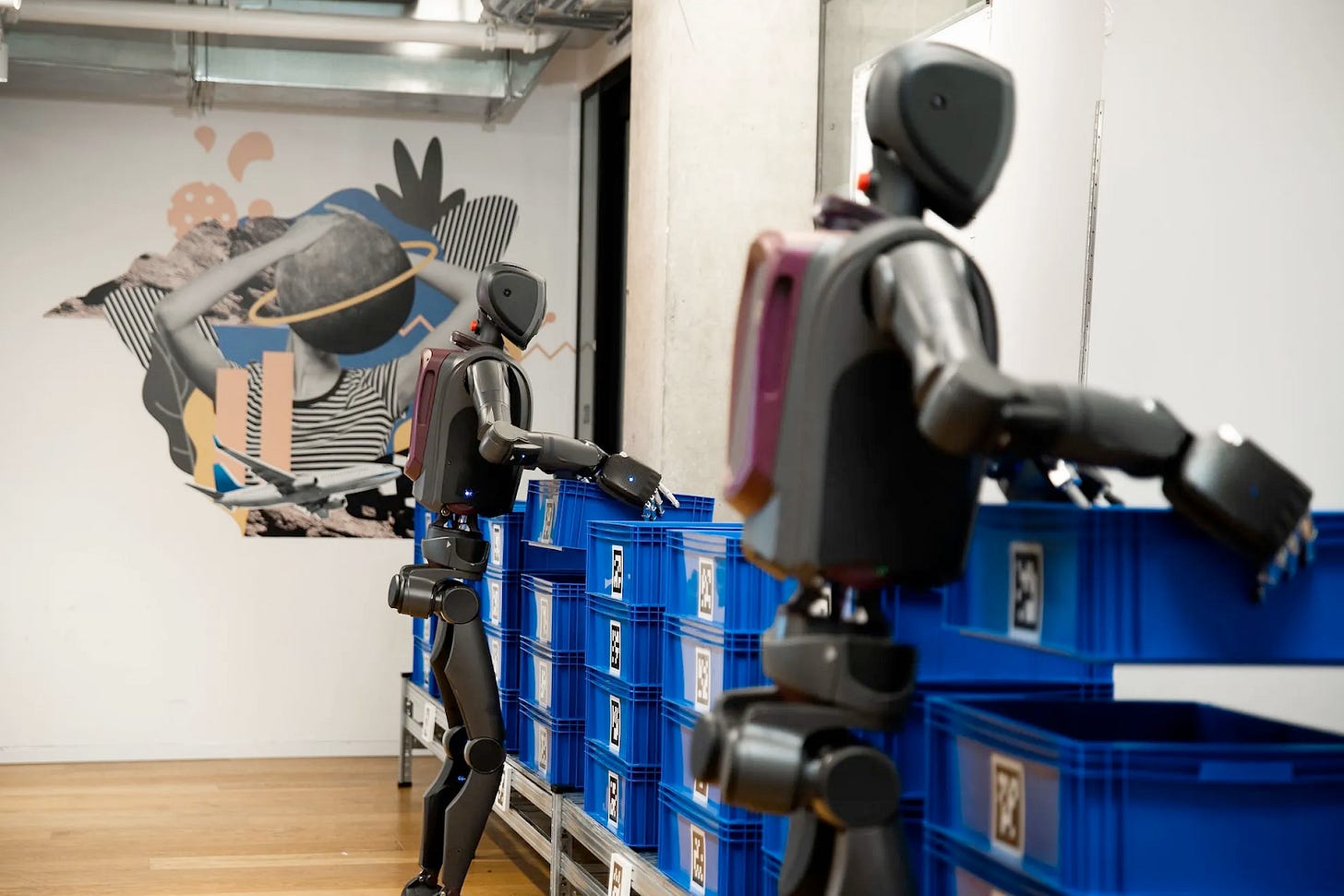
Mobileye has acquired Mentee Robotics for ~$900M, extending its autonomy stack beyond cars into humanoid robotics. Mobileye built its business supplying automakers with vision processors and software that handle perception, mapping, and driving policy for ADAS and hands-off highway autonomy, shipping at automotive scale across 10M+ vehicles. The deal effectively uses Mobileye’s mature ADAS revenue base (a $24.5B contracted pipeline over the next eight years) to fund a longer-horizon bet that the same autonomy stack that works for cars can generalize to physical AI beyond vehicles.
John Ternus, Apple’s head of hardware engineering, could be next in line to replace Tim Cook as CEO if he steps aside. Ternus, who joined Apple in 2001, is known for his attention to detail and knowledge of Apple’s vast supply network. Apple began accelerating planning for Cook’s succession last year after Cook told senior leaders he would like to reduce his workload. Cook will likely become the chairman of Apple’s board should he step down as CEO.
Hadrian raised an expanded Series C extension at a $1.6B valuation led by T. Rowe Price, with participation from Altimeter, D1, StepStone, Founders Fund, Lux, a16z, Construct Capital, and others. The company is building vertically-integrated, high-throughput U.S. factories for aerospace, defense, and critical infrastructure under its “Factories as a Service” model. The capital will fund factory expansion, workforce training, and further deployment of automation, AI tooling, and real-time manufacturing software.
Cambium raised a $100M Series B round to scale its AI-driven advanced materials platform for aerospace and defense. The company designs new monomers, polymers, and composite systems in-house, including thermal protection resins that cut carbon-carbon fabrication times for hypersonic components by up to 80%. Cambium is positioning itself as a foundational materials supplier for hypersonics, missile defense, directed energy, and next-generation aircraft. The round was led by 8VC.