

Interesting Links 🏭
- Booking a satellite launch has gotten absurdly simple, where SpaceX now sells smallsat rideshares like airline tickets on the Falcon 9. A 50 kg payload to orbit starts at $325k, with extra mass at $6.5k/kg and missions running every four months to sun-synchronous orbit (a common path for Earth-imaging satellites), with other options available in LEO and polar orbits. The checkout flow also doubles as a primer on how rideshare payloads work: a mounting plate (the standardized base a satellite bolts to) sets the weight limit and bolt pattern, a separation system provides the spring-loaded mechanism that deploys the satellite into orbit, adapters or extended electrical hookups accommodate non-standard designs, and fueling is booked if the spacecraft carries propellant.
- For anyone curious (or with the budget), the Rideshare Payload User’s Guide covers everything from interfaces, separation hardware, flight environments, and verification.

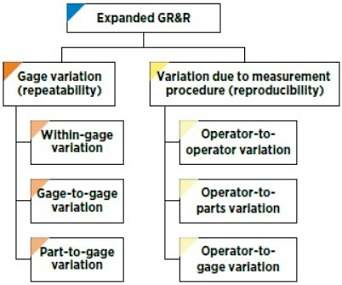
- At some point if you go deep enough into metrology, you end up measuring the measuring tool itself. Gage R&R (Repeatability & Reproducibility) is a method used in metrology to quantify how much of the variation in data comes from the measurement system itself (the gage, the operator, or the process) rather than from the parts. Repeatability captures the spread when the same operator measures the same part multiple times; reproducibility captures the spread across operators. A standard GR&R study looks at part and operator effects, while expanded versions layer in extra variables like different gages, labs, or locations. The results are graded against simple thresholds: less than 10% error is excellent, 10–30% might be tolerable depending on context, and above 30% means the measurement system is masking the signal.
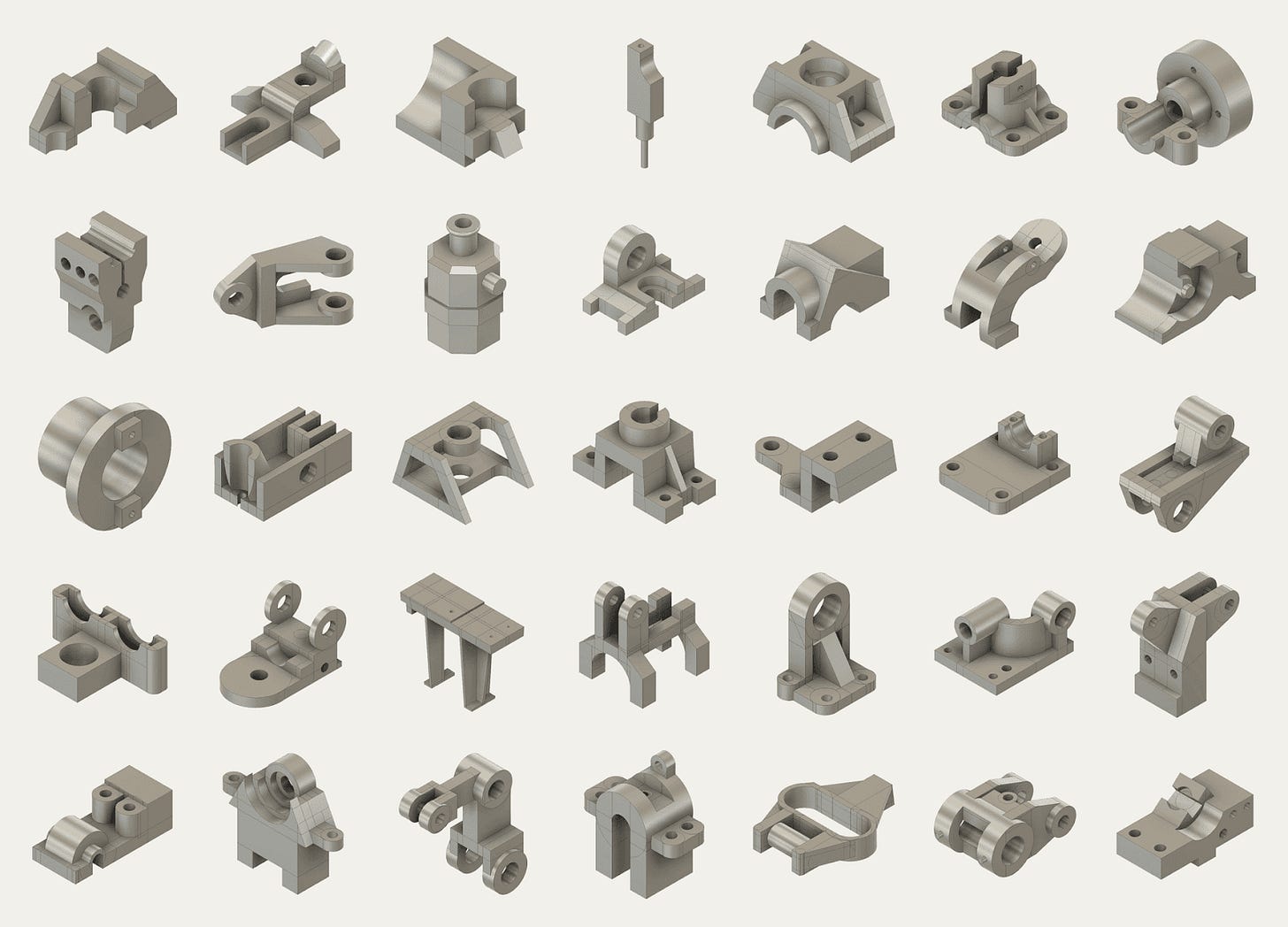
- Spectral Labs recently released a research preview of SGS-1, a foundation model that generates parametric 3D geometry from images or meshes. Given an image or a 3D mesh, SGS-1 can generate CAD B-Rep parts in STEP format…outputs are accurate and can be edited easily in traditional CAD software. It’s also live on Hugging Face as a research preview (we tried it with mixed results), but maybe that’s the point: AI gets the design 50-75% of the way there, and the human in the loop does the rest.
- A convection toaster oven, with a bit of creative hacking, also just happens to be a good stand-in for a hobbyist reflow oven. In SMT assembly (components are soldered directly onto pads), reflow soldering runs a PCB through a controlled temperature profile—preheat, soak, reflow, and cool—so solder paste melts, flux cleans the pads, and surface tension pulls components into alignment. For prototypes and low-volume builds, SMT parts are often hand-placed, while in production they’re automated by high-speed pick-and-place machines before passing through long multi-zone conveyor ovens. See this close-up shot of reflow of a chip component.
- One of the hardest problems in visual inspection is that defects are rare, so manufacturers actually generate synthetic variants from a few real images to train models. A reader of this newsletter recently showed us how diffusion models can spin up labeled defect variations from a small sample of ten images (e.g. edge cases for weld defects, micro-cracks in castings). Bosch recently applied the same strategy at their Hildesheim plant for stator production, generating synthetic fault images for weld-defects used to train motor inspection models before real defects existed. Also see this primer on types of machine visions used in inspection.
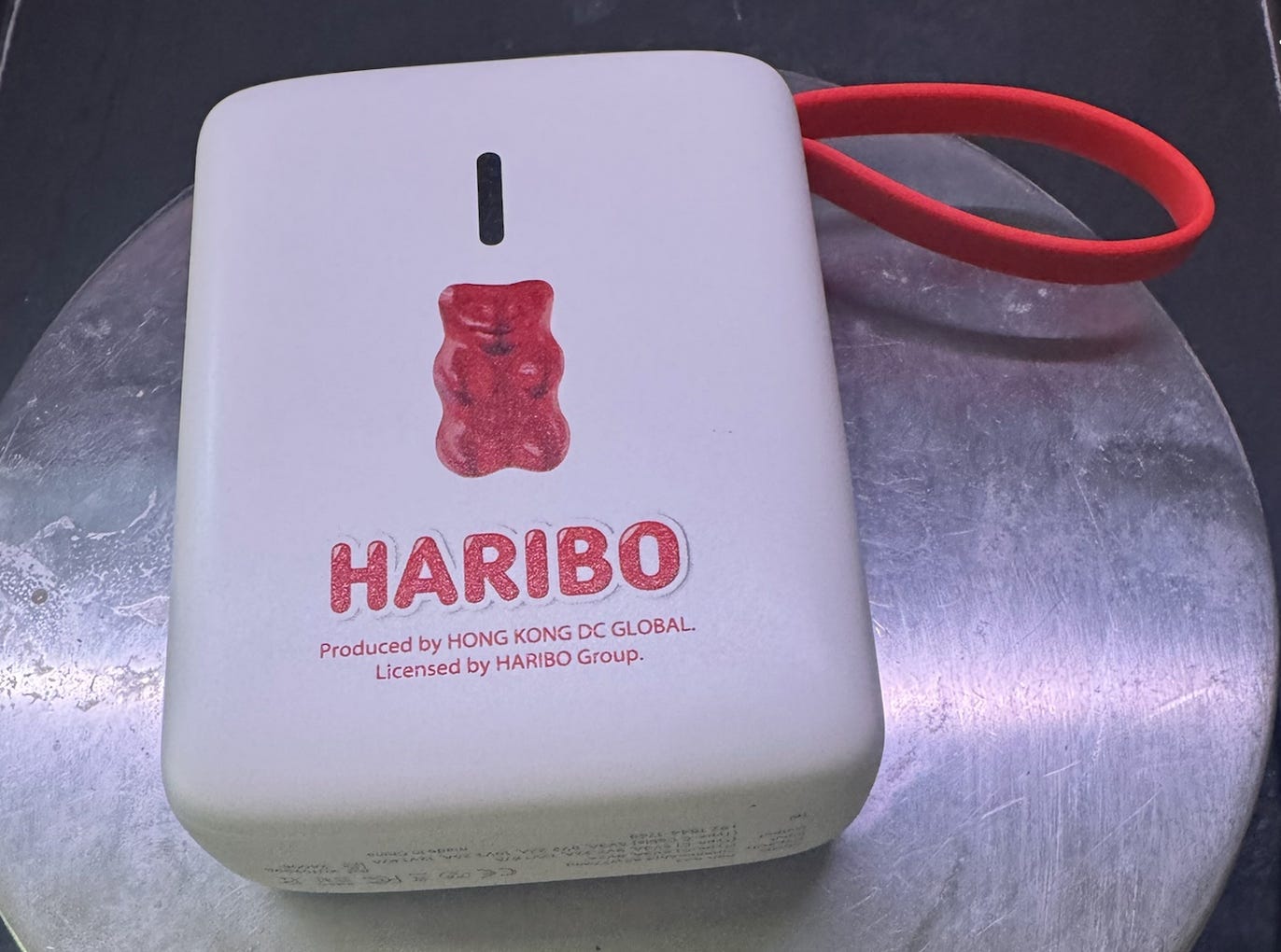
- One fun link to close out the week: Haribo (yes, the gummy bear company) sells a 20,000 mAh battery bank made by Hong Kong DC Global. Not a gimmick—reviews are actually quite positive.
- A couple upcoming events on the horizon:
- We’re running it back with another SF Hardware & Manufacturing Happy Hour in November (11/13). Last time drew 150+ engineers and founders over free food, drinks, and good shop talk. Register here!
- Our friend Aaron is putting on PDX in Phoenix, a conference with hands-on training in CAD, GD&T, DFM, and metrology. Use code HFYI50 for a discount on registration.
Startup Spotlight: Hestus, Autocomplete for CAD
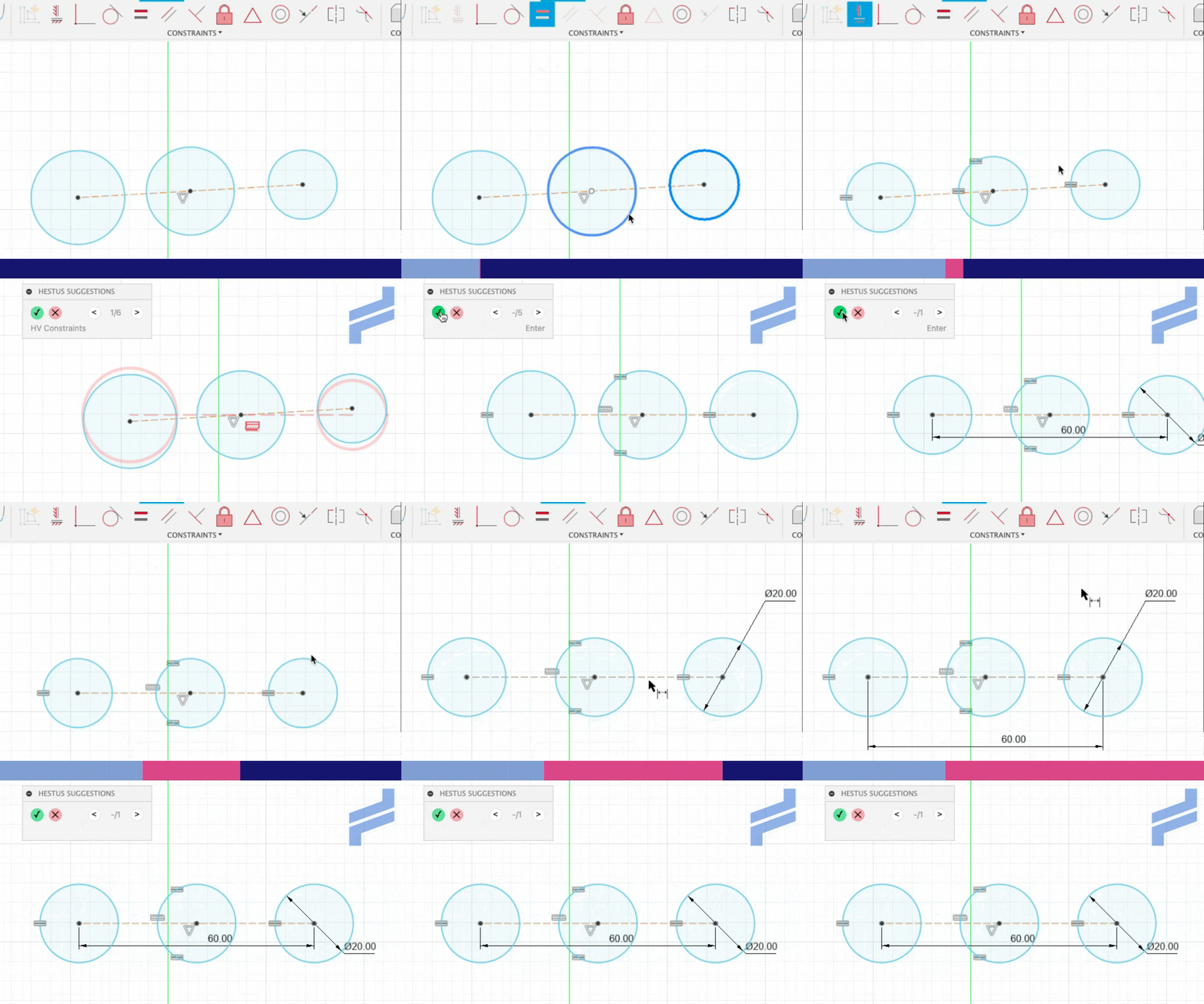
Hestus is an AI copilot for Autodesk Fusion that eliminates the most tedious parts of your workflow. Instead of manually applying dozens of obvious sketch constraints or dimensions, Hestus proactively suggests them for you — cutting down digital housekeeping so you can focus on the complex problems you actually care about. Hestus proposes the most relevant suggestions to your CAD in real-time like:
- Constraints: proposes geometric constraints automatically.
- Generative geometry: suggests useful sketch elements like centerlines and mirrors.
- Dimensions: fills in missing dimensions with a single click.
See it in action and try Sketch Helper for free at hestus.co 👇
Startup News 🚀
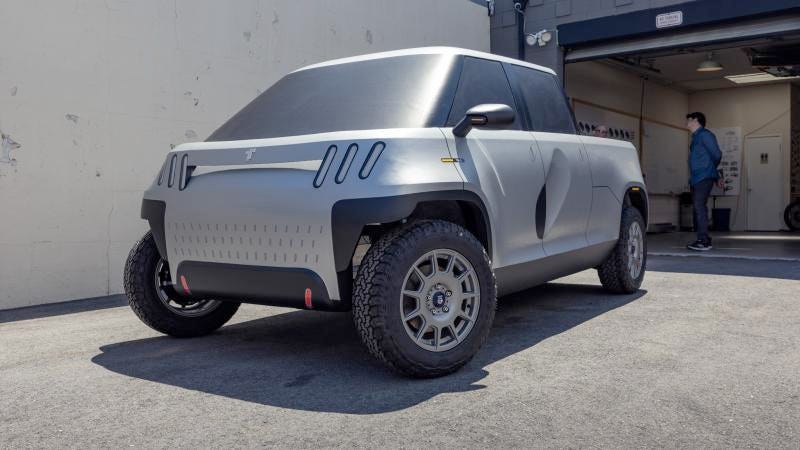
- Telo raised $20M in Series A funding to develop its compact electric truck, the MT1, designed for dense urban environments. Unlike traditional EV startups chasing mass-market scale, Telo is targeting unit profitability early with a current target of ~5,000 builds per year. The small electric truck seats five, carries a five-foot bed, and promises ~350 miles of range from a 106 kWh pack with first deliveries planned for 2026. Investors include Yves Béhar, Tesla co-founder Marc Tarpenning (board member), and Salesforce CEO Marc Benioff.
- NOX Metals raised $4.6M in a pre-seed round as a Detroit-based startup focused on redefining American metal supply chains. The startup provides certified aluminum and tool steels with DFARS compliance, software-based quoting, and end-to-end order tracking. The company was a recent member of YC’s Summer 2025 batch.
- Niron Magnetics broke ground on a 190k sqft manufacturing facility in Sartell, Minnesota, for producing rare-earth-free iron nitride permanent magnets. The plant will enable a new domestic supply chain using abundant materials for high-performance applications in data center cooling, automotive motors, robotics, and defense with a 1,500t annual capacity starting in early 2027. Stellantis Ventures, the investment arm of the automotive manufacturer, last led funding in Niron in 2023.
- Morse Micro raised $59M to scale production of its Wi-Fi HaLow silicon solutions for long-range, power-efficient IoT connectivity. The funding will drive the launch of next-generation reference designs like HaLowLink 2 and support mass production with OEMs to enable scalable, secure networks in industrial and consumer applications. MegaChips led the funding.
- Corintis raised $24M in Series A funding to advance its in-chip microfluidic cooling platform for data centers and AI hardware. The technology integrates liquid channels directly with chips to remove heat more efficiently—up to 10x better than conventional methods—enabling higher-performance systems with improved board-level thermal management. The round was led by BlueYard Capital, with Intel’s Lip-Bu Tan joining the board.