

👋 Happy Saturday! This week’s highlights include field notes from factory visits across the United States, how to reverse hack a smart scale and dump its firmware, and a chart that visualizes just how crowded Earth’s orbit has become.
Interesting Chart: Space Debris, by the Numbers

As satellite launches hit new highs each year, Earth’s orbit is filling with both active hardware and long-lived debris. From the European Space Agency (ESA) in their annual Space Environment Report:
- Roughly 40,000 objects are currently tracked in orbit, with around ~11,000 as active payloads. The remainder consists of defunct satellites, spent rocket stages, and mission-related debris.
- The true debris count is estimated to be far higher:
- 54,000 objects >10 cm including active payloads
- 1.2M objects between 1–10 cm
- 130M objects between 1 mm–1 cm; most too small to track, but still capable of damaging spacecraft.

Interesting Video: ‘Lockpicking’ for Electronics
Smart scales like the Wyze that can estimate body fat along with other health metrics use bioimpedance to send a small current through your body. A Bluetooth SoC (in this case, a Chipsea CST92F25) handles the sensing and syncs the data to your phone.
This teardown walks through how to extract firmware from the chip using a common hardware hacking method called Serial Wire Debug (SWD), an ARM interface that lets you pause the CPU and read memory directly from the chip.
The process:
- Translate the datasheet to identify the SWDIO (data) and SWCLK (clock) pins
- Connect a SEGGER J-Link, a USB debug probe that interfaces with the chip over SWD
- Hook up power, ground, reset, and debug lines to the J-Link
- Dump flash and SRAM using a custom script triggered right after boot
- Load binaries into IDA Pro, assign base addresses, and start analyzing user data in memory
Technically, if you find someone with this scale, you could dump their height, weight, age, and ‘athlete type’ setting.
Interesting Article: Takeaways from 28 Factory Visits
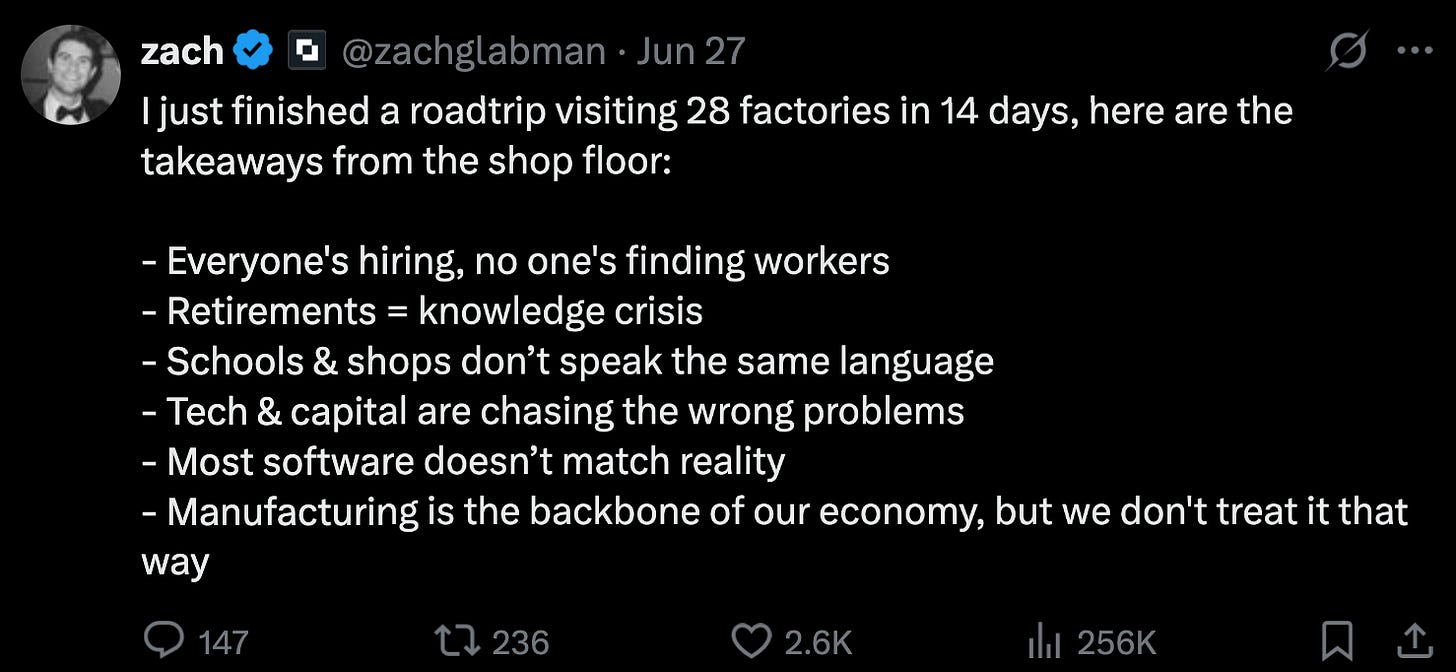
Field notes from Zach, who recently spent two weeks on the road visiting 28 factories across the U.S., from small job shops to advanced aerospace suppliers.
One section we found particularly revealing was on the question of what kind of work machine shops are actually able to pursue:
“Commercial manufacturing gets crushed by overseas competition, so the only profitable path left is chasing aerospace and defense work that China can’t legally touch due to ITAR restrictions. New $150B investment into defense and military technology doesn’t quite incentivize people to invest elsewhere, either.”
Startup Spotlight: CoLab launches AutoReview
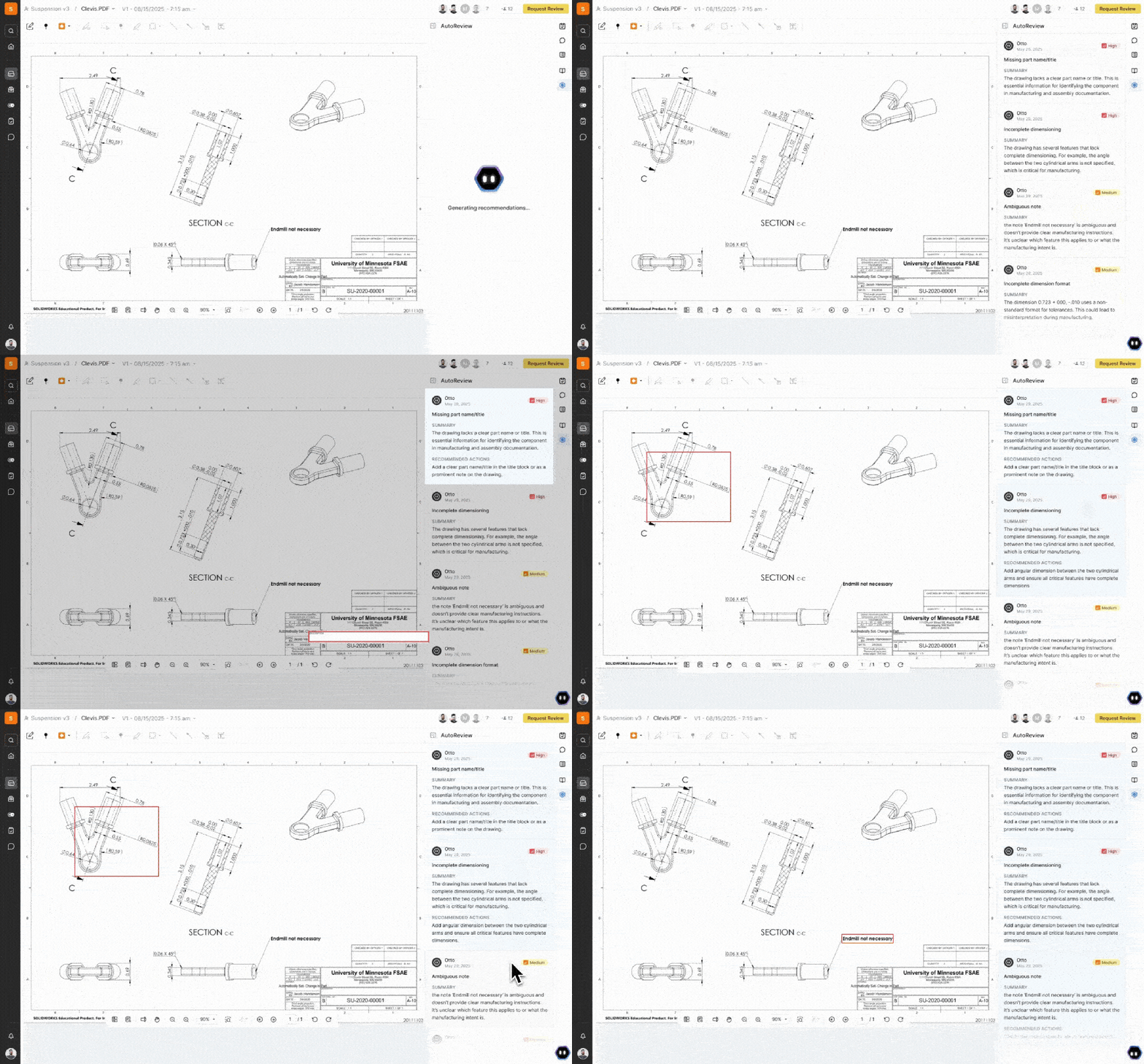
CoLab just launched AutoReview, an AI-powered tool that scans drawings and 3D CAD files to automatically generate design comments and markups. Here’s what it can find:
- Drawing errors (ambiguous notes, missing dimensions)
- DFM optimizations based on best practices in machining, sheet metal, injection molding, and more
- Non-conformance with your company’s design standards and guidelines
- Conflicts with lessons learned on past programs
CoLab estimates AutoReview can reduce drawing review time by 30-40%, saving 2,500+ engineering hours for a complex NPD program. Learn more here.
Manufacturing & Startup News
More leftovers from our weekly research:
- MP Materials signed a $500M supply agreement with Apple to deliver rare earth magnets made entirely from recycled materials, starting in 2027. The deal includes a new recycling line at its Mountain Pass facility and will support hundreds of millions of devices.
- Pure Lithium is investing $46M to relocate to Chicago and establish prototyping and manufacturing facilities for lithium metal batteries, targeting EVs, drones, grid storage, and defense applications.
- Droneforge raised $2.5M in pre-seed funding to build AI models, datasets, and deployment tools for autonomous drones. Its Nimbus SDK is designed to support hardware-agnostic use in early-stage and agricultural applications.
- Sthyr raised $1M in seed funding to develop mechanically rechargeable zinc-air batteries for long-duration energy storage.
- CisLunar Industries raised $1M in seed funding to scale production of power processing units for high-power space applications like Hall-effect thrusters, aiming for tens of units per month.
- Synopsys officially completed its acquisition of Ansys 18 months after the first public announcement. Synopsys is best known for its suite of EDA tools used to design and verify semiconductors, while Ansys is known for its simulation software for modeling physical systems.