

Interesting Links 🏭
- An interactive map of every U.S. manufacturing megaproject over $1B, tracking where semiconductors, EVs, batteries, and renewables are being built. Altogether, 46 megaprojects are underway across the country, representing $560B in total investment and 165,000+ expected jobs. Some interesting observations:
- Arizona leads in capital expenditure at $185B, driven by TSMC and Intel. New York follows with Micron’s $100B megafab.
- EV & battery projects outnumber semiconductor fabs 18 to 8. Georgia, North Carolina, and Michigan are key hubs.
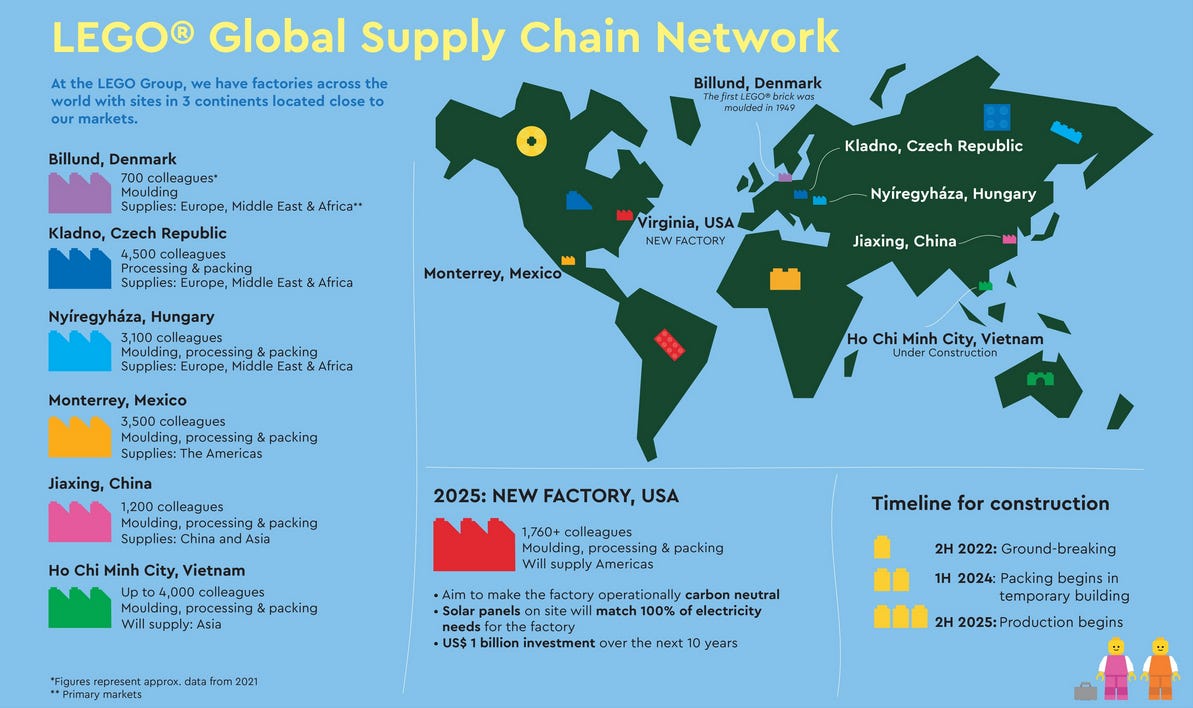
- LEGO is building a $1B production factory in Virginia and recently announced a second facility for distribution in the same state; both are targeting completion in 2027.
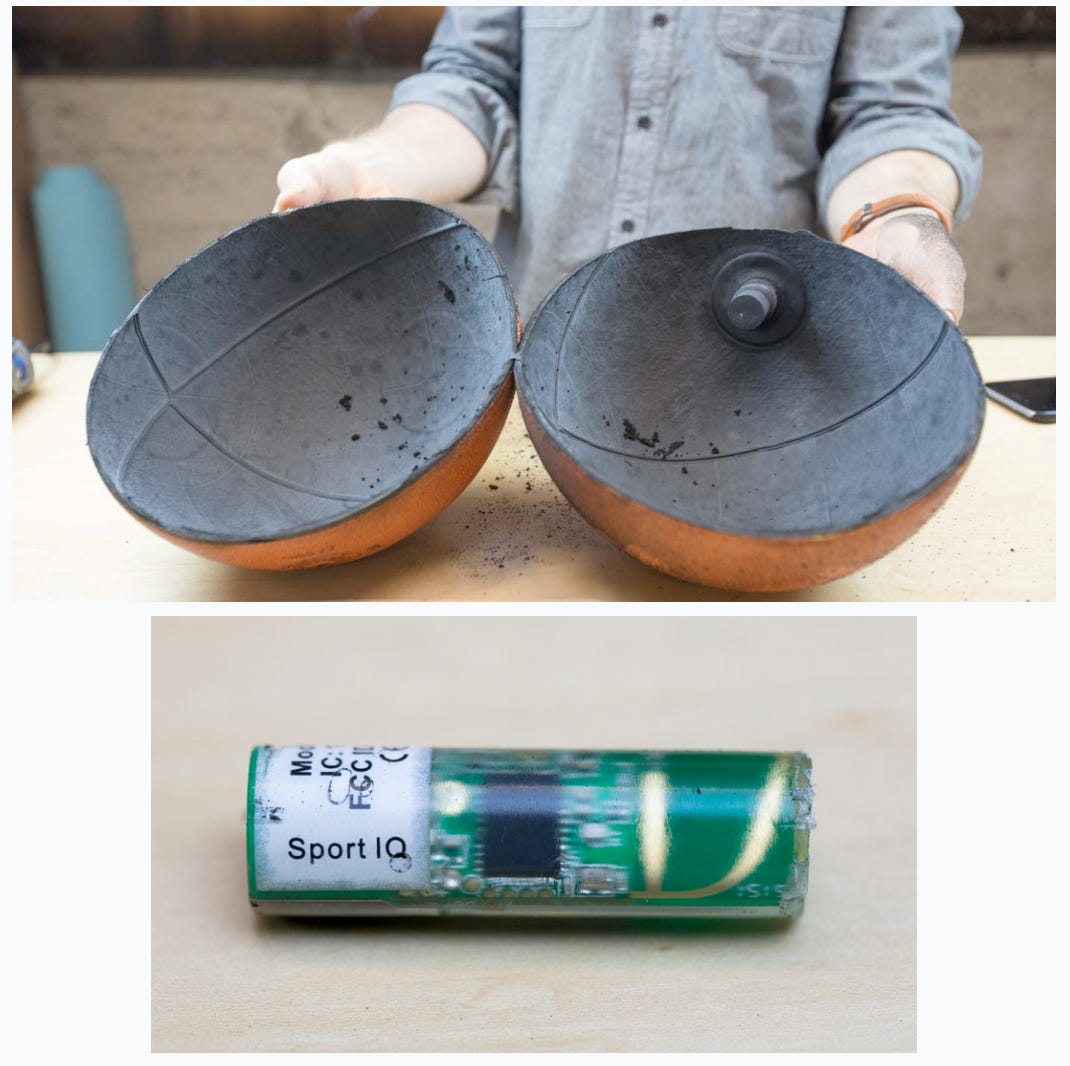
- A closer look inside a $200 ‘smart’ basketball designed during the height of the connected fitness gold rush. At its core, it’s a simple Bluetooth Low Energy (BLE) + accelerometer combo that sends motion data from the ball to a smartphone app, and powered by a non-rechargeable 3V coin cell (~2-year lifespan) encased in a protective epoxy shell within a rubber tube. The main chip is a TI CC2541 priced around $1.50 at volume today, and estimated BOM cost was likely $20–30 after packaging. This BLE + accelerometer pairing was common in low-power wearables at the time as BLE stays in deep sleep to conserve power, and the accelerometer acts as the trigger: spike the sensor and the chip wakes up. Today, the app no longer works and the battery can’t be replaced without destroying the ball. Planned obsolescence, but this time sealed up in rubber.
- Note: The electronics were outsourced to a Finnish contractor called SportIQ, and Wilson simply embedded the module in one of their standard basketballs. It looks like the same tech has now resurfaced: SportIQ (now SIQ) partnered with Spalding in 2024 to launch another $200 smart ball, bundled with a subscription and a new layer of branding.
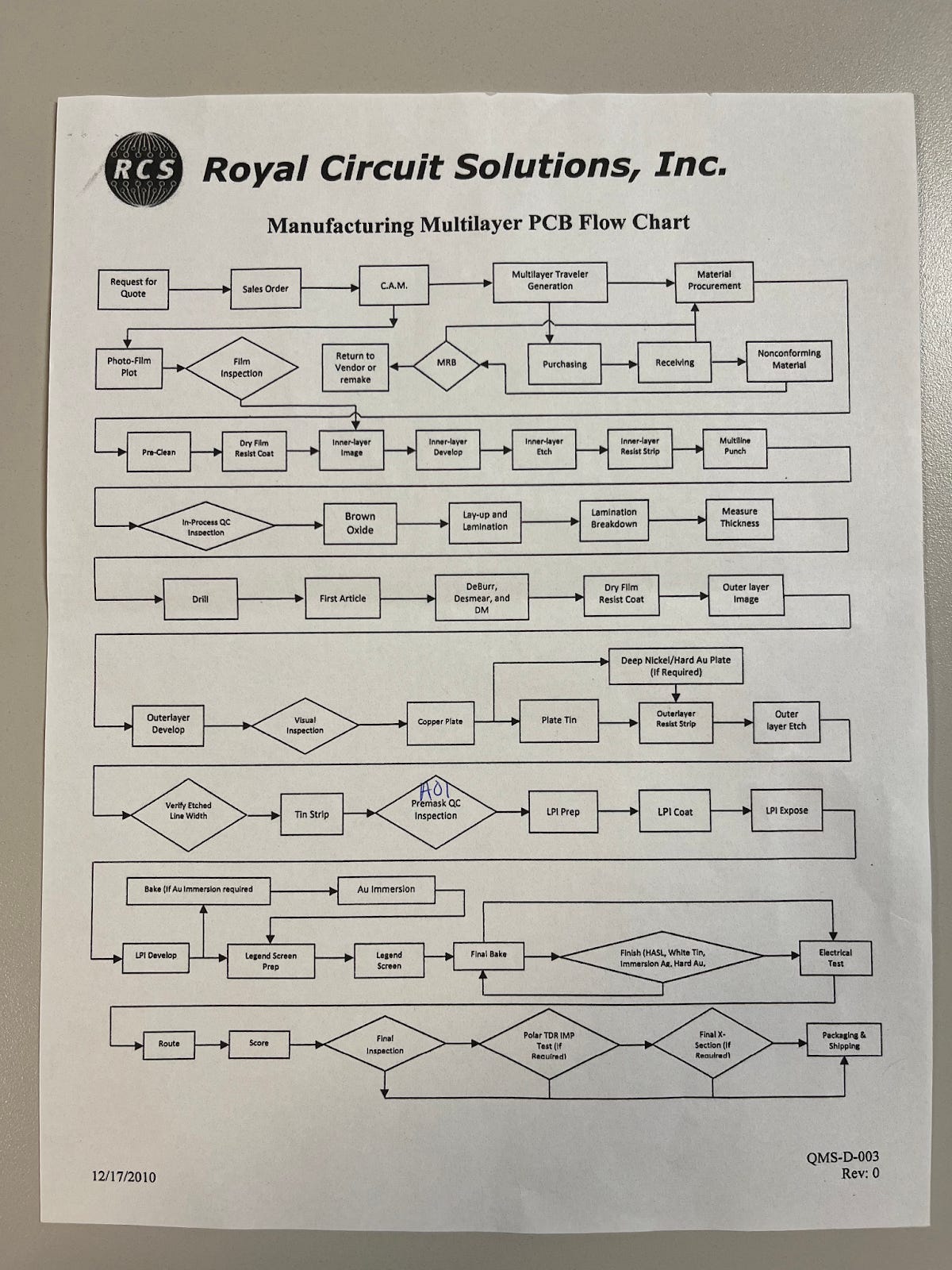
- If you missed it over the weekend, we spent a day at a quick-turn PCB factory in Hollister, CA walking the floor and tracing the full path from quote to finished board. The full process flow diagram is below. Turns out fabricating a PCB is a bit like layering up a sandwich once you see it up close!
- A clever platform for something nearly every hardware build needs: Loombotic just came out of stealth with instant quoting for custom wire harnesses. You can upload a drawing for a quote or use their drag-and-drop builder to spec connectors (JST, TE, etc.), wire gauges, lengths, and colors with real-time pricing from prototype to production. Check out their demo video here.
- One of the co-founders, Lucas, has actually been reading Hardware FYI for a while and recently came on board as an official partner. We’ve been following his story for a bit - he was the youngest Certified SolidWorks Expert at 15 (seriously, his old YouTube tutorials are still up!) and started the company during YCombinator’s Fall 2024 batch. Their first idea for automating 2D drawings went viral on X before pivoting into on-demand wire harness production. The more we research early-stage startups, the clearer it is that the best bets are on people. Highly suggest checking them out!
- Intel’s new CEO Lip-Bu Tan reportedly told employees it’s “too late” to compete with Nvidia in AI training, and that Intel will shift focus to edge AI on devices and agentic systems. For decades, Intel operated as an integrated device manufacturer that designed and fabricated its own chips. That model worked when Intel led on process and could amortize fabs across massive x86 volumes, but as nodes shrank (nominal minimum feature size, e.g. “3nm”), the economics flipped. Today’s leading-edge fabs cost $20–30B (TSMC’s 2 nm fab in Hsinchu is pegged at >$30B) and require near-full utilization to stay viable. TSMC, by contrast, runs a pure-play foundry model manufacturing chips designed by customers like Nvidia and Qualcomm that stay ‘fabless’. Intel is now adopting a hybrid model, continuing to design CPUs while building out Intel Foundry Services to produce chips for external customers and justify its $100B+ fab investments.
- Only the Paranoid Survive by former Intel CEO Andy Grove is a worthwhile read on how companies navigate (or fail to navigate) strategic inflection points. Ironically, Intel missed one of its own when it turned down the chance to make chips for the first iPhone.
- Cursor, now one of the fastest software startups to hit $100M ARR, actually started as an AI CAD co-pilot before pivoting.
- Casio, the Japanese electronics company known for its digital watches like the indestructible G-Shock, dropped a limited-edition, ring-sized watch to celebrate its 50th anniversary.
- An IRL event in the works - we’re renting out an entire beer garden in SF for a Hardware & Manufacturing Happy Hour around late August. Free food, free drinks, good people to talk shop. Check it out here!
- A live workshop on conceptual aircraft design from nTop on 6/17.
A couple fun links with two events worth checking out:

Startup Spotlight: CoLab launches AutoReview
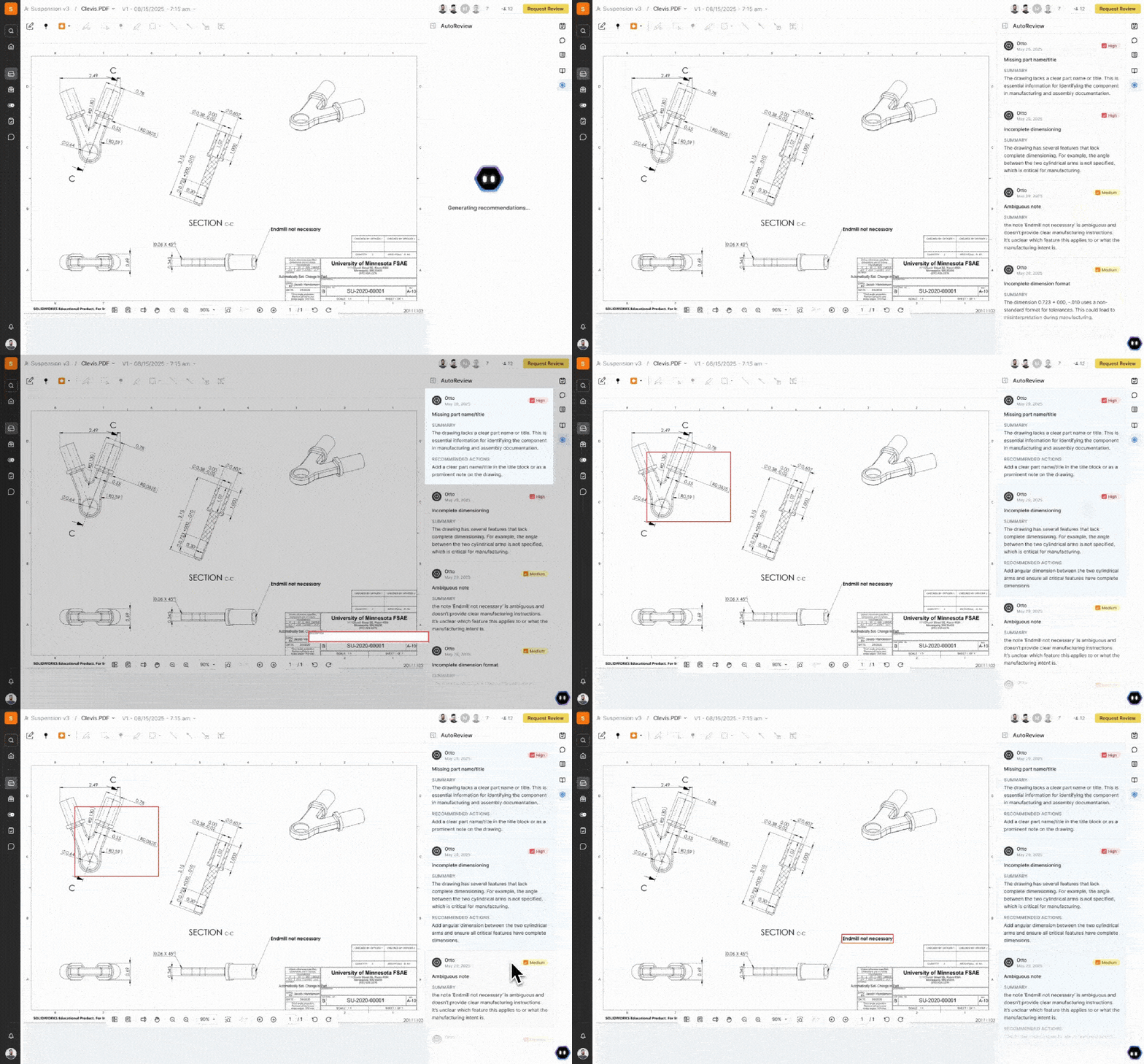
CoLab just launched AutoReview, an AI-powered tool that scans drawings and 3D CAD files to automatically generate design comments and markups. Here’s what it can find:
- Drawing errors (ambiguous notes, missing dimensions)
- DFM optimizations based on best practices in machining, sheet metal, injection molding, and more
- Non-conformance with your company’s design standards and guidelines
- Conflicts with lessons learned on past programs
CoLab estimates AutoReview can reduce drawing review time by 30-40%, saving 2,500+ engineering hours for a complex NPD program. Learn more here.
Startup News 🚀
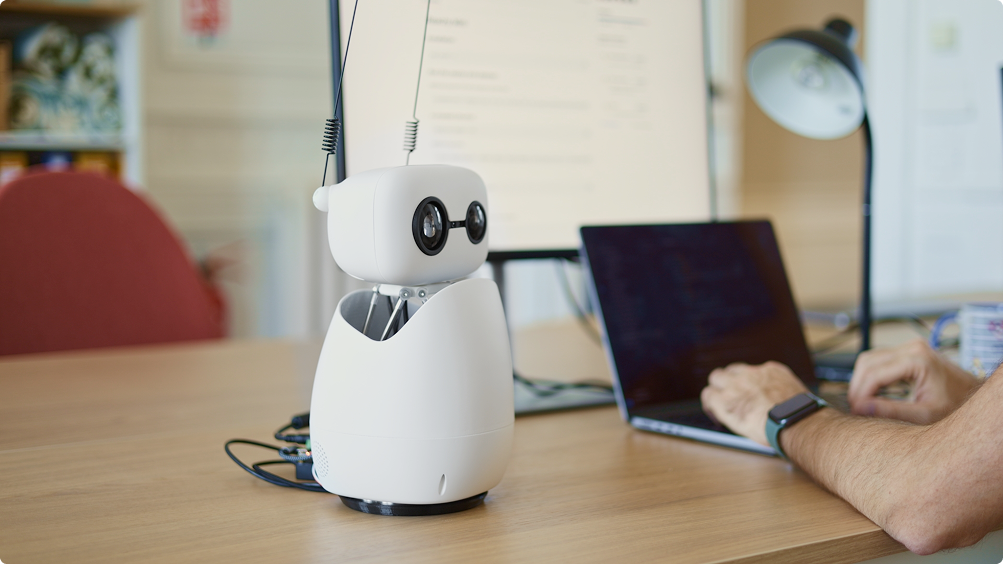
- Hugging Face just launched Reachy Mini, its first robot since acquiring Pollen Robotics in April 2025. The robot is an $299 open-source desktop robot designed for AI experimentation and human-robot interaction with integrations to Hugging Face’s platform with access to over 1.7M models and 400K datasets. It features a motorized head, animated antennas, and a suite of basic sensors like a camera, microphone, and speaker. Think of it as a low-cost developer kit for embodied AI.
- Varda Space Industries has raised $187M in Series C funding to scale its space-based pharmaceutical manufacturing efforts. The round supports a new 10,000 sqft lab for biologics like monoclonal antibodies and plans to increase mission cadence. Varda has successfully completed three missions to date, with a fourth currently in orbit and a fifth planned by year-end. Their edge lies in microgravity manufacturing and hypersonic reentry, two core enablers of the orbital pharma economy. NatCapCentral and ShrugCap led the investment.
- Apolink, a Y Combinator-backed startup, raised $4.3M in an oversubscribed seed round to build a real-time connectivity network for LEO satellites. The company plans to deploy a 32-satellite constellation by 2029, using a hybrid RF-optical architecture to eliminate communication dead zones. Their system supports up to 256 users per orbital ring at 9.6 kbps, offering backward-compatible, hardware-agnostic links. Investors include Y Combinator and 468 Capital.
- Boston Metal announced a $51M convertible note to accelerate the scale-up of its critical metals plant and capitalize on a recent milestone in sustainable steel production technology. The funds will support the deployment of the second phase of its critical metals facility in Brazil, with the company’s Molten Oxide Electrolysis (MOE) technology offering a unique advantage by extracting high-value metals from mining waste. Plans are for the Brazil plant to come online in mid-2026. Funding partners include BHP Ventures and Breakthrough Energy Ventures.
- RealSense completed its spinout from Intel and raised $50M in Series A funding to accelerate its AI-powered vision technology for robotics and biometrics. to scale its AI-powered vision systems for robotics and biometrics. The funds will support go-to-market expansion and hiring across all teams. Their flagship D555 depth camera is currently used in 60% of autonomous mobile robots and humanoids and features Power over Ethernet (PoE), where it can receive both power and data through a single Ethernet cable. The move comes as the robotics market is projected to surpass $200B within six years.