

Topics worth your time this issue: why the US grid is still running on 19th-century electrical principles and what modern power electronics could enable, making motors play music, a practical set of heuristics for using AI to write embedded firmware, mapping the world’s maritime chokepoints, and a week of funding in hypersonics, satellites, and composites.
Interesting Links
- Every watt generated, stored, or consumed today has to move through infrastructure designed before modern power electronics existed. That same mismatch is what's driving the current obsession with the grid, and the subject of Drew Baglino’s essay on the history of power electronics and why medium voltage is the next frontier. The US grid is, at its core, still organized around 19th-century electrical principles: iron-core transformers, fixed-ratio voltage conversion, and infrastructure designed for one-way power flow. More than two-thirds of transmission lines and large power transformers have been in service for over 25 years, while transformer demand has doubled since 2019, costs are up ~80%, and the US faces a ~30% supply deficit constrained by a single domestic supplier of specialty electrical steel. “Five decades in, nearly all power semiconductor progress has accrued to low-voltage applications: telecoms, datacenters, vehicles, chargers, solar, batteries. The distribution grid, operating at medium voltage between 7.2kV and 34.5kV, remains dominated by passive, mechanical hardware.” Data centers are driving more load growth, solar and batteries are making flows bidirectional, and electrification is pushing more power through infrastructure that was never designed to actively manage it.

- Making motors sing is one of engineering’s oldest party tricks, and a rite of passage that’s older than most people realize. The general mechanism works as follows - drive any electromechanical system to oscillate in the audible range, and it will produce sound. Control the frequency and you can control pitch, then sequence it over time to get music. Arguably the most famous example is the Curiosity rover, which in 2013 used its sample handling system to vibrate at controlled frequencies and “play” Happy Birthday; no speakers, just instrumentation driven in the audible range. A more accessible version exists with Bambu Lab 3D Printers with public documentation and a dedicated web tool that converts MIDI (think digital sheet music) into G-Code, assigns tracks to the machine's three motors, and plays the result directly from an SD card. For example, a printer playing the Mario theme.
- Tips for Using AI to Write Embedded Firmware offers a great set of heuristics, the best of which is: treat the model like an eager junior engineer who doesn’t read enough documentation. Do lean on it for scaffolding, boilerplate, and getting from blank screen to something running. Don’t trust it on pin configuration, interrupt models, bus contention, clock stretching, or anything touching real-time and concurrency unless you like debugging above all else. Resource constraints are another blind spot, since these models ingest vastly more code deployed on much more powerful computers, so suggestions almost always run heavy on RAM/flash for constrained targets.
- On a related note, Awesome MCP for Hardware is a curated directory of MCP servers and clients for connecting AI models to embedded devices, serial interfaces, oscilloscopes, and other related lab hardware. Model Context Protocol (MCP) is an open standard that gives AI models a common interface to external tools; think of the same way a peripheral needs a driver, a model needs MCP to talk to anything outside itself, except the protocol is universal: any model can talk to compliant tools without custom integration. Some very cool use cases include using an MCP server to let a model control a Keysight/Agilent oscilloscope over Ethernet. Describe the task (i.e. “verify the I²C and PWM functionality of this port”), and the model can configure channels, set triggering, measure frequency and duty cycle, and return a pass/fail summary. Video demo here.
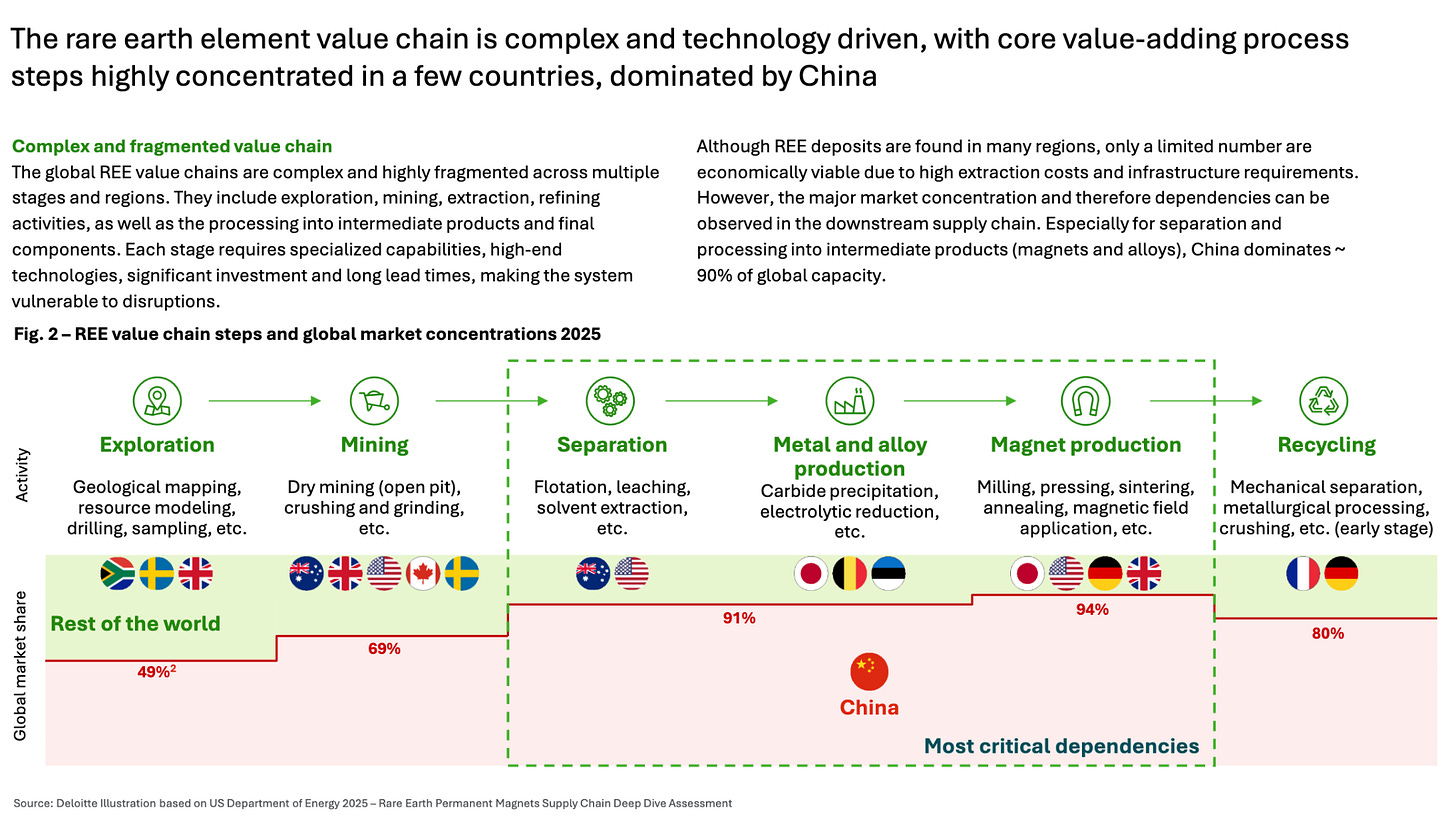
- Most companies don’t buy rare earths directly; they buy the motors, magnets, sensors, and semiconductor modules that contain them, only to find out how exposed they are when a supplier can’t deliver. Deloitte’s guide walks through mapping that exposure and sequencing mitigations from safety stocks to component redesign and supply diversification. If you buy any of the above, it might be worth a few phone calls to get a better sense of how exposed your supply chain is to geopolitical chicanery.
- The high-level takeaway: the Western world mines the ore, and by the time it becomes a magnet or alloy, roughly 90% of that processing runs through a single country.
- Also related to global supply chains, the world’s maritime choke-point mapped two ways:
- ShipMap is an animated map of global shipping traffic over a full year.
- Global Maritime Traffic captures the same data live.
- And one fun link to round out the week: there’s a $9 game on Steam that’s part simulation, part hands-on tutorial to learn how data centers work.
Startup News
- Hermeus raised $350M in Series C funding ($200M in equity, $150M in debt) at a $1B valuation to continue development of unmanned hypersonic aircraft. The startup recently flew a demonstrator the size of an F-16, with the next iteration targeting supersonic flight and a third aircraft already in the works. Rather than building its own engine, Hermeus pivoted to modifying Pratt & Whitney’s F100 engine, putting the company on a faster development track while opening up near-term DoD contracts. The round was led by Khosla Ventures with existing investors like Canaan Partners, Founders Fund, and RTX Ventures also participating.

- Foundry Robotics raised $19M in seed funding to build what it calls an “AI-first, robotics-native” end-to-end manufacturer focused on assembly. The company is positioning itself as a dual-use manufacturer integrating software, robotics, and production in-house, though specific product and facility details are light. Backers include Khosla Ventures, Red Glass Ventures, Zero Shot Fund, Hanabi Capital, and Ora Global.
- Starfish Space raised more than $100M in a Series B to scale production of its Otter spacecraft, designed to service, refuel, and deorbit satellites in GEO and LEO. The ~90-person Seattle-based company has multiple spacecraft in production with first launches slated for later this year, backed by contracts for a geostationary life-extension mission and a separate mission with the U.S. Space Force. Starfish is also operating Otter Pup 2, a test vehicle validating its rendezvous and docking autonomy stack. The round was led by Point72 Ventures, with Activate Capital and Shield Capital co-leading
- Portal Space Systems raised $50M in Series A funding to build two maneuverable spacecraft: Starburst, a high-agility bus, and Supernova, a solar-thermal propulsion vehicle designed to move quickly between orbits. The capital will fund a 52,000 sq ft factory in Bothell, Washington with planned capacity for 12 Supernovas and 16 Starbursts per year. The round was led by Geodesic Capital and Mach33.
- Hybron raised $25M in seed funding to scale production of carbon fiber composite components intended to replace metal parts in defense and aerospace systems. The El Segundo-based company uses high-pressure molding to achieve 10–15 minute cycle times per part, claiming 5× lower cost and 100× faster throughput than traditional composite processes. The raise follows a nine-figure contract with a major European munitions manufacturer and was led by Marque Ventures.