

Interesting Links 🏭
- In one of the coolest real-world applications of control theory, how do you measure and regulate a cooktop that can dump enough power to boil a liter of water in ~40 seconds? Impulse’s answer (US20240288175A1) is to measure heat flux, the rate of heat flow per unit area, rather than the temperature of the cooktop surface. The design uses a spring-loaded, self-heated contact puck under the pan where the controller holds the puck at a fixed setpoint and tracks how much power is needed to keep it there. That heater power is proportional to the heat flowing across the pan–glass interface and with the thermal resistance known, the controller can infer the pan’s temperature in real time (e.g. when the pan temperature crosses the sensor setpoint, the signal flips sign). The result is a high-bandwidth signal for a PID control loop: drive maximum power during preheat, back off before overshoot, and correct instantly when the load changes like when the pan shifts or food is added.
- More context on PID (proportional–integral–derivative) control here: Kp drives response, Ki removes steady-state error, Kd damps oscillations. Same controls math you learned in class, but in real products!

- 507 Mechanical Movements, Henry T. Brown’s classic technical reference on mechanisms from hydraulics to steam engines, lives on in the digital world with animated versions at 507movements.com. It’s a mechanical index of gears, linkages, pulleys, and cams, and also a great primer on mechanism design. See #18, two fixed pulleys and one movable pulley, #140, a toggle-joint for a punching machine, or #119, reciprocating motion of a rack driven by a pinion that alternates above and below.
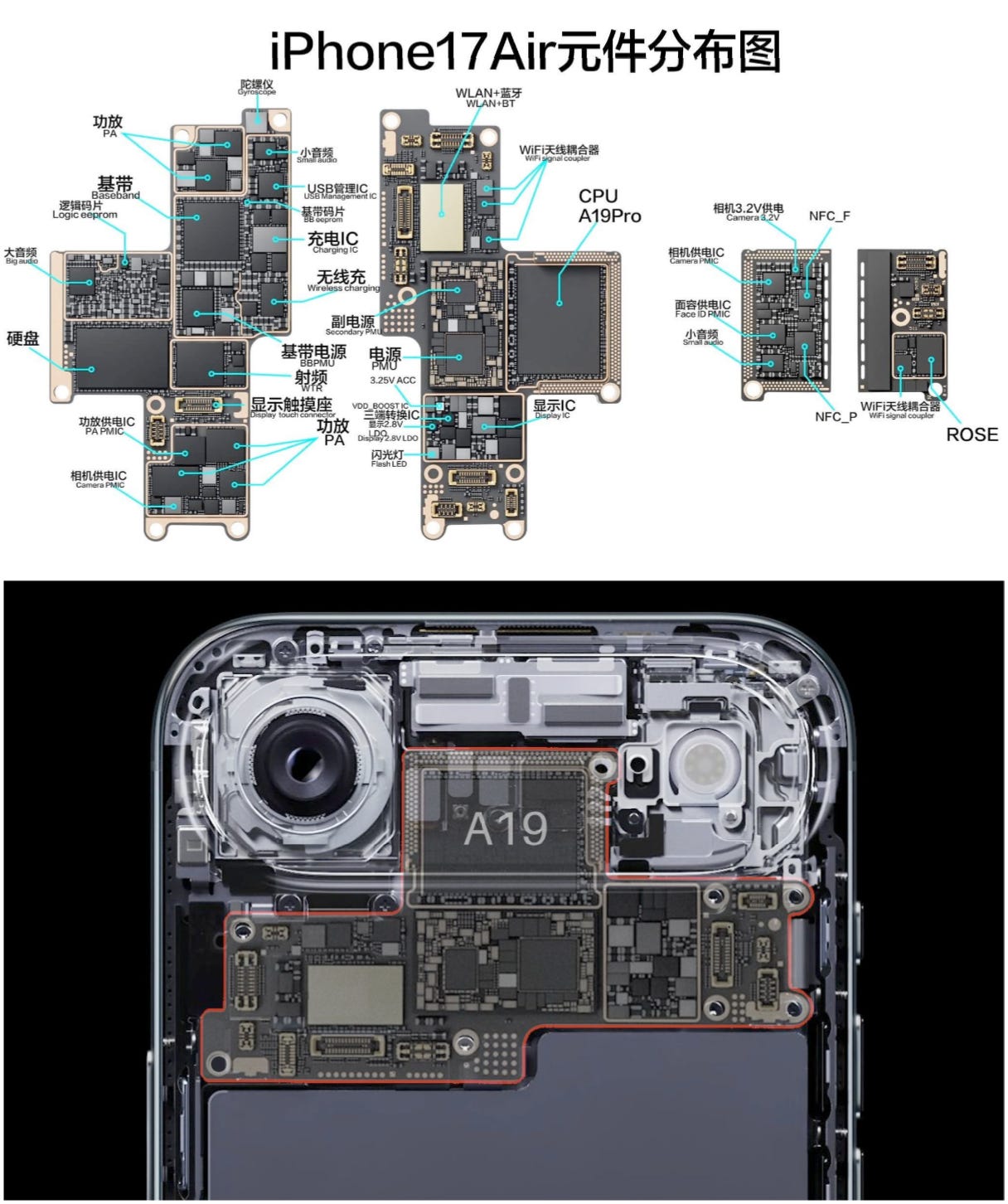
- An early look at the iPhone 17 series logic boards. The new iPhone Air measures in at 5.6mm thin where the A19 SoC fits inside the raised camera plateau, and the rest of the logic board assembly is housed in the main body of the phone.
- The era of camping outside Apple Stores is over (largely replaced by preorders and online ordering), but supply chain estimates show first-weekend demand came in higher than last year.
- The Bell Systems Technical Journal was AT&T's in-house research journal, published from 1922 until the breakup of the Bell System in 1983. For a large majority of the 20th century, AT&T operated as a government-regulated monopoly where guaranteed profits from running the U.S. phone network gave it the freedom to pour money into long-horizon research, effectively making the lab a sandbox for fundamental science and engineering. It served as the company’s showcase for cutting-edge R&D across telecommunications, electronics, computing, and physics — much of it fundamental to modern technology today. Some of the most notable publications include:
- The concept of a ‘bit’ of information (Transmission of Information, 1928)
- The first point contact transistor (Physical Principles Involved in Transistor Action, 1948); later won a Nobel Prize in Physics.
- And the UNIX operating system (Special issue on UNIX, 1978)
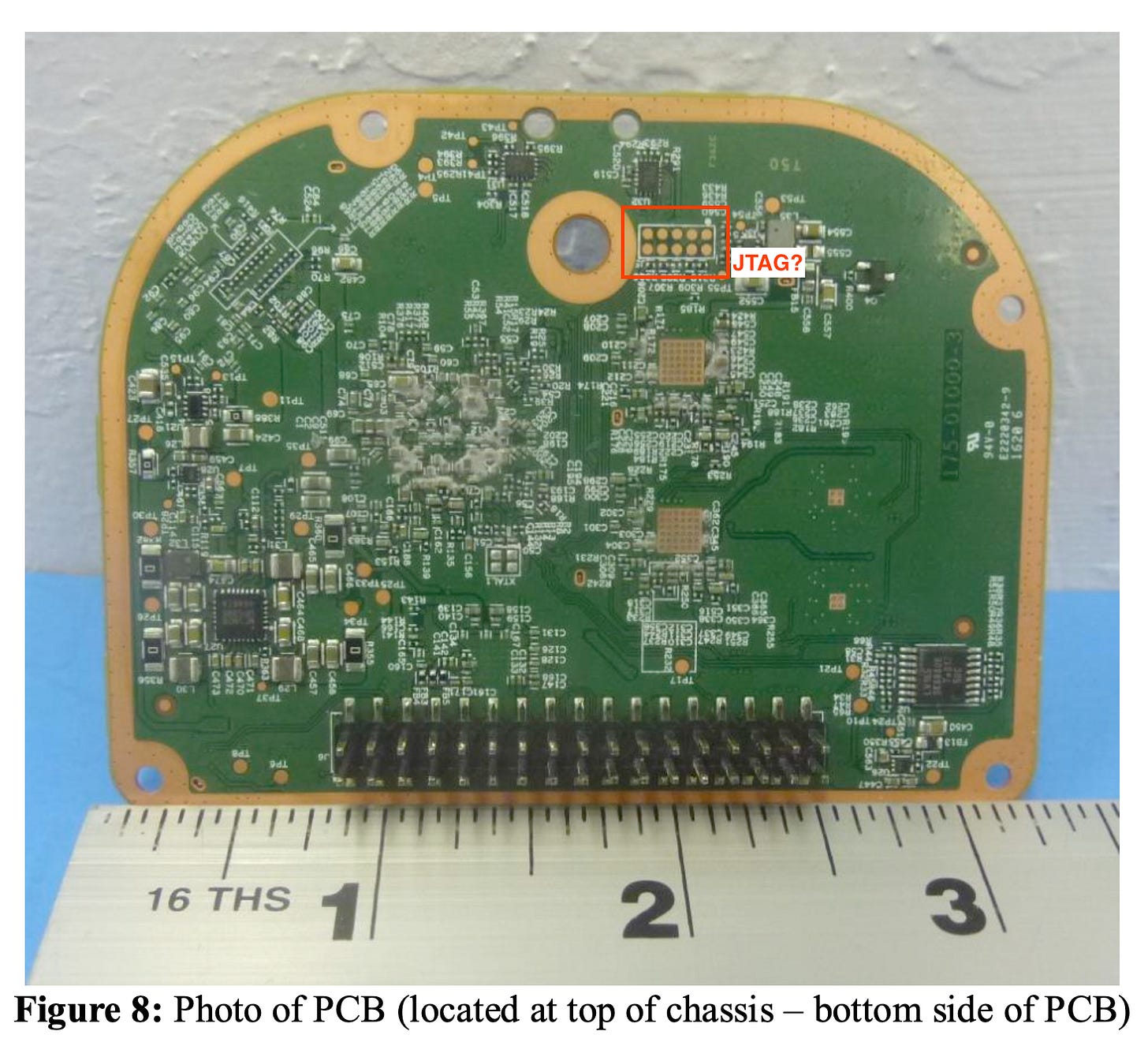
- A two-part hacking guide for the Amazon Eero 6. The author uses FCC photos to spot likely debug pins (JTAG/SWD), then brute-forces them with a cheap Arduino Nano RP2040. The guide itself is also a useful walkthrough of common defenses used in real products: most modern SoCs ship with secure boot (boot ROM only runs images signed by the vendor) and the debug ports fused shut (one-time eFuses disable halt/memory-read even if the pins are exposed). You can still map the pins, but with those protections the cores won’t stop and you can’t just dump the firmware. To bypass the protections mentioned above, the author goes around the SoC entirely and desolders the eMMC (the NAND+controller package that stores the firmware), connects it into a test socket wired to a USB3 adapter, and the host computer now treats it like a removable drive, allowing a raw dump of the 4 GB image. With that, he could mount partitions directly and inspect the Linux filesystems, services, and binaries inside.
- A couple announcements to round out the week:
- Spots are still available for our private event in the South Bay Area on 9/30! Free foods, free drinks and good people to talk shop - check it out here!
- AllSpice is putting together a ’50 Hardware Innovators’ award — nominations are open for engineers, students, hobbyists, and founders.
Jetson delivered its first eVTOL personal aircraft to Palmer Luckey, former founder of Oculus and now founder of Anduril. The aircraft is a rotorcraft eVTOL certified under FAA Part 103 ultralight rules (no license required, but limited to single-seat, daylight, low-altitude recreational use). Still very cool to see SN #003 out in the wild, and the company reportedly has a 2-year order backlog.

Startup News 🚀
- Two major quantum computing announcements:
- PsiQuantum raised $1B in Series E funding to build utility-scale quantum computing sites in Brisbane, CA and Chicago, IL. The company uses a photonic qubit approach built on semiconductor manufacturing, producing quantum photonic chips and optical switches that connect over standard telecom fiber — a key requirement for existing partners like Nvidia. Instead of the chandelier-style cryogenic setups common in the field, PsiQuantum houses its system in modular rack-mounted cabinets with integrated cooling, making them easier to fit into existing data centers.
- Infleqtion secured over $540M in gross proceeds through a SPAC merger at a $1.8B pre-money valuation to advance its technology roadmap. The company also sells deployable quantum sensors such as clocks and RF receivers for navigation and timing, with customers including Nvidia, NASA, and the U.S. Department of Defense.
- Shortages in electrical steel last year exposed major bottlenecks in the transformer supply chain. Heron Power raised significant funding to address the gap, and now larger players are moving in:
- Tesla plans to manufacture electrical transformers in-house for the $65B market. The units will support grid-forming functions like regulating voltage and frequency to enable more inverter-based power and reduce blackout risks. The move also ties directly into Megapack and Megablock integration, and follows a wave of talent departures to Heron Power last year.
- Hitachi Energy is investing over $1B in U.S. grid infrastructure, including a new $457M transformer factory in Virgini. The plant will produce high-voltage units alongside its existing campus, adding much-needed domestic capacity.
- Rendezvous Robotics raised $3M in pre-seed funding to transition its modular tiles from demos to orbital products The flat-packed modular tiles magnetically self-assemble for in-space structures that can be reconfigured via software, allowing for space infrastructure like large-scale antennas, solar arrays, and sensors without launch volume constraints. Lead investors are Aurelia Foundry and 8090 Industries.