

Interesting Links
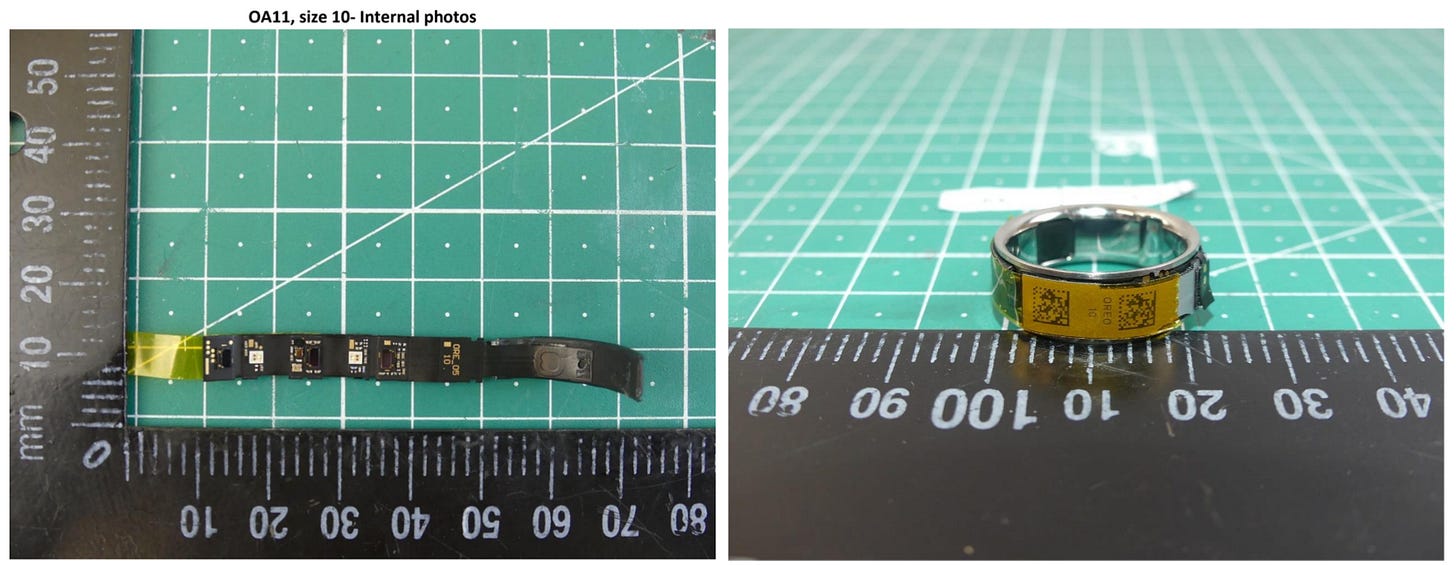
- An interesting manufacturing constraint specific to rings: twelve ring sizes means twelve hardware SKUs, far more than most wearables. Each size up also reportedly adds ~1 mAh of battery capacity.
- A useful primer on compliant mechanisms (also known as flexures), often described as the ultimate form of mechanism reduction. A clothespin illustrates it well: the traditional version is three parts (two jaws, one spring); a dolly peg is one part that does the same job by using elastic deformation instead of a discrete spring. The same principle operates across a broad range of scales beyond prototyping. NASA-funded researchers have demonstrated monolithic pointing mechanisms for spacecraft attitude control, replacing multi-part gimbals with a single 3D-printed titanium flexure. In high-mix material handling, the compliance often lives in the end effector by deforming to fit the part. At the microscale, the interdigitated comb fingers in MEMS accelerometers form a compliant mechanism: a proof mass suspended on flexure springs, with acceleration read out as a differential capacitance change. For those interested in learning more, the classic references are from the Howell Group at BYU (theory and practice).
The latest Scan of the Month from Lumafield puts four health wearables through industrial CT, exposing their internal packaging and integration without disassembly. The Oura Ring 4 shows what modern wearable integration looks like: a curved flex PCB, infrared emitters and photodiodes, a charging coil, and a custom-shaped Li-poly cell all packed into a ~2.5 mm cross-section inside a torus. The glucose monitor, on-body injector, and hearing aid follow a similar pattern. Mechanically simple, electrically crowded; most of the work is in the flex stackup, routing density, and packing a full system into millimeters of volume.


A process that might previously have meant preparing for a major review every couple of months starts to shift toward smaller, more continuous checkpoints. The formal review doesn’t disappear, but it increasingly reflects a history of incremental decisions instead of being the first time the design is examined closely.
- Right-Sizing Reactors unpacks a tension that’s been haunting nuclear economics since the 1970s: the assumption that bigger reactors mean cheaper power. The paper distinguishes between economies of scale (cost per unit capacity decreases as reactors get larger) and economies of volume (cost decreases through learning-by-doing across serial production). These have different optima, and pursuing one can undermine the other. The author draws an explicit parallel to SpaceX’s strategy with the Falcon 9 rocket; where other launch companies used a single large engine per rocket, SpaceX combined nine smaller engines enabling easier transport, faster iteration, and supply chain diversification. Small modular reactor (SMR) proponents are betting on the same logic for reactor deployment with more frequent iteration and a broader supply base.
- For a utility adding 7 GW: seven 1-GW units gets you to 7th-of-a-kind; 300-MW SMRs gets you to the 23rd. If fabrication is standardized, past studies found that each doubling of builds reduced costs by roughly 10–28% at the architect-engineering firm level.
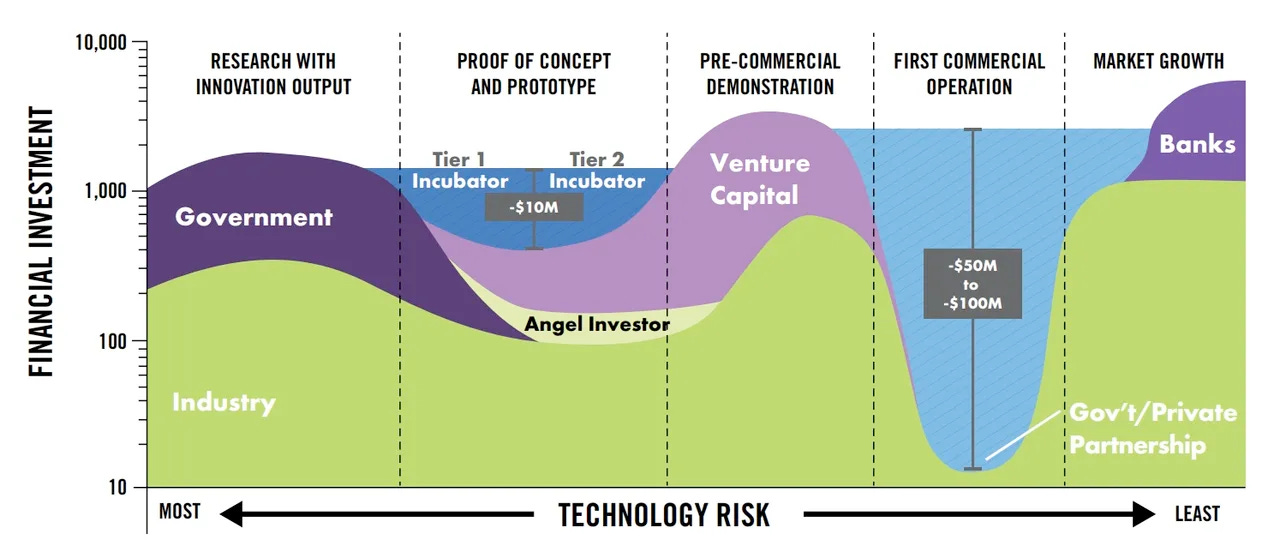
- As capital floods back into manufacturing and other physical industries, this breakdown of climate’s commercial valley of death from 2024 is worth reading — especially for startups moving from pilot/prototypes to full-scale production. In this context, the valley of death isn’t the typical early R&D gap (high burn, no revenue); it’s the gap between demonstrating a process at pilot scale and proving unit economics outside a controlled environment. Slightly outside our usual engineering scope, but important context on any startup building in the space. Most early-stage VCs are aiming for 10× outcomes, growth equity funds look for similar returns, and infrastructure capital is underwriting assets for ~50% returns. The first commercial plant fits cleanly into none of those boxes (too risky for infrastructure, too capital-intensive and slow for venture) which is how companies end up stranded exactly when they need the most capital.
- A couple fun links to round out the week:
- Windborne Systems might have the most self-aware engineering job description we’ve read in a while — looking for someone “who enjoys applying increasingly cursed out-of-the-box solutions to reduce part count and complexity” and has the “ability to solder 0402 components by hand without wanting to cry.”
- Original iPods are seeing a quiet resurgence as purpose-built digital devices: no feeds, no notifications, just music.
Startup News
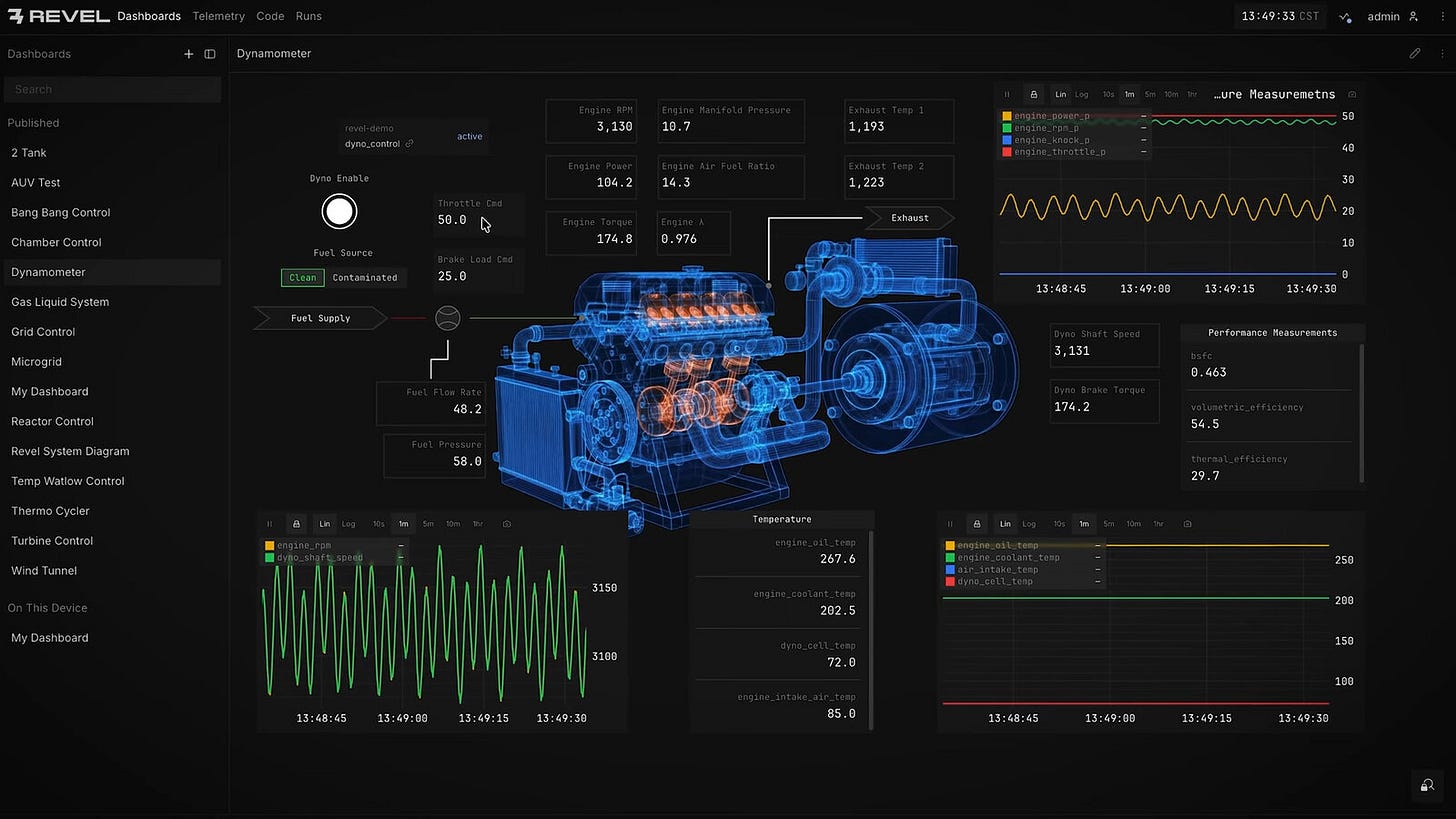
- Revel raised a $150M Series B round to expand its software platform for testing and controlling complex hardware systems. The company’s core product replaces legacy tools like LabVIEW with a modern environment for configuring test stands, streaming telemetry, and issuing real-time commands to systems such as rocket engines and nuclear reactors. Founded by a former SpaceX software lead and first deployed on rocket engine test stands, Revel is now expanding into broader industrial control use cases. The round was led by Index Ventures with participation from Redpoint Ventures, Thrive Capital, and Felicis.
- Mesh Optical Technologies raised over $50M in funding to scale production of high-speed optical transceivers for AI and data center interconnects. The company’s first product, the Alpha C1, is a 1.6 Tbps optical transceiver designed for improved power efficiency and lower latency in bandwidth-constrained clusters. Instead of manually assembling optical components at low volume, Mesh fabricates its optical engine using flip-chip die bonding processes similar to advanced semiconductor packaging. The round was led by Thrive Capital.
- Flux raised a $27M Series B round to expand its AI-powered PCB design platform. The company reports 1M users have used Flux to create 6.4M+ projects to date. The new capital will accelerate development of its AI Hardware Engineer agent, improve performance for complex board design, and deepen integrations with distributors, manufacturers, and other workflow tools. The round was led by 8VC, with participation from Bain Capital Ventures, Liquid 2 Ventures, and Outsiders Fund.
- Chariot Defense raised $34M in a Series A round to scale its hybrid power systems for defense platforms. The company builds battery-based energy storage units with integrated power electronics and control software that manage generation, storage, and load routing in the field. The hybrid power system line includes a 5 kWh portable unit and a 315 kWh deployable system designed to power drones, sensors, EW, and command-and-control systems while reducing continuous generator use. Chariot says units are deployed with U.S. Army teams and is expanding production as it works toward programs of record. The round was led by Andreessen Horowitz, with participation from DCVC and Shield Capital among others.
- Flow Engineering announced that Rivian selected its platform as the requirements system of record across the R1 and R2 vehicle programs, bringing the full engineering organization onto a single systems engineering platform. A notable example of newer engineering tools displacing legacy requirements software inside a modern automotive OEM.