

Topics worth your time: YC’s growing hardware footprint and timeless advice for setting up a lab, a16z’s American Dynamism 50, data-access controversy for CAD-based assistants, and more.
Interesting Read: YC Builds a Hardware Lab
For most of its two decades, Y Combinator’s bread and butter has been software and SaaS-related startups, which is to say the typical company needed little more than a laptop and a cloud bill. Much can change in twenty years, and a surprising amount in just two. Simply examine the evolution of their Requests for Startups, which first showed interest in US manufacturing and hardtech in 2024—the same year Ares Industries became their first defense investment—and have only leaned further in since. By their own count, over 20% of their startups now work on hardware, and it’s quite the sign of changing times that YC also just posted an open role for a Hardware Lab Manager.
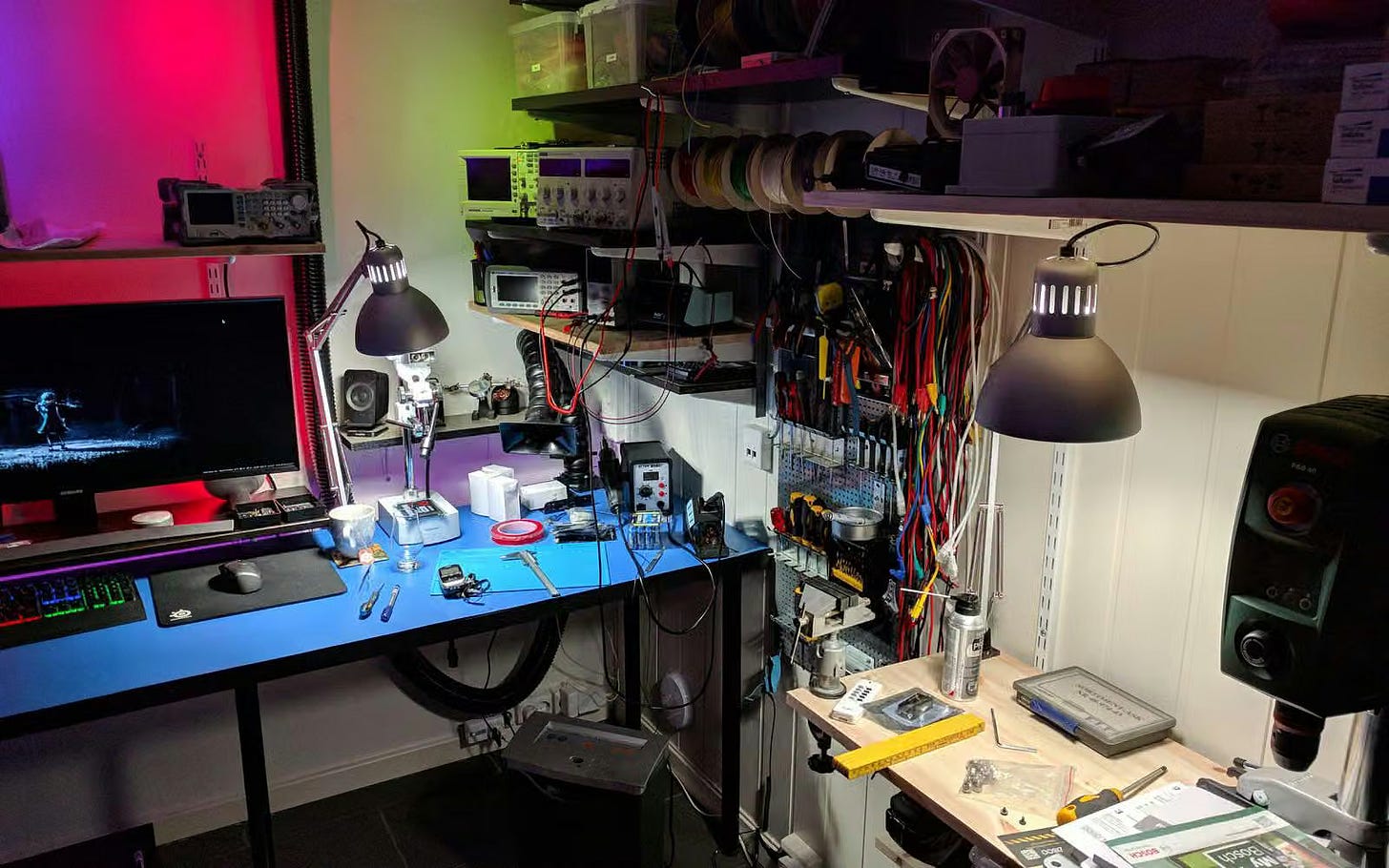
Setting up a utopian lab space has long been a personal fascination of ours (show us an engineer who hasn’t once daydreamed about their ideal shop), and the right space is shaped by the nature of the work and people in it. As such, we’ve collected a growing catalogue of tips for anyone just as curious:
- For working space, we prefer industrial workbenches with a riser shelf; liquidators and auctions sell them cheap.
- For shared work surfaces, use butcher block: abuse freely, then replace it.
- Metal pegboards can turn a blank wall into storage.
- 3D printing has never been cheaper to get right: Bambu Lab for FDM, Formlabs Form Studio 1 for SLA.
- Good hand tools pay for themselves. Wera is worth the premium, and their Tool-Check Plus kit will outlast most of your projects.
- Calipers are the one place not to cheap out; Mitutoyo is still the gold standard.
- Keep a stocked fastener assortment (M2–M6 screws, nuts, washers and heat-set inserts) in labeled bins, and let McMaster-Carr cover the rest.
- Label bins, label drawers, label shelves, label the label maker.
- Follow what Adam Savage calls first-order retrievability.
- For electronic bench essentials, see Altium’s guide to kitting out an electronics lab. +1 for cordless soldering irons.
- Lever-nut connectors (WAGO’s are the standard) make quick work of wiring.
- Use stack-and-hang bins to organize parts by P/N for in-house builds and to track inventory.
- Heavy-duty hand cleaner at the sink, blue shop towels for cleanups.
- Give everyone a personal toolbox stocked with the basics.
- There are shop tools and there are your tools, and by Friday nobody can tell which is which. Entropy always wins, but you can slow it down by cleaning up daily.
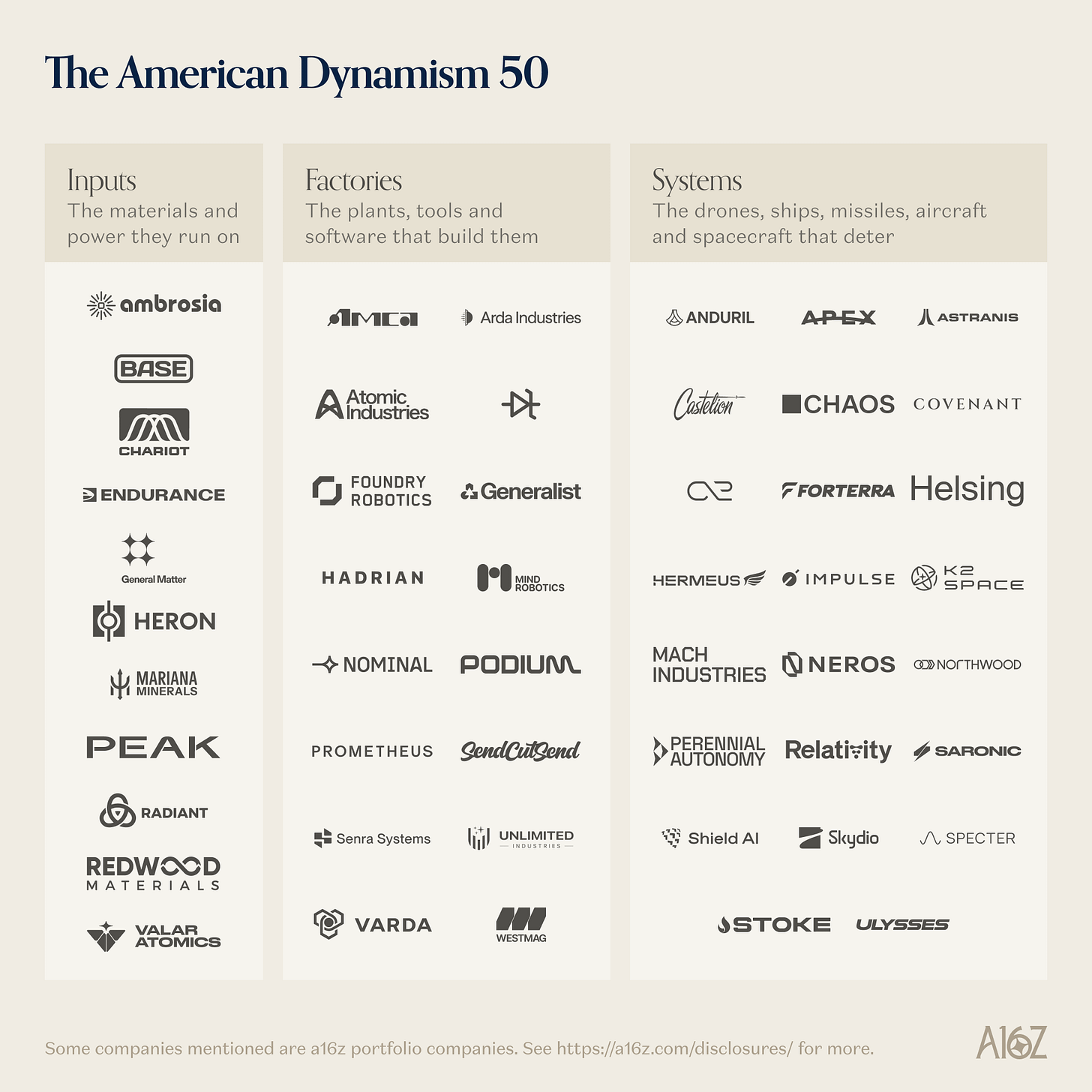
Interesting Chart: a16z’s American Dynamism 50
a16z released its annual American Dynamism 50 list. For a look at the broader landscape, see our maps for aerospace & defense, climate & energy, physical AI & robotics, and software for hardware.
More From Around the Web
- South Park Commons on dimensions of excellence - five identifying traits they look for in founders before a company even exists.
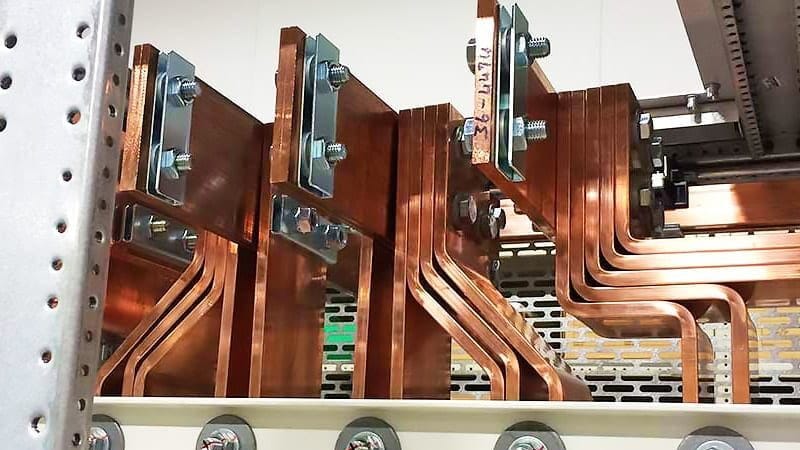
- A primer on busbars, the copper or aluminum bars that distribute high currents to multiple circuits.
- An electronic toy kitchen simulating butter melting and sliding around a pan.
- Some drama from r/SolidWorks over seemingly unrestricted read permissions in a third-party CAD assistant.
- An interactive world map for tracking PCB fabrication and assembly shops.
Manufacturing & Startup News
- Physical Intelligence is reportedly in talks to raise at least $1B at a $20B valuation to build general-purpose foundation models for robots.
- Helicon raised $16.5M to automate composite manufacturing, pairing simulation with robotic assembly to produce composite structures.
- American Advanced Materials raised a $12.5M seed round to design U.S. plants for titanium sponge, the raw material behind aerospace and industrial titanium alloys.
- Colare raised a $2.5M pre-seed round for technical screening of hardware engineers, using simulation-based assessments in CAD, FEA and PCB design.