

Topics worth your time: the steep valley of death for new automakers and how the incumbents build cars, how a product can be both a commodity and one of the hardest to bring to market, flight regimes from subsonic to interstellar, Nvidia’s H200s piling up in Hong Kong, and more.
Interesting Read: Bringing a New Car to Market
With Tesla now retooling its original Model S and Model X lines for humanoid assembly, it’s hard to comprehend how unlikely it looked even a decade ago that any new automaker would last long enough to have product lines to retire. Look no further than the long list of EV startups that tried and either went bankrupt or faded into obscurity: Faraday Future, Byton, Lordstown, Fisker, Arrival, Canoo, and Nikola may be names that still ring a bell.
The few that made it either survived the valley of death or skipped it entirely. Tesla made it through ‘production hell’ on the Model 3, and Rivian by staying ahead of years of cash burn with an IPO at the peak of the EV boom and a recent multibillion-dollar joint venture with Volkswagen.
Most other car manufacturers that eventually reached scale had a head start, whether a motorcycle business (Honda), a battery business and the densest tech-industrial supply chain in the world (BYD), or a government set on building a domestic auto industry (Hyundai). Starting from scratch as a new automotive OEM has historically been considered a fool’s errand.
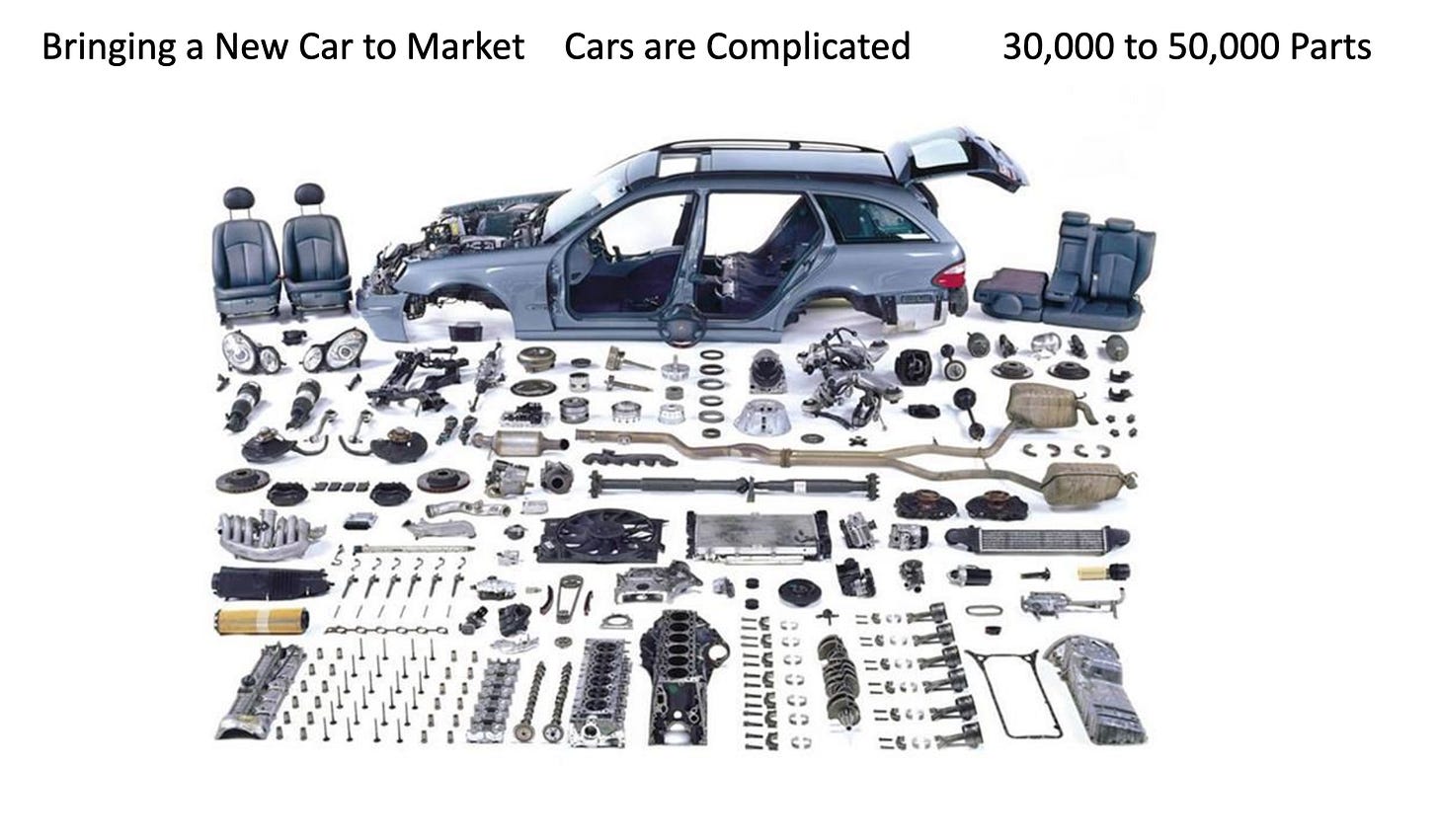
For those interested, the University of Cincinnati’s series on Bringing a New Car to Market (II, IV, V) is a useful high-level overview of automotive development as the incumbents practice it. A few observations on how the car can be both a commodity and one of the hardest products to bring to market:
- Incumbents benefit from evolutionary design. For example, they use modular platforms to build on a shared core and design around fixed interfaces (see VW’s MQB or Hyundai’s E-GMP).
- Front-loaded capital makes the valley of death very steep. Some back-of-the-envelope math for staffing: 1,000 employees at ~$100K each over a four year program comes to ~$400M. Now consider the costs of tooling a factory and ramping up production, each of which can easily exceed that.
- An ecosystem of shared suppliers means a car is increasingly bought, not necessarily built. Suppliers can design and sell complete systems (brakes, seats, infotainment, battery cells) to automakers, often including the software for the car.
- Ford CEO Jim Farley once described ~150 modules running code from different suppliers, where even changing the seat controls in Ford’s own cars required permission from Bosch, one of those suppliers!
More From Around the Web
- A tour of CircuitHub’s quick-turn PCB factory and robotic assembly system.
- Betabound has plenty of hardware beta-testing rabbit holes. New countertop oven or at-home Pilates device, anyone?
- Speaking of new devices, Trepo recently launched an agentic kitchen assistant device for grocery shopping.
- Some gentle fun with transistors.
- One hand surgeon’s perspective on Why I Hate the Index Finger.
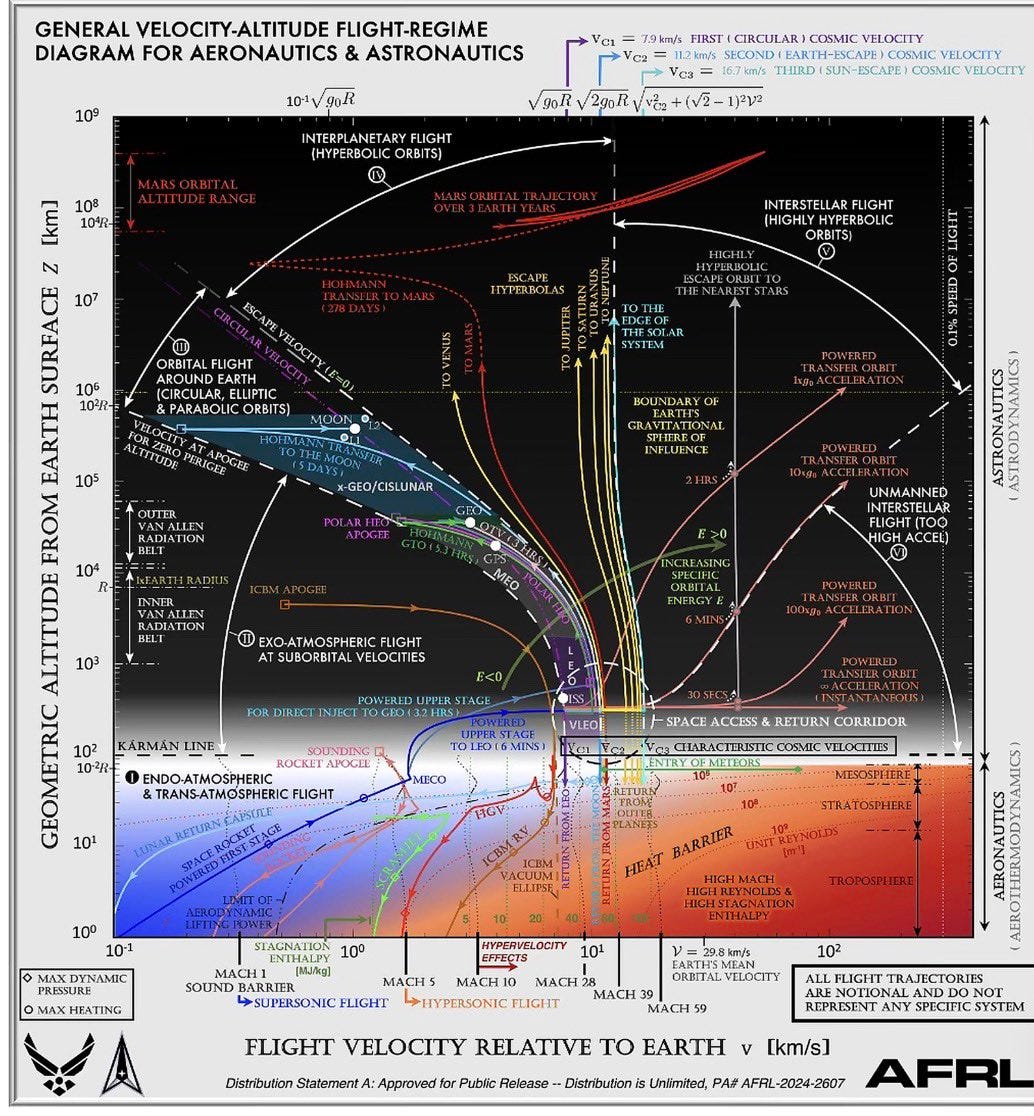
Interesting Diagram: Mapping Flight Regimes
Manufacturing & Startup News
- Northwood Space raised a $375M Series C at a reported $2B valuation to increase manufacturing fivefold for its phased-array ground stations, which can talk to six satellites at once.
- Humble Robotics raised a $51M Series A to start customer pilots of its electric autonomous hauler, which carries standard shipping containers on regional routes of up to 200 miles.
- Harbinger raised a $240M Series D to expand beyond medium-duty EV trucks into batteries, energy storage, and defense, while it builds out a $300M+ order of 2,000 electric trucks for FedEx.
- Nvidia’s H200s are reportedly stockpiling up in Hong Kong, with ~600,000 chips waiting on import approval.
- Hypersonica raised a €100M Series B to build Europe’s own hypersonic missile; it flew its first test from Norway in February and is aiming to deploy by 2029.