

👋 Happy Saturday! A few highlights for your weekend: lecture notes on geothermal fundamentals, a chart of Airbus A320 sensor locations (and how bad architecture crashed the 737 Max), and everything you never knew you needed to know about washers.
Interesting Lecture Notes: What It Takes to Make Geothermal Work
Humans have tapped into geothermal heat since the Stone Age, mostly for keeping warm, bathing, and gathering around natural hot springs. Advances in drilling and power systems are now making it viable at larger scales as a renewable and dispatchable resource.
This MIT lecture walks through how it works: tapping into underground heat reservoirs, either naturally occurring hydrothermal systems (liquid, vapor, steam) or engineered ones called enhanced geothermal systems, where hot dry rock is fractured to create a reservoir.
Most geothermal plants generate low-grade heat (100–200°C) but still manage a high capacity factor (~90%), meaning they can run almost constantly. Fun fact: Iceland gets more than 70% of its energy from geothermal, and in the Paris Basin, a deep underground reservoir of warm water beneath northern France, geothermal systems actually heat ~187,000 homes!
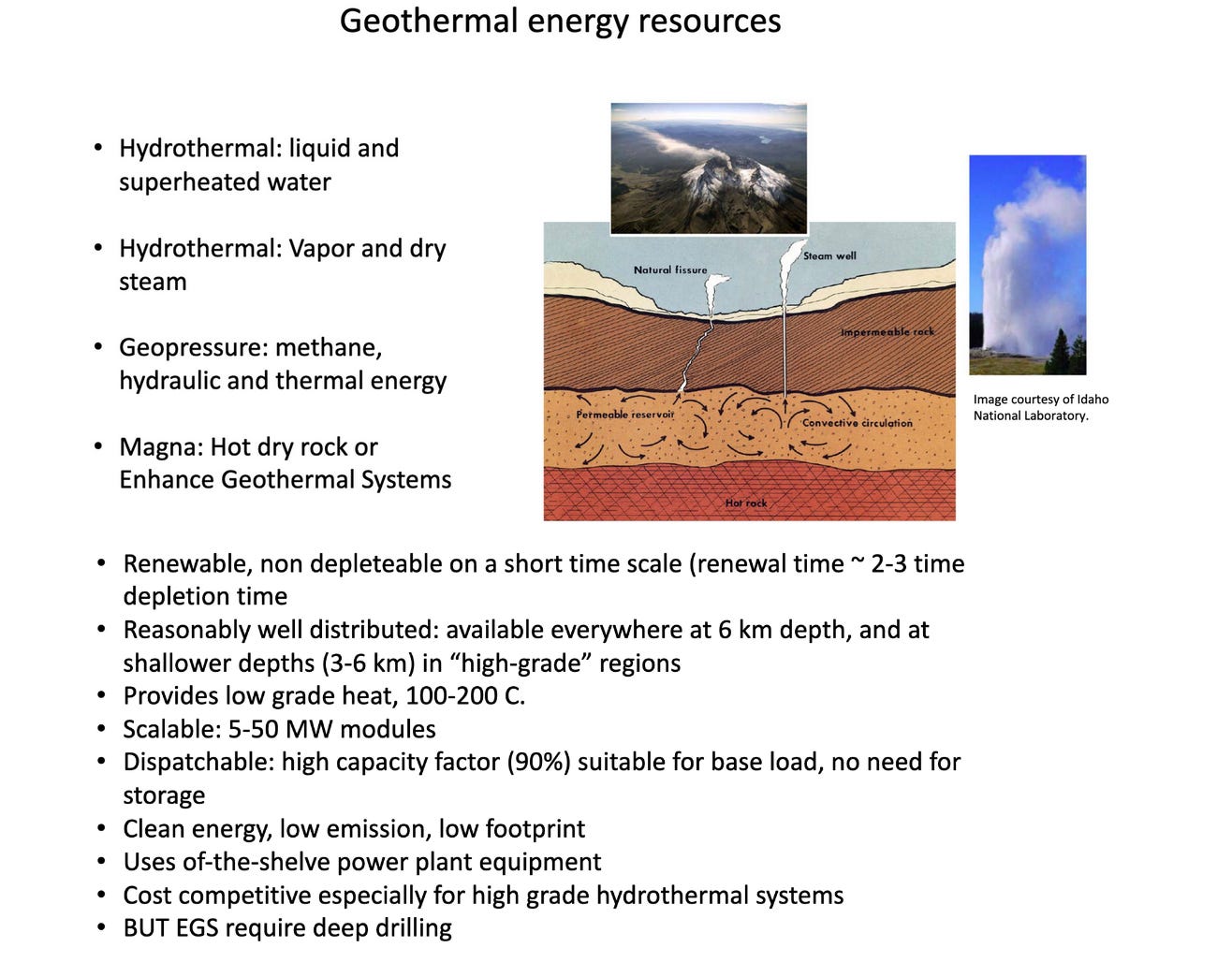

Like thermodynamics, geothermal has its own three laws about depth, heat, and flow:
- First Law: Completed well cost increases exponentially with depth
- Second Law: Power plant cost decreases linearly with temperature
- Third Law: As resource quality decreases, drilling costs dominate

Also of interest: a recent paper on enhanced geothermal systems, the tech that startups like Fervo Energy are betting on to make geothermal scalable.
Interesting Video: The Forbidden Knowledge of Washers
More about washers than you thought you ever needed to know: history, types, manufacturing, and why they matter.
"In a world of increasingly complex technology, the washer reminds us that true engineering brilliance often lies not in complication but in the refined perfection of the fundamentally simple."
Interesting Chart: Airbus A320 Antenna & Probe Locations

In aircraft, most probes and antennas are redundant by design. In practice, whether that redundancy is used depends on system architecture.
The Boeing 737 Max is a classic example of one of the biggest engineering failures in modern history. The plane had two Angle of Attack (AOA) sensors, but the original MCAS software pulled input from only one. MCAS (Maneuvering Characteristics Augmentation System) was designed to automatically push the nose down if it sensed the aircraft was at risk of an aerodynamic stall. Without cross-checking between sensors, a single bad AOA reading could trigger MCAS repeatedly, a failure mode that contributed directly to fatal crashes and global grounding of the fleet in 2020.
Manufacturing & Startup News
More leftovers from our weekly research:
- Agility Robotics is reportedly raising $400M for humanoid warehouse robots, valuing the company at $1.75B.
- Divert secured $90M in project financing to build a food-to-energy facility in North Carolina.
- The Canadian Nuclear Safety Commission issued a construction licence for the BWRX-300 SMR, expected to contribute over $10.5B to Canada’s GDP.
- Fourier raised $18.5M in Series A for hydrogen electrolyzers inspired by data centers.
- Phlux Technology raised $12M in Series A funding for their infrared sensor technology.
- Portal Space Systems raised $17.5M in seed funding to develop solar-heated spacecraft for rapid orbital maneuvers.