

Interesting Links 🏭
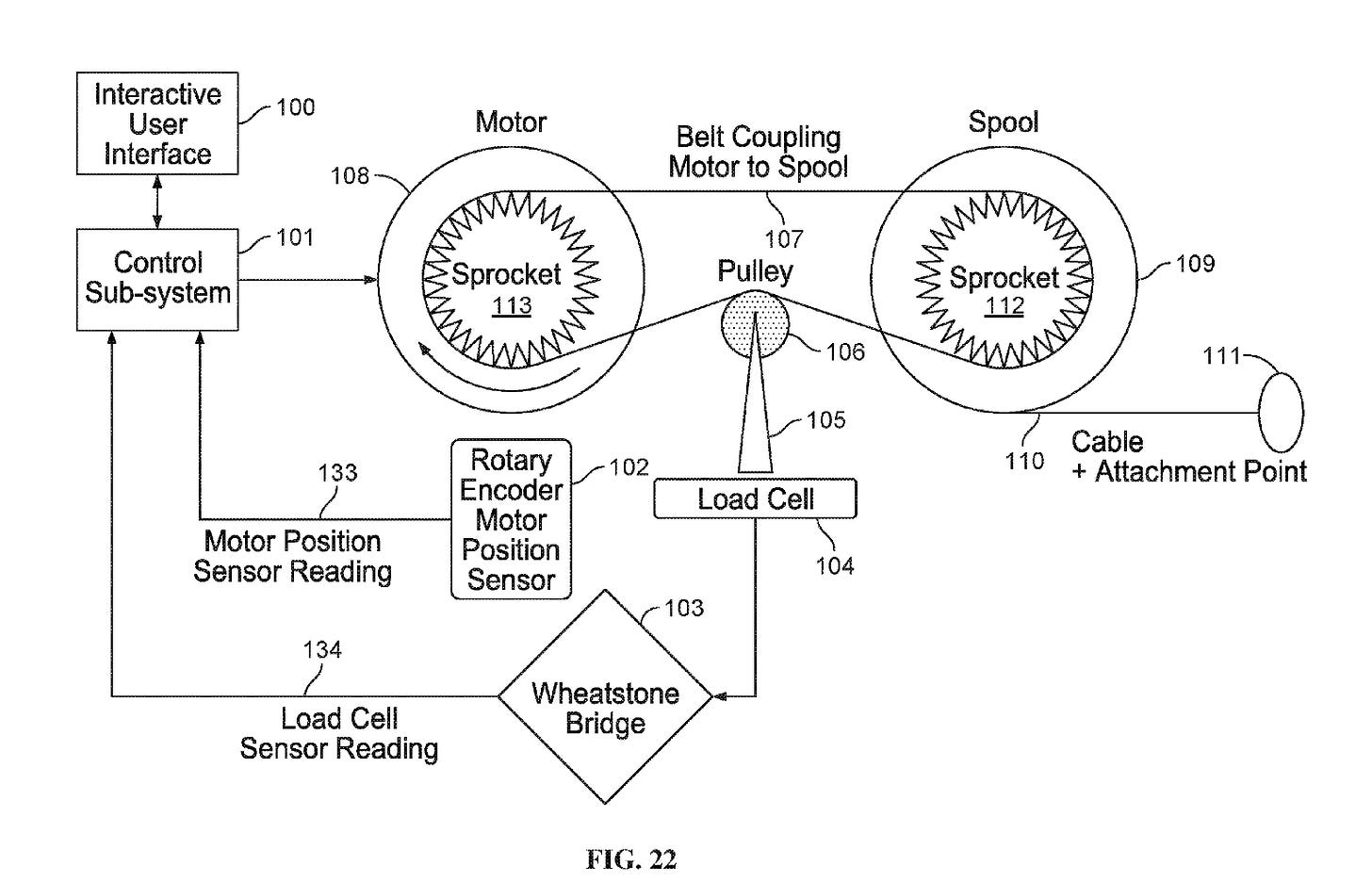
- Did you know the earliest vision for at-home digital fitness came from video games, specifically the Nintendo Wii? A patent from Tonal (circa 2012, US8287434B2) explicitly cites exercise and fitness video games like Wii Fit, EA Sports Active, and Zumba Fitness as inspiration. Systems like Tonal’s that use digital weights rely on a clever interplay of motors, sensors, and control algorithms to recreate the feel of real resistance. A 3-phase motor (typically BLDC or induction) is coupled to a spool that winds a cable connected to the actuator (handle). The core operating principle is a software-controlled feedback loop that adjusts motor torque in real time to simulate resistance profiles—ranging from weight stacks to custom strength curves. Sensor data from encoders and load cells (position, velocity, force) feed into dynamic models that compute the required torque, which result in a programmable resistance that mimics traditional weights. The full system spans several patents, but this one nails the core idea.
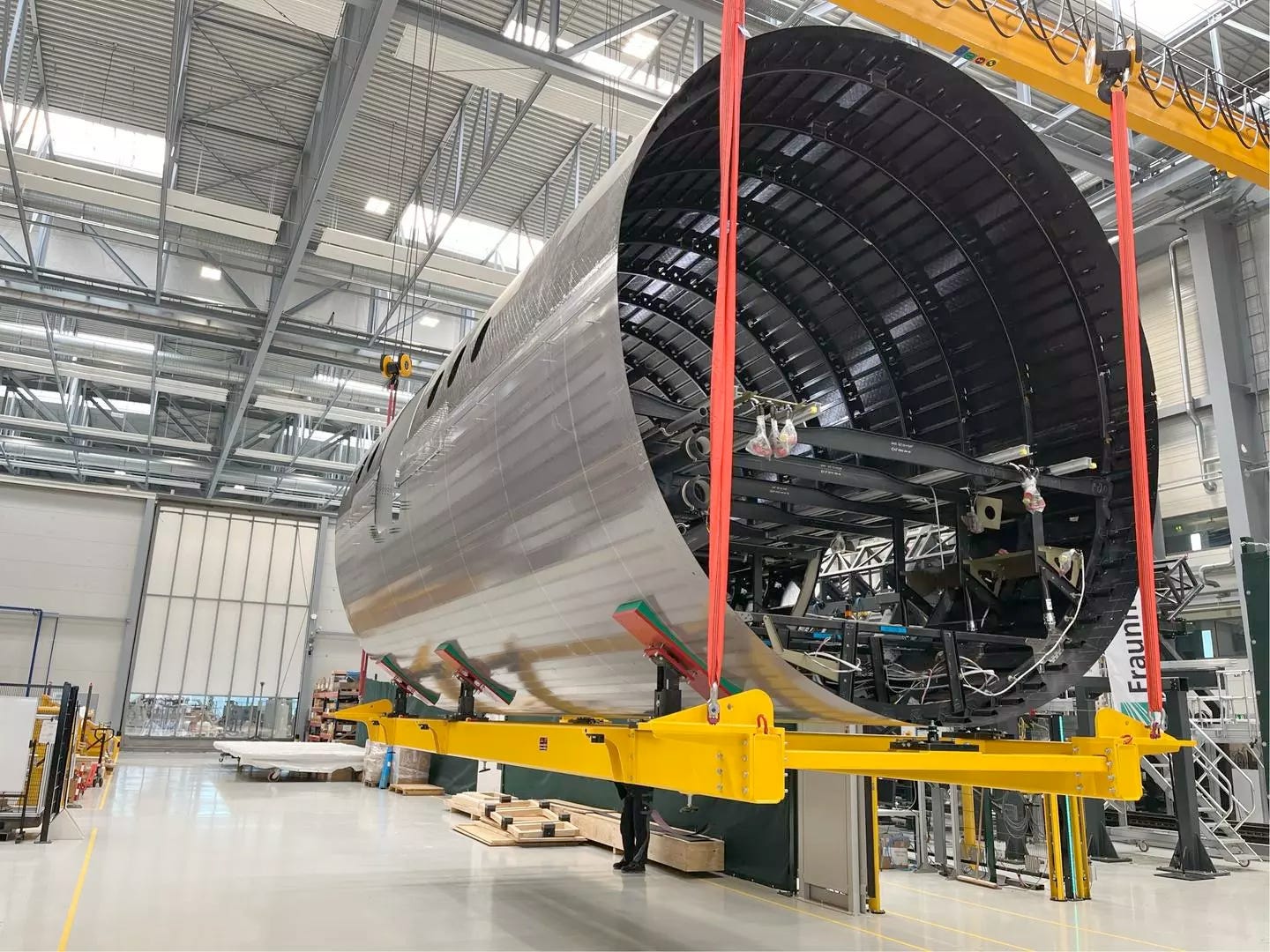
- Airbus and Boeing are preparing for a major leap in jet production—up to 100 narrow-body aircraft (e.g. single-aisle) per month—as they explore new materials and faster manufacturing methods for future 737 and A320 replacements. For context, Airbus produces ~50 A320s a month, with Boeing trying to get 737 output up to 38. Both are built mainly from aluminum using decades-old manual riveting and semi-automated assembly. While no new aircraft launch is imminent, both companies are studying thermoplastic composites and robotic assembly to support faster, higher-volume production. Airbus recently unveiled a thermoplastic fuselage demonstrator made of two half-shells joined with ultrasonic welding. Full notes on the state-of-the-art in aerospace thermoplastics linked here.
- In a world dominated by data, investing in a book-scanning robot actually makes a lot of sense. These machines follow a surprisingly elegant process: a book is placed in a V-shaped cradle, a page separation mechanism (often using vacuum suction) lifts and flips the pages, and an image system captures each spread. Systems like the ScanRobot can process up to 2,500 pages per hour and are used by institutions with massive digitization needs (think national libraries, research universities, and archival agencies). The printing press gave us books. Now, these machines give them back to the digital world. Watch one in action here.
Noah’s Smith’s “Decade of the Battery” post from 2022 seems to be playing out well since his last update in 2024. Over the past few years, batteries have taken over almost every sector. EV sales keep growing while traditional internal combustion car sales have stalled. More investment is going into grid storage. And batteries now power everything: drones, cordless vacuums, delivery robots, farm equipment, and even traditional appliances now come with an integrated lithium-ion battery option.
The Decade of the Battery will look more like earlier decades, in which physical appliances like washing machines, refrigerators, and air conditioning were the hot new thing. The battery revolution means that the pieces of our world are starting to free themselves, get up, and move around.

- Toyota is turning its UK Burnaston plant into a circular factory (effectively a refurbishment facility). Starting in late 2025, it’ll process 10,000 end-of-life vehicles a year—stripping them down to recover 120,000 parts, 300 tons of plastic, and 8,200 tons of steel. The idea is simple: instead of leaving value in junkyards, pull it back into the supply chain. BMW, Renault, and Stellantis are all doing the same. To see what this looks like in practice, here’s a behind-the-scenes video of one of Europe’s most advanced dismantling facilities.
- A couple fun links to round out the week:
- Sam from informal built a Dunkin’ donut hole dispenser and wants to trade the licensing agreement for the design in exchange for a pontoon boat. You can read his pitch at deardunkin.com.
- If you ever needed a reason to be bullish on our line of work: Vinay Hiremath, who sold Loom to Atlassian for nearly $1B, is now studying physics and looking for a mechanical or electrical engineering internship. His viral blog post “I am rich and have no idea what to do with my life” sums it up.
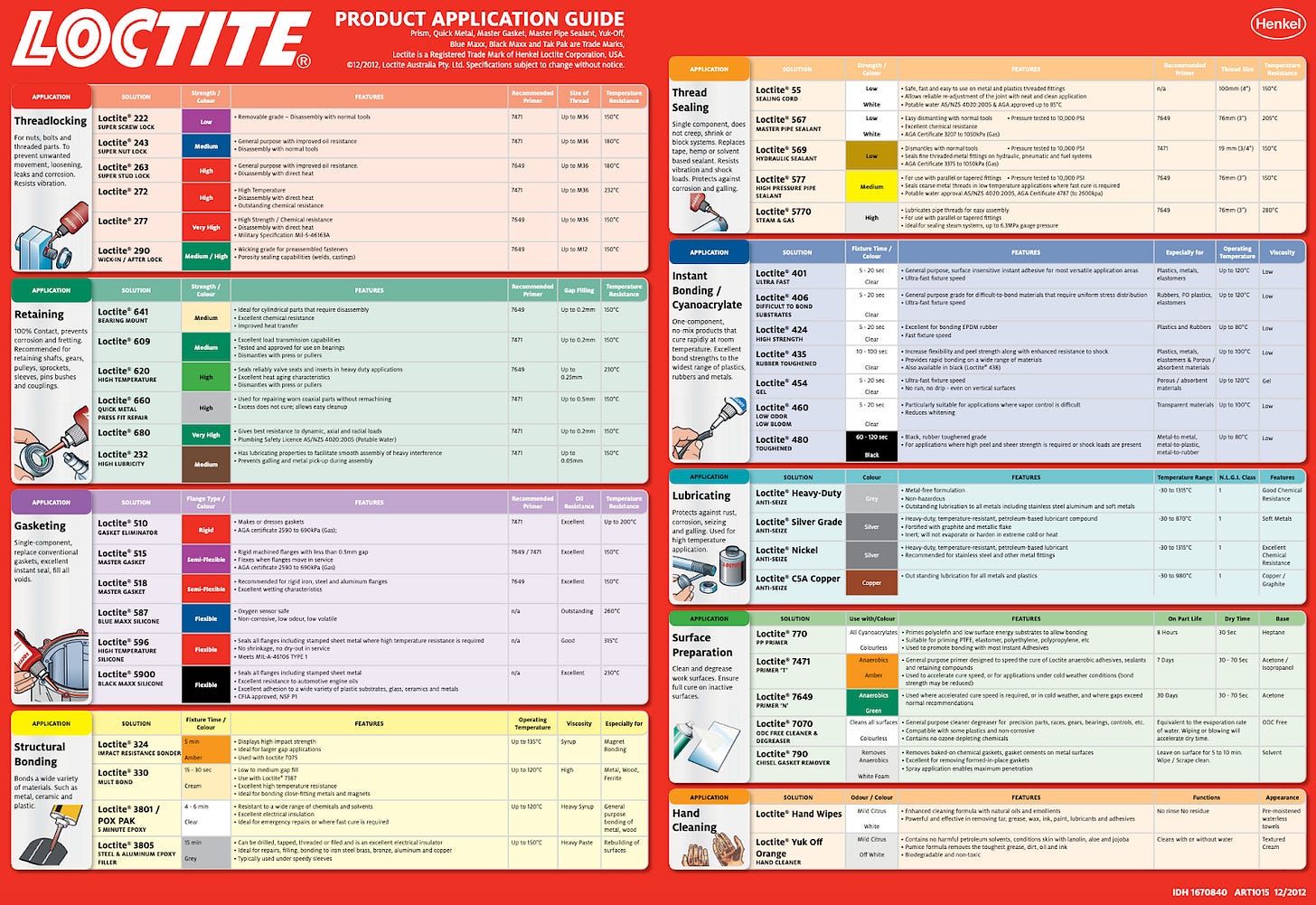
- A quick reference chart for selecting the right Loctite threadlocker based on material and surface type. High-res. wall chart linked here.
Startup News 🚀
- Rivian has spun out a stealth micro-mobility team into a new startup called Also, backed by $105M from Eclipse Ventures. Their first product is an “e-bike” that will debut later this year, with production slated for 2025. Rivian CEO RJ Scaringe, who chairs the board, sees an opening to undercut today’s overpriced e-bikes by applying Rivian’s tech stack and scale. The company’s broader mission is to build small EVs for consumer and commercial applications, with an e-bike as the first form factor
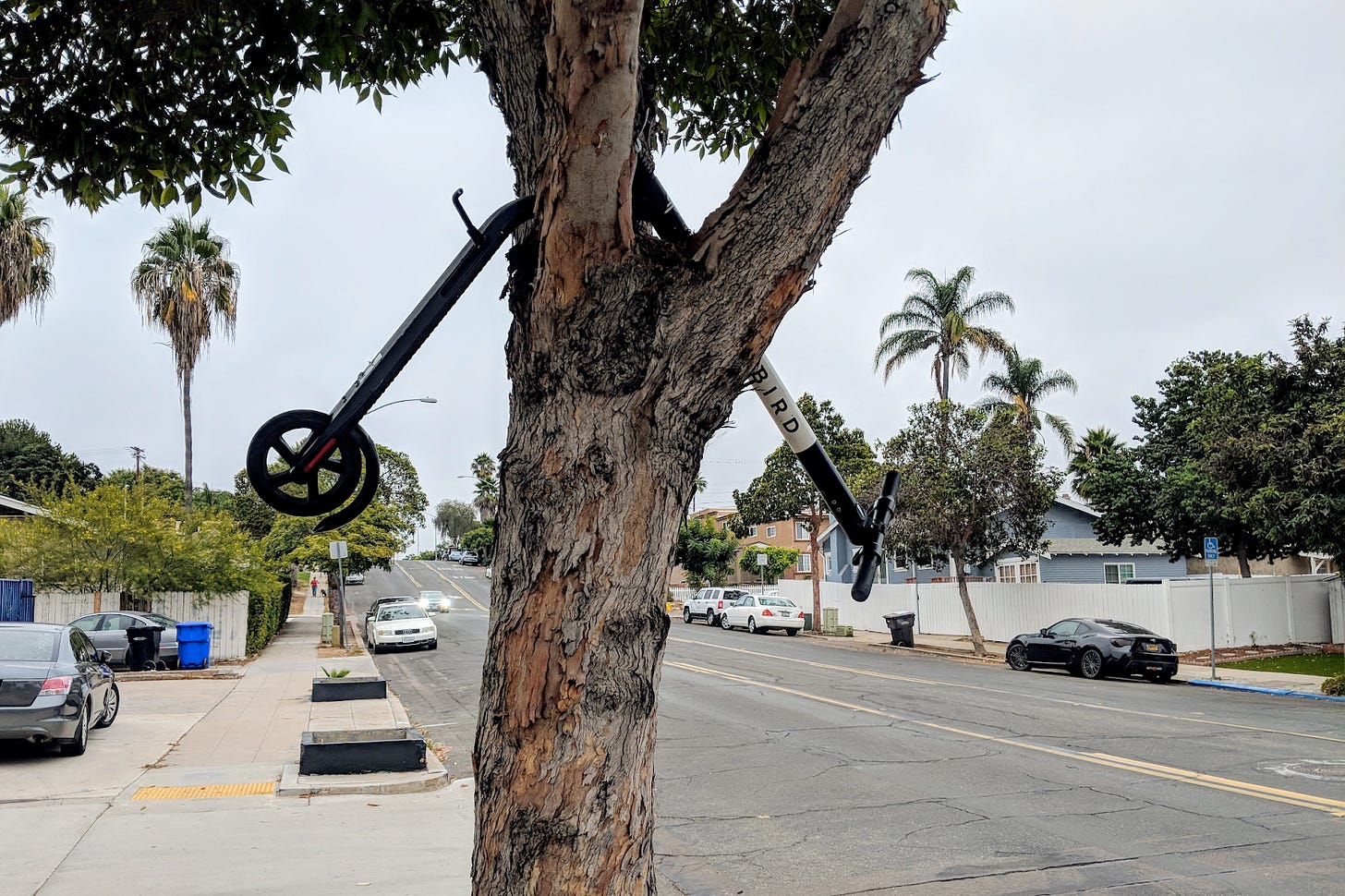
- Note: We’ve been skeptical of micro-mobility — anyone remember Boosted’s high-profile bankruptcy or the viral clips of Uber’s Jump bikes getting crushed in landfills? That said, the global e-bike market was $41B in 2020 and is projected to reach $69B by 2028, so we get the rationale for new ventures in the space.
- Another co-pilot for 2D drawing startup has emerged: Hanomi raised $3M in seed funding to automatically create fully compliant 2D drawings. The general idea of startups in the space is the same: eliminate drafting work and generate drawings for part designs using LLMs. By our count we’ve now noticed three startups all with the same idea: Drafter, DraftAid, and now Hanomi.
- New funding rounds in the robotics sector:
- Contoro Robotics raised a $12M Series A to scale its AI-powered trailer and container unloading robots, targeting one of the last holdouts of warehouse automation. The company plans to scale its fleet of unloading robots and expand into new logistics markets and launch their next gen. Palletizing system. The round was backed by Doosan, Coupang, and Amazon’s Industrial Innovation Fund among existing investors.
- Dyna Robotics raised a $23.5M seed round to commercialize low-cost, task-specific robots as a stepping stone toward general-purpose embodied AI. The Redwood City-based company is starting with simple tasks like folding and food prep using stationary robotic arms. The round was co-led by CRV and First Round Capital, with backing from a team of founders with prior exits and DeepMind research experience.
- Brain.space has raised $11M in Series A funding to grow its Brain-Data-as-a-Service platform, which captures high-resolution brain activity using 115 EEG sensors. The company is building large-scale mental models designed to predict human behavior by decoding neurological patterns. Since emerging from stealth in 2022, Brain.space has conducted experiments with astronauts aboard the International Space Station, measuring brain activity before, during, and after spaceflight. The round was led by Toyota Ventures, with an additional $3.5M in non-dilutive funding from the Israel Innovation Authority.