Interesting Links
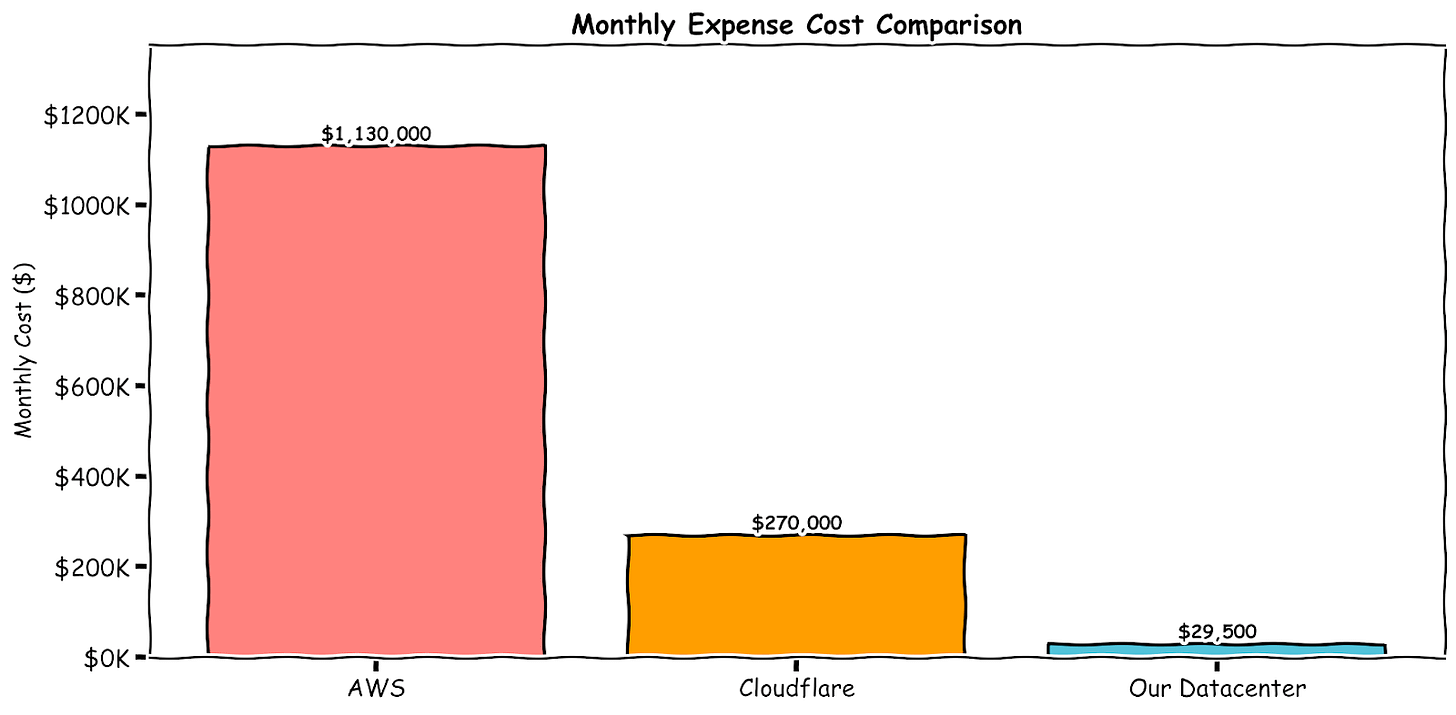
How to Rack 30 Petabytes of Storage walks through how a startup built a storage cluster for 90M+ hours of video data in a colocation facility over the course of a weekend—and why it’s always worth questioning default assumptions. In this case: why petabyte-scale datasets belong in cloud services like AWS (1 PB ≈ 1 million GB). Instead of paying roughly $12M/year on AWS, the team rented space from a San Francisco colocation center and stacked 2,400 used enterprise hard drives, bringing total costs to $29.5k/month (after $426.5k in upfront hardware and setup costs). The cluster itself was assembled in just 36 hours during a drive-stacking marathon with friends and contractors, closer to a hardware hackathon project than the months-long data center deployments this kind of infrastructure usually requires.
Walter Isaacson’s biography of Elon Musk recounts a similar instinct during his early days at Twitter: a Sacramento data center cost over $100M per year, and engineers internally estimated it would take six to nine months to shut down safely and migrate traffic to one of Twitter’s other data centers in Portland. Upon hearing the timeframe, Musk instead flew to the facility and began personally unplugging and wheeling out server racks to speed up the shutdown. He later admitted the maneuver was a mistake, as tens of thousands of hard-coded references were scattered throughout the codebase, but the episode reveals the same core instinct: question assumptions, move faster than the organization thinks is possible, and accept breakage as the price of speed.
- Introducing the POC Valley, the inaugural publication from Deploy ’95, looks at why most industrial technology startups die between proof-of-concept and deployment. Of deals that reach proof-of-concept, only 5% convert to deployment. (In manufacturing, a POC is typically a limited trial where a vendor installs its technology on a single production line or process). The piece breaks the problem into four recurring causes:
- Missing business urgency: technical excitement doesn’t necessarily translate into budget authority.
- Misaligned stakeholders: late-arriving decision-makers raise questions unrelated to the core technology but critical for deployment.
- Procurement systems built for incumbents: processes designed for billion-dollar suppliers choke on a $20K pilot from a three-year-old startup.
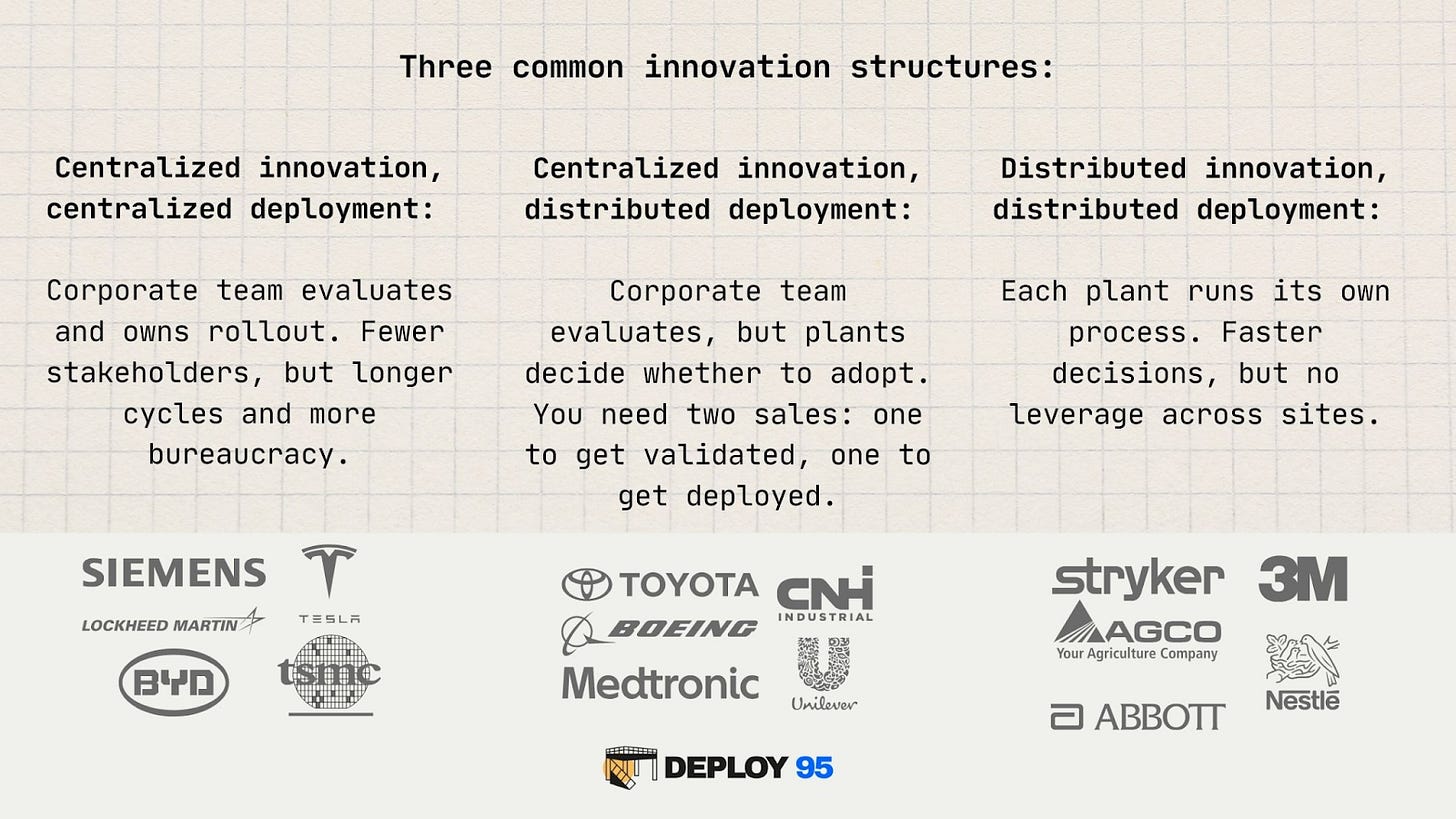
- Innovation teams disconnected from operations: central groups can approve a POC but lack authority to drive adoption on the factory floor.
The author’s practical takeaway is straightforward: start at the plant if you want true deployment, working from the factory floor outward instead of through centralized innovation teams.
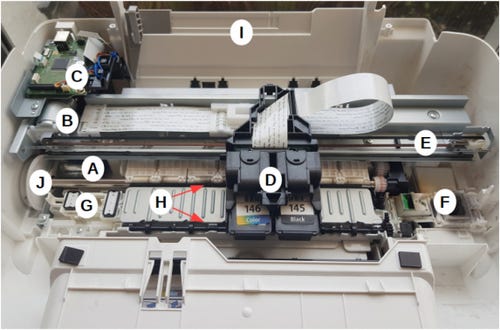
- InkFiltration is an academic paper demonstrating how inkjet printers can be turned into acoustic covert channels for exfiltrating data from air-gapped networks. The attack injects imperceptible light-yellow rectangles into print jobs; these trigger the printer’s multi-pass mode, modulating the timing of paper roller activations to encode binary data that a nearby smartphone can record and decode. The bit rate is slow (~0.5 bps), but sufficient for passwords. Printers are ideal targets because they’re shared, accessible, and their mechanical noise is something people learn to completely ignore. The paper’s broader catalog is worth noting where acoustic, optical, electromagnetic, thermal, magnetic, and vibrational emissions have all been exploited as out-of-band covert channels. Ed Yong’s An Immense World calls this umwelt: every organism perceives only a thin slice of the physical world around it. Every device you build is potentially broadcasting on channels you aren’t listening to; someone else might be.
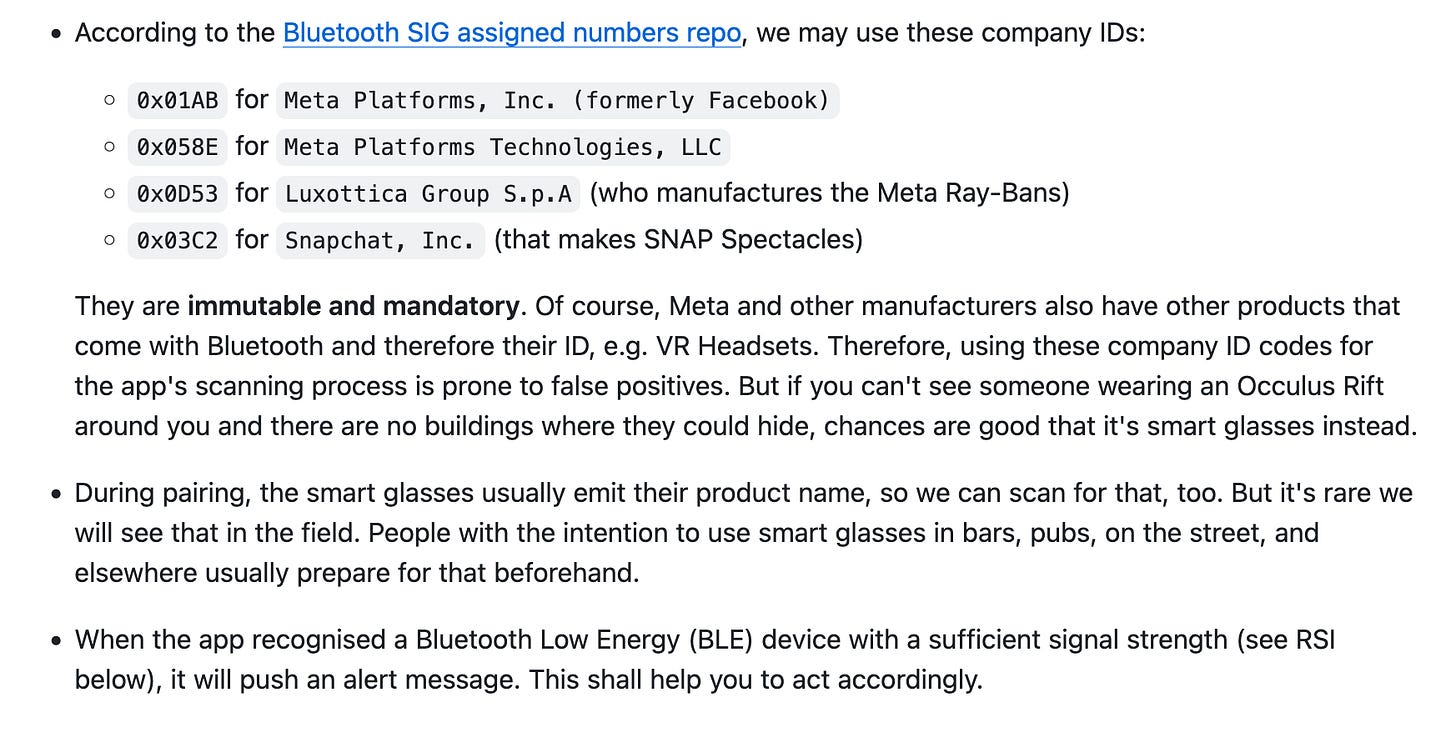
- A small but growing countermovement is taking that seriously: 1) Nearby Glasses scans BLE advertising frames (short broadcast packets sent before any connection is established) for manufacturer IDs associated with companies like Meta, Luxottica, and Snap; 2) Spectre I jams nearby microphones with inaudible signals. The threat model used to be nation-states and air gaps; now it's the device in everyone's pocket.
- Two useful references: a hardware acronym glossary and a manufacturing term glossary. Hardware engineering produces a remarkable amount of three and four-letter shorthand (EVT, DVT, PVT, NPI, ECO) until entire discussions read like alphabet soup. Not a great convention, since at times they double as a mild form of knowledge gating, but in practice they’re a necessary evil.
Startup News
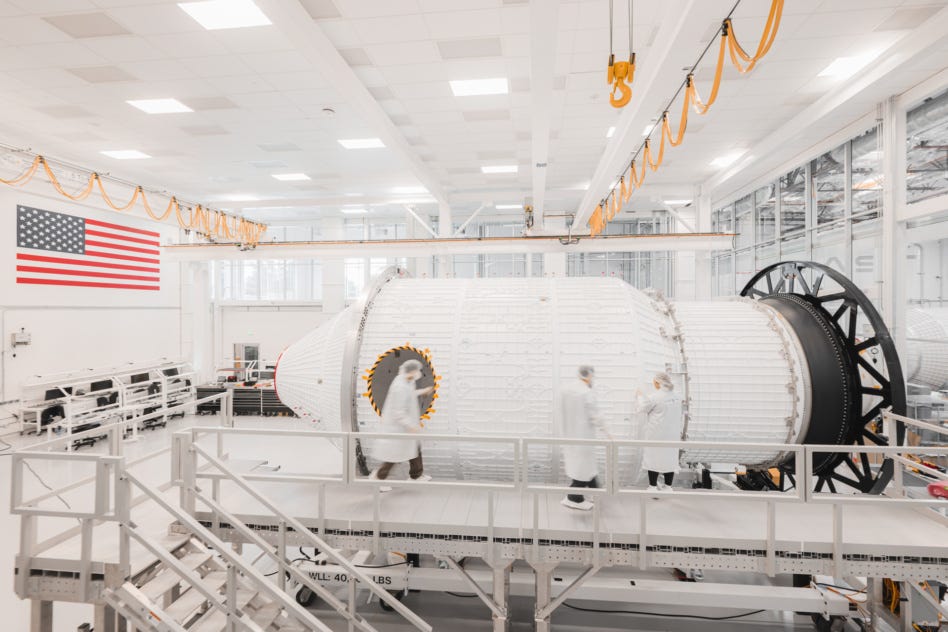
- Vast raised $500M in new financing ($300M Series A equity and $200M in debt) to continue development of its Haven commercial space stations. The company plans to launch the single-module Haven-1 pathfinder in 2027, followed by the larger Haven-2 station beginning in 2028 as a proposed commercial successor to the International Space Station, which is scheduled to retire around 2030. Vast is one of several companies—including Axiom Space, Blue Origin / Sierra Space (Orbital Reef), and Voyager Space / NanoRacks (Starlab)—competing to build the first privately operated stations in low Earth orbit after the ISS retires.
- Sierra Space raised a $550M Series C at an $8B valuation to expand spacecraft production and grow its national security business. The company is developing the reusable Dream Chaser, a runway-landing cargo vehicle designed to carry supplies to orbit and return payloads to Earth, originally built for ISS resupply but increasingly positioned for commercial space stations and defense logistics missions. Sierra Space is also developing inflatable station modules and is a partner in the Orbital Reef project (Blue Origin’s planned commercial space station). The round was led by LuminArx Capital.
- Nominal raised an $80M Series B-2 round to expand its platform for managing engineering and test data from complex hardware systems. The platform captures and structures telemetry and test data from hardware systems, replacing legacy test software and ad-hoc telemetry pipelines. The round was led by Founders Fund with participation from Sequoia and General Catalyst, among others.
- SPAN, a startup building software-defined residential electrical panels, announced a partnership with Eaton, including a $75M investment to expand distribution of its smart panels. The companies plan to co-develop panels combining Eaton’s circuit protection hardware with SPAN’s load monitoring and control software.
- After the first wave of AI wearables like the Humane AI Pin and Rabbit R1, Qualcomm introduced the Snapdragon Wear Elite, a 3nm wearable chip designed for devices such as pins and pendants. The SoC integrates a Hexagon NPU and low-power eNPU capable of running small on-device models (~2B parameters) and camera-based vision workloads.
A pair of large space funding announcements this week: