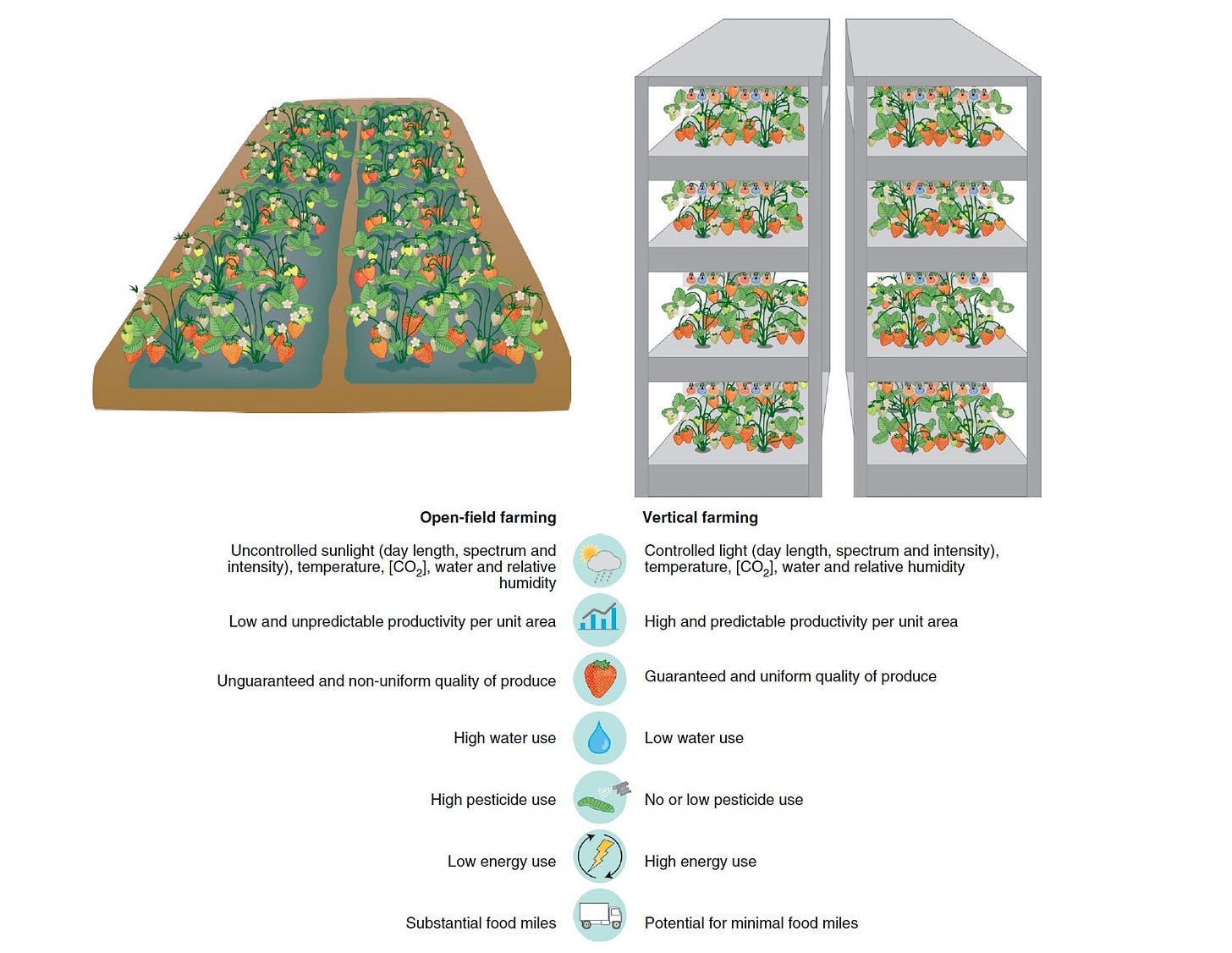
When the music stops and the funding dries up, all that’s left are unit economics. Vertical farming raised billions over the last decade on the promise of local, soil-free produce; this piece looks at what’s left now and how some are still trying to make the model work. The vision of vertical farming is simple: grow up instead of out, especially when half the world’s habitable land is already farmland. In practice, what happens is that you trade a land problem for an energy problem where the economics of vertical farms are tied to the price of electricity. For example, in the UK, growing a kilogram of lettuce can cost £3–£5 in energy alone already matching its retail price. Existing companies today are now leaning into high-margin crops (strawberries, herbs, etc.) or moving to container farms where margins still exist. As put by the WSJ:
Profits have been tough to come by, however, because the hardware-intensive indoor facilities are generally harder to scale than, say, software developers. And increasingly costly multilevel facilities have relatively high energy costs as they grow commodity crops largely undifferentiated from those of field farms. .
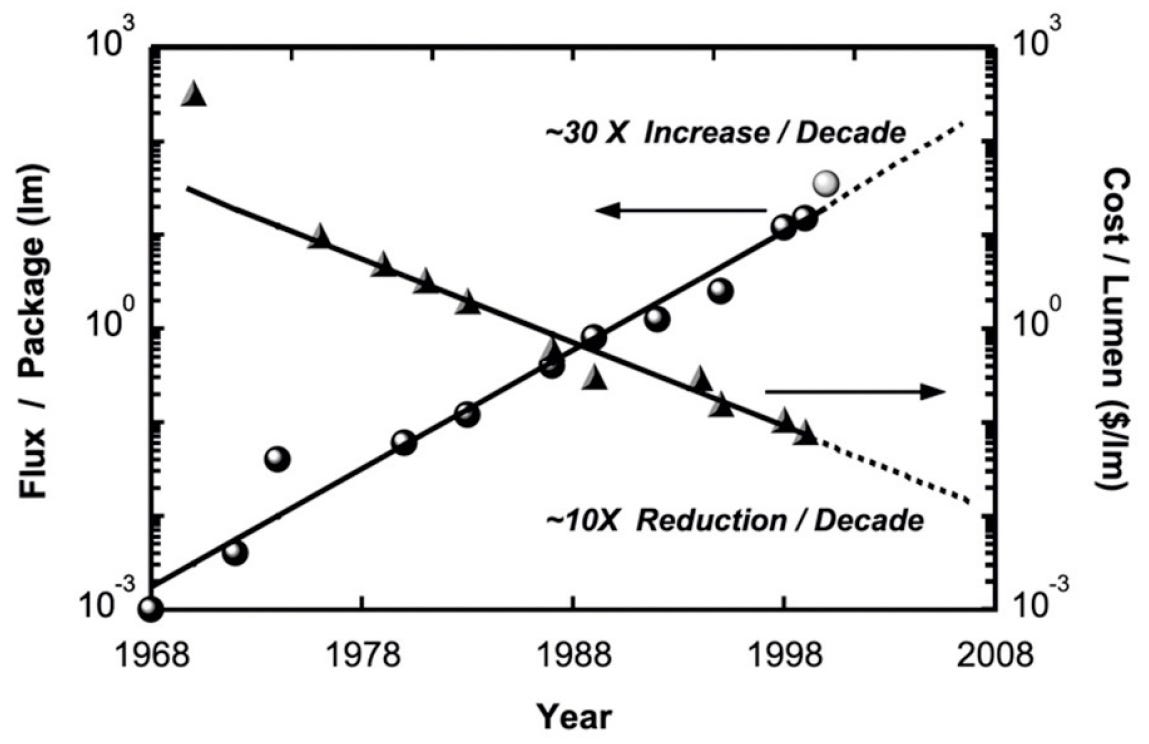
Haitz's Law is the LED equivalent of Moore’s Law. Coined by Roland Haitz, it predicts that every decade LED brightness increases by a factor of twenty while the cost per lumen drops by a factor of ten. In regards to vertical farming, perhaps a revitalization may come when the next efficiency drop occurs.
A surprisingly effective waterproofing method for electronics is to hermetically seal a PCB in a giant brick of wax. Encasing a board in wax isn’t something seen in modern assembly lines—wax lacks the durability, temperature resistance, and process control required for production—but works as an easy solution for hobbyists at home. The closest production comparison is potting, where a PCB is physically encapsulated in resin (e.g. underwater urethane compound) to create a permanent, waterproof block for use in harsh environments like maritime applications. Highest level of protection, but makes rework or inspection nearly impossible.
This is part of Project Bob, where two engineers are attempting to livestream a 25,000-mile journey on an autonomous drone boat that hopefully doesn’t sink.
Potted PCB Example
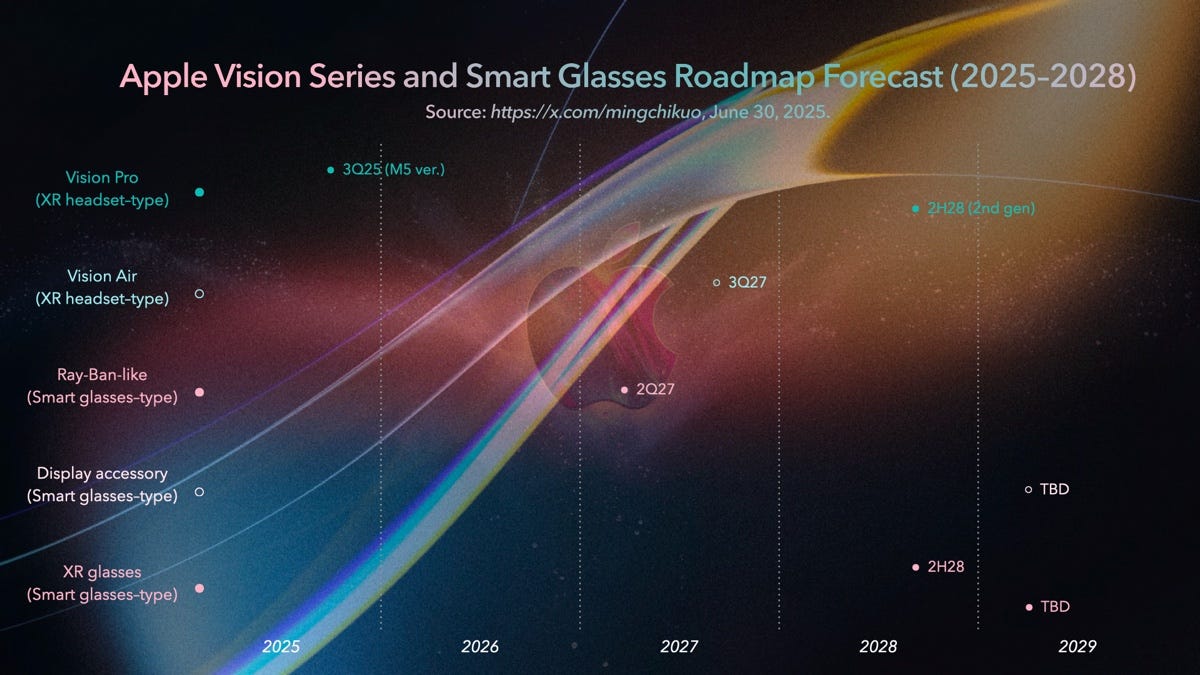
From “The Most Accurate Apple Analyst in the World”: a look at Apple’s head-mounted product roadmap over the next 2–3 years. No new launches are expected in 2026, but seven projects are in development—three Vision series (Vision Pro, Vision Air, Vision Pro 2nd Gen) and four smart-glasses variants aimed at competing with Meta’s Ray-Ban smart glasses. This isn’t a prediction on product adoption, just an observation: Apple did overshoot production on the first gen. headset and carried surplus inventory (100,000+ units) to sell through 2025. Luxshare, the Vision Pro CM, was reportedly told that the factory “might need to wind down” manufacturing last Fall.
For vision systems alone, we recommend The Foundations of Computer Vision from MIT Press, a free, high-quality textbook. It covers the spectrum from image formation and representation to modern machine learning techniques like neural networks. An excellent reference that bridges classical computer vision methods with their modern learning-based counterparts. For instance, motion estimation, a key topic in computer vision, traditionally relies on optical flow algorithms, but the book also explores equivalent supervised and unsupervised learning approaches.
A couple fun links:
CAD speedrunning is turning into the next e-sport: get a 2D drawing, and race to model it from scratch.
This is the profile on Ming-Chi Kuo, coined by many as the best Apple analyst on the planet. Track record is included, and he makes his predictions by tapping into their supply chain months before a keynote.
Allspice.io raised a $15M Series A funding round to expand its collaboration platform for electrical engineers. Designed as the GitHub for hardware, AllSpice lets teams review and comment on PCB and ECAD files directly—formats that don’t translate well over Slack or email. Their platform integrates with existing workflow tools like CAD and PLM systems and current customers already include Blue Original, Bose, and Tools for Humanity. The funding round will go toward hiring and launching a close-beta AI agent that can validate designs and catch errors early.
Nascent Materials launched from stealth with a $2.3M seed round to develop new ways of producing lithium-ion battery cathode materials. The company’s process enables the use of lower-purity domestic raw materials, reducing reliance on Chinese supply chains. The startup aims to scale production for multi-kilogram batches and expand into nickel-manganese-cobalt (NMC) and lithium-manganese-rich (LMR) chemistries to meet rising demand from U.S. battery producers. SOSV led the round.
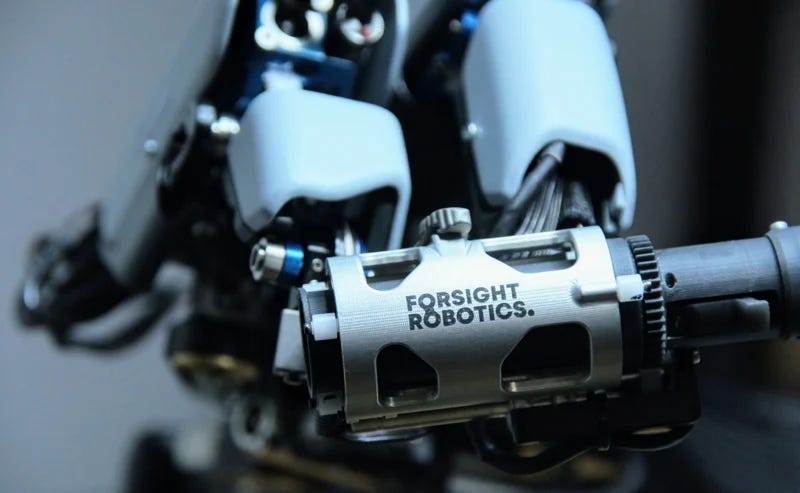
ForSight Robotics raised a $125M Series B funding round to advance its robotic system for ophthalmic surgery platform. Their system uses computer vision and micromechanics to automate eye procedures like cataract surgery, aiming to improve outcomes and address growing global demand. First-in-human trials are expected later this year, following successful animal studies and key regulatory milestones. The funding comes as the number of ophthalmologists is projected to drop 12% by 2035.
Galbot, a startup specializing in embodied AI, raised a $153M funding round bringing its total funding to over $330M since 2023. The Beijing-based startup builds wheeled humanoid robots with dual arms, deployed in factories at Mercedes-Benz and Zeekr for tasks like packaging and inventory handling. The funding will support development of its embodied AI models and expand industrial automation efforts through new partnerships like Bosch’s Boyuan Capital.