

Interesting Links 🏭
- A primer on how defense startups get funded. Most successful defense startups today don’t follow the traditional Department of Defense (DoD) acquisition path. In the legacy model, traditional primes like Lockheed or Raytheon wait for the government to define a requirement, then bid to build a custom system under a cost-plus contract. That process can take a decade to reach production, with rigid milestones (A/B/C), multi-year budgets, and extensive compliance reviews. Startups today take a different route: build a working product with private capital, then sell it under newer contracting mechanisms like OTAs (Other Transaction Agreements) or through the Middle-Tier Acquisition (MTA) pathway, which allow the DoD to prototype and field tech. without going through the full process. Venture capital buys speed, and DoD contracts buy scale and durability.
- This is a snapshot of the legacy acquisition process, tracking how programs advance through each milestone with layers of documentation and oversight. The chart itself is overwhelming—which is kind of the point; the process really is that dense!
- From two years of detailed analysis at Bedrock Materials: an open-source technoeconomic model for evaluating sodium-ion batteries. As lithium prices spiked in 2022, sodium-ion was widely assumed to be a cheaper alternative that traded energy density for lower material costs and better raw material availability. Bedrock set out to test that assumption. The conclusion: even under optimistic assumptions, sodium-ion cells remain more expensive than lithium iron phosphate (LFP) per kWh mainly due to lower volumetric energy density which drives up packaging and processing costs. Cost parity would require lithium carbonate to exceed $44/kg (currently <$10), or for both sodium cathode and anode materials to hit unlikely performance and manufacturing breakthroughs. Full whitepaper here.
- Note: LFP is a widely used, low-cost lithium-ion chemistry; primarily used in EVs and stationary storage
- New from Honda: not a car, not a bike, a rocket! A surprising new player has entered the reusable launch vehicle (RLV) market, and it’s not a startup. Honda, an enigmatic transportation conglomerate known for everything from bicycles to airplanes, has long supplied components for space launch vehicles. Last week, Honda joined the small club of companies demonstrating a reusable rocket with a successful vertical takeoff and landing test (a prototype that reached 900 feet). Honda aims to achieve a suborbital launch by 2029, targeting small satellites unsuitable for larger platforms like SpaceX’s Falcon 9. Technical details about the rocket are limited, but footage suggests it uses cryogenic propellants, likely a methane-liquid oxygen mix.

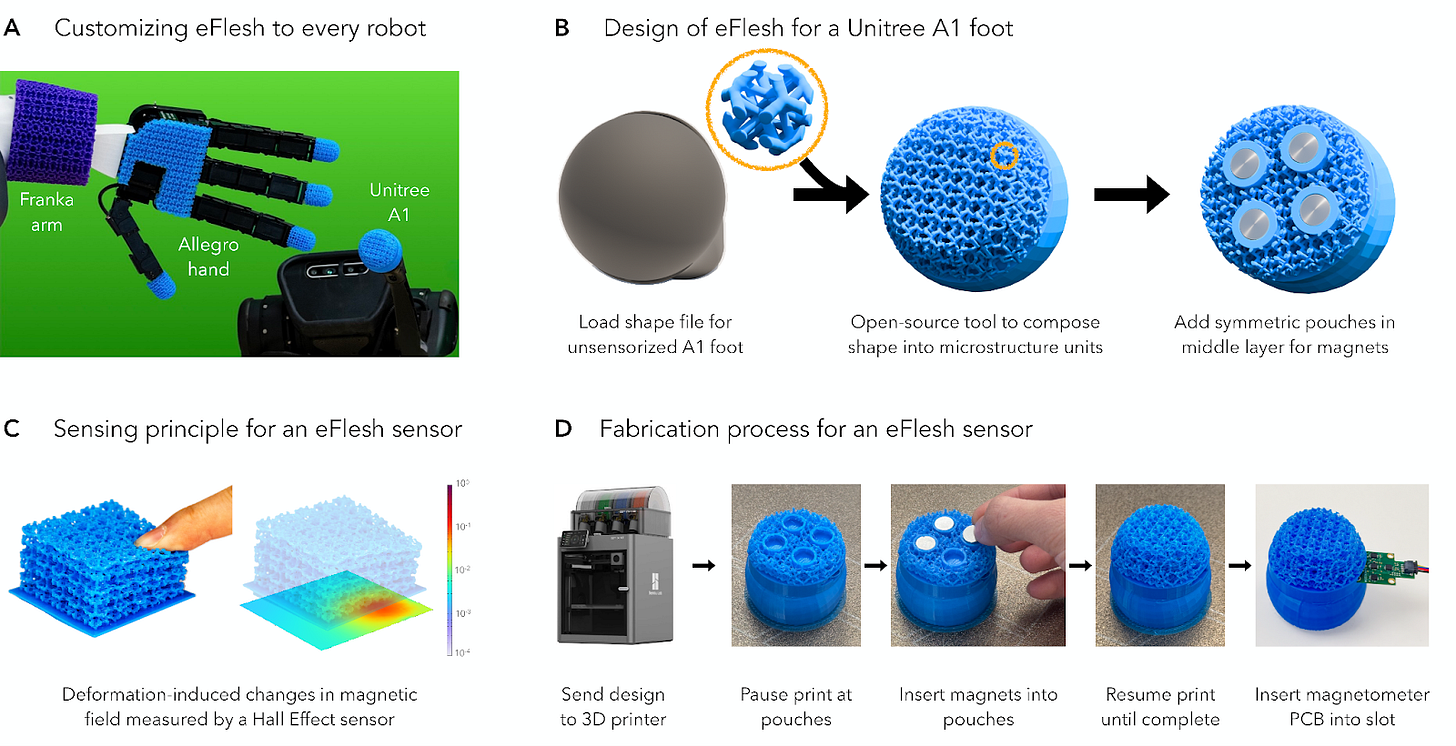
- eFlesh is a low-cost, customizable, 3D-printable tactile sensor for robots. It works by 3D printing a flexible, sponge-like mesh and embedding small magnets at fixed positions during the print. When a force is applied, the magnets shift slightly and a nearby magnetometer detects these movements to infer the magnitude and direction of the touch. The set-up enables more precision manipulations in tasks where the robot can “feel” alignment or applications like gripping objects when slippage can be sensed. Full paper here.
- Drilling deep into the Earth’s crust is challenging. Below 3km, temperatures can exceed 500°C, and pressures become extreme. Traditional mechanical drilling relies on rotating drill bits to grind through rock, but at such depths, high temperatures and pressures cause bits and drilling fluids to degrade rapidly. Replacing worn components is increasingly difficult as depth increases, requiring equipment to be hauled up and down long boreholes. Millimeter-wave drilling overcomes these issues by using electromagnetic waves (30–300 GHz) to melt and vaporize rock, effectively acting as a contactless, directed-energy drill. Quaise Energy is leading the commercialization of this technology and recently demonstrated its potential by drilling through granite and basalt at a test site near Houston TX, using a 100-kW gyrotron integrated into a hybrid drilling rig.
- Some fun links to round out the week:
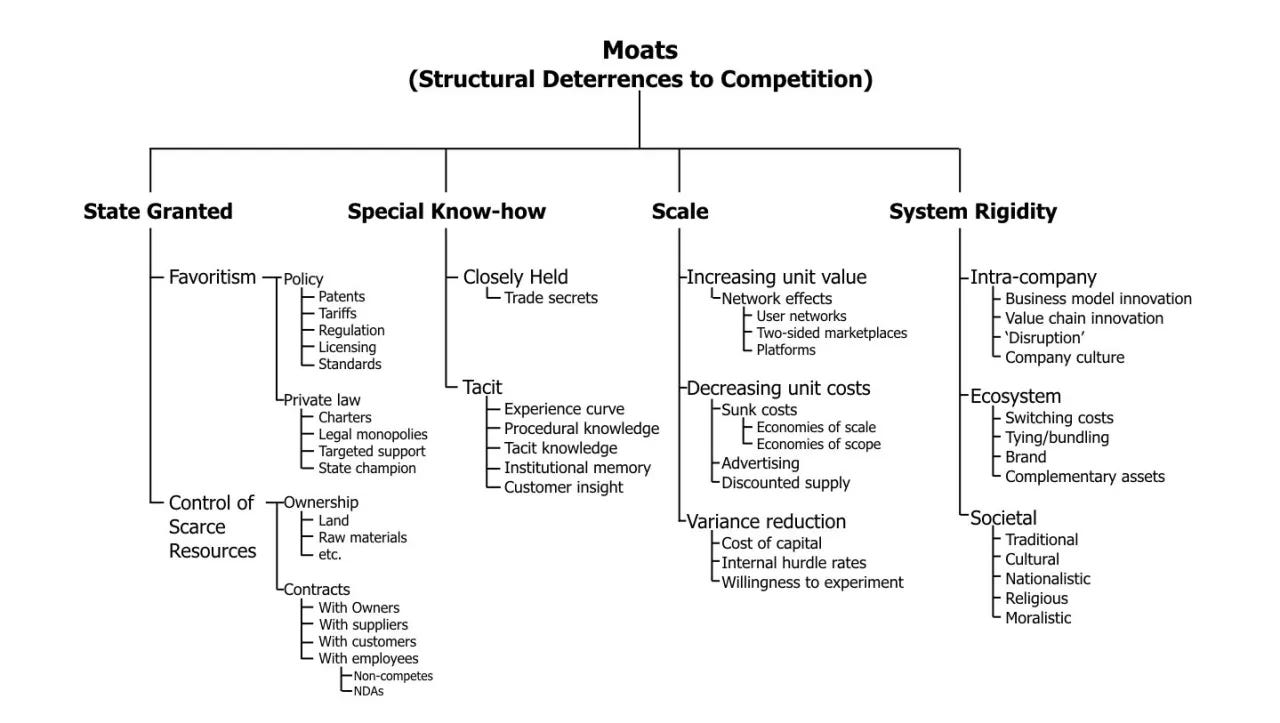
- Leaning on the philosophical side of building a company—most startups don’t begin with a moat. What protects them early on isn’t defensibility, but uncertainty itself as the early moat: the idea is too small, too weird, or too early for others to bother copying. That ambiguity is the founder’s initial advantage to buy time and build something real.
- A silkscreen easter egg from the Bose hardware team.

🗓️ Upcoming Events
6/26 – Injection Molding Defects (and How to Design Around Them) (Online)
7/15 – Cofactr CA-01 Warehouse Tour (Long Beach, CA)
Join Cofactr and friends for a behind-the-scenes look at their new SoCal operation.
10/21–22 – Product Development Expo 2025 (Mesa, AZ)
A hands-on training workshop for working engineers about tolerance stack-ups, surface modeling, metrology, DFM, and more. Use HFYI50 to get $50 off registration costs!
Startup News 🚀
- Senra Systems raised a $25M Series A round to automate wire harness manufacturing for defense and aerospace production. Wire harnesses are critical electrical subsystems found in every major electro-mechanical assembly (think drones, satellites, rockets), but U.S. production remains labor-intensive and is often outsourced to low-cost countries. The company is building software-defined manufacturing systems to speed up production, with current customers including Anduril and Saronic. Interestingly enough, the round was co-led by Figma CEO Dylan Field and CIV.
- Sorcerer raised a $3.9M seed round to deploy autonomous weather balloons and build AI-driven weather forecasting models. Their system collects high-resolution atmospheric data—temperature, pressure, humidity, wind—by adjusting altitude between the stratosphere and surface using only solar power without consumables (i.e. expendable weight like sand or pellets dropped to ascend). Early partners include the U.S. National Weather Service and the government of El Salvador, with applications in aviation, agriculture, and disaster planning. The round was led by FCVC.

- A new unicorn has emerged in the robotics sector: Gecko Robotics raised a $125M Series D round at a $1.25B valuation. The company builds climbing, flying, and swimming robots that inspect critical infrastructure using non-destructive testing methods like ultrasonic sensing, laser scanning, and thermal imaging to detect corrosion, material loss, and structural fatigue. Data is processed through its platform to generate predictive maintenance models and operational insights. The round was led by Cox Enterprises, with participation from Founders Fund, XN, and Y Combinator.
- Meter raised a $170M Series C round to expand its full-stack networking platform, delivering enterprise-grade hardware like switches and access points as a managed service.
- More in the defense landscape:
- Mach Industries raised $100M to expand manufacturing and scale its autonomous weapons systems that include VTOL drones, high-altitude strike gliders, and stratospheric sensor platforms.
- Applied Intuition raised a $600M Series F round to expand its autonomy and simulation tools. Already used by OEMs and AV startups, it’s now working with the U.S. Army on rapid retrofits for ground vehicles.