Highlights this week: Zero propellant space propulsion 🛸 ferroelectric capacitors for energy storage 🧢 supersonic test flight approved 🛫
📝 Featured Article: FixturFab has a great blog out with an overview of PCBA testing methods.
Interesting Links 🏭
Exodus Propulsion Technologies co-founder Dr. Charles Buhler explains how they have developed a new type of propulsion system that generates thrust without the need for any propellant. Their device creates an asymmetry in the electrostatic field, which results in a net force being applied to the center of mass of the system. Discussed in a theory-heavy presentation that eventually delves into the origins of such theories as Bob Lazar’s gravity waves in Area 51, the EM drive, mach effect thrusters, and mass anomalies from spacecraft in the Van Allen belts. The technology is being pursued by Exodus Propulsion Technologies with their first patent filed. The team intends to validate 146 vacuum chamber experiments to date with a space test soon, which will be key to proving if these results hold true.
OpenTTD is an open source simulation game based upon the popular Microprose game "Transport Tycoon Deluxe", written by Chris Sawyer. It’s a great experiment in transportation management, supply chain, and manufacturing. Both games are worth a play.
Researchers have developed the first general-purpose photonics processor in an effort to reduce the non-recurring engineering costs of designing application-specific photonic integrated circuits (ASPICs) and other FPGA-based solutions. The photonics processor combines a traditional silicon processor which configures an optical processing unit with standard functions such as arbitrary waveform generation, beamforming, etc. Photonics systems cannot be scaled down like other silicon applications, because the wavelength of light they deal with is fundamental. The reconfigurability and low-loss performance of this photonic processor represent an important advancement that could enable new capabilities in areas like wireless communications, radar, and signal processing.
Researchers at Washington University in St. Louis have developed a novel 2D/3D/2D heterostructure material that can significantly improve the energy density and efficiency of ferroelectric capacitors, a key component for electrostatic energy storage. This breakthrough allows for the manipulation of dielectric materials without losing their charge storage capabilities, enabling energy densities up to 19 times higher than commercially available ferroelectric capacitors with over 90% efficiency. These advancements are particularly crucial in sectors requiring robust power management solutions, such as electric vehicles and infrastructure development.
BryceTec, the analytics and engineering firm that partners with science and technology clients and delivers government program support, just released their much anticipated smallsat report for 2024. Smallsats are defined as 1200kg of mass or smaller and roughly 80% are for communication purposes. Some key trends which are emerging: smallsats represented 97% of all spacecraft launched in 2024, of these 66% are operated by SpaceX with the next largest operator at 7%, smallsat mass is increasing year-over-year but results are skewed by Starlink with non-SpaceX operated satellite mass stabilizing.
EvoLogics has developed the next generation of its Quadroin autonomous underwater vehicle, which is designed for efficient monitoring and surveying of ocean environments. The Quadroin AUV features a distinctive, penguin-like design that provides excellent hydrodynamic properties, enabling high speeds of up to 10 knots while minimizing energy consumption. Here’s a research paper on the hydrodynamic performance of a penguin wing and why the penguin is the fastest underwater swimmer among the wing-propelled diving birds.
A great primer on memristors from Digi-Key. Memristors are essentially a fourth fundamental passive electronic component, in addition to resistors, capacitors, and inductors. Memristors combine resistors and inductors, making a component that resists and remembers the flow of charge. This could help build electronics that can both compute and store data, similar to how neurons work in the brain (enabling more energy-efficient AI hardware). Potential applications in analog circuit emulation, memory devices, interactive art, neuromorphic computing, and advanced data storage. Experimentally, the ideal memristor has yet to be demonstrated, and there aren’t any commercially available components on the market today.
Startup News 🚀💰:
Nominal, a startup building tools and data infrastructure for complex hardware development, raised $27.5M out of stealth from Lux Capital, General Catalyst, Haystack, Founders Fund, Caffeinated Capital, and others.
Diagon has raised a $5.1M Seed round led by the Westly Group which includes an $800k SAFE the company previously announced. Diagon is building an equipment sourcing and procurement platform for process and industrial automation equipment such as those used in automotive and battery manufacturing.
Rivos has raised a monster $250M Series A in its third extension to date. The company is developing chips intended for AI applications within data centers based on a RISC-V architecture. The company’s next product is expected to be the first AI-focused RISC-V chip. Funding led by Matrix Capital Management.
Magnus Metals has raised a $74M Series B for its industry 4.0 focused digital casting platform. The process equipment Magnus produces is a blend of traditional casting and additive manufacturing and has the capability to process up to one ton of materials. Co-led by Entrée Capital and Target Global.
British Virgin Islands-based Satellogics has announced a $30M strategic investment from the cryptocurrency stablecoin foundation Tether. Satellogics sells Earth observation capabilities from its fleet of satellites which it prototypes and manufactures. After slower than expected revenue growth last year the company is redomiciling to Connecticut so it can better pursue US contracts. Strategic investor Tether is notably opaque about the reserves backing its $109B stablecoin platform, which includes $3.7B in private investments such as Satellogics.
Serve Robotics, formerly known as Postmates X, a spin-out created after Postmates was acquired by Uber had a disappointing debut on the public markets after it went through a reverse merger with a special purpose acquisition company (SPAC). With a fleet of 2k robots in SF and LA, 2023 revenues of ~$200k at a $1.5M loss which is disappointing (-$7.5k/robot!) considering the company can take orders through Uber Eats as Uber remains a 17% shareholder (Nvidia has 11%, the company is a major graphics card customer).
BOOM Supersonics XB-1 test aircraft has been cleared by the FAA to exceed mach 1 and fly supersonic in the Black Mountain supersonic corridor. The company will complete a series of 20 test flights leading up to the inaugural supersonic test with the next flight set to test the aircrafts landing gear deployment.
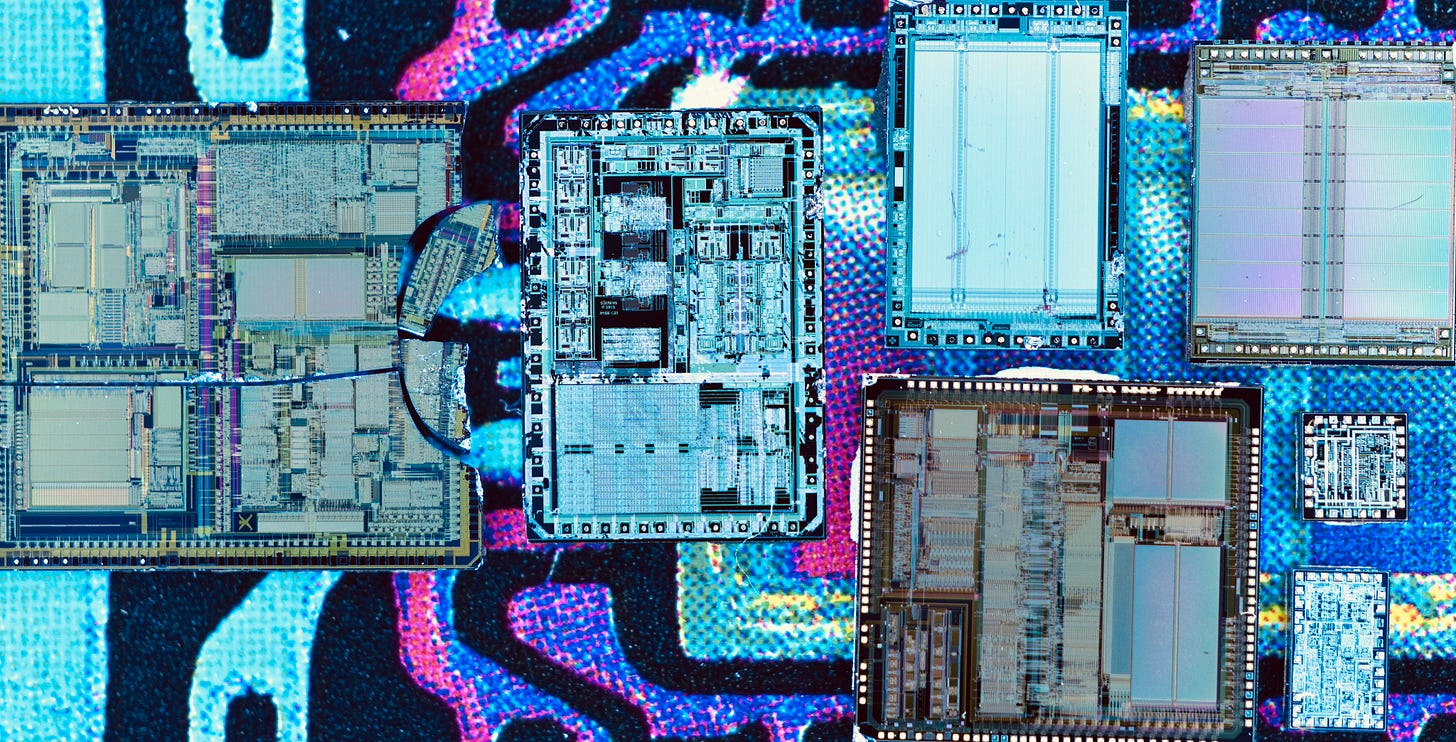
Open die shot from a Samsung S4 smartphone featuring a number of Siemen’s IC’s with a silicon doodle on the leftmost one.