Highlights this week: Tidal power surging 🌊 flight computer breakdown 🖥️ quantum computing breakthrough ⚛️
📝 Featured Article: From FixturFab: How to Select a Test Fixture covers the differences between development, production, and test systems.
Interesting Links 🏭
This video from Lafayette Systems breaks down the flight computer in the Diamond-X rocket, which handles guidance, navigation, and control. The video includes the PCB layout process and component considerations. In the US, there are no specific legal restrictions on actively controlling a model rocket. If you would like to get started in active control, the r/Rocketry discord is a great place to get started and to learn active control from the experts.
Hardware FYI is building the go-to resource for hardware engineers. They’ve started with mechanical engineering interview prep (check out the cheat sheet), a job board, and an active forum.
This video describes the $4M, 730-ton tuned mass damper in the Taipei 101 skyscraper. One of the largest dampers in the world, this gold orb is suspended from the 92nd story and counteracts swaying forces from wind and earthquakes, reducing sway by 30-40%. The damper played a big part in last week’s earthquake.
Generating electricity from predictable tidal streams and ocean currents is an incredibly promising opportunity. Wave energy has been assessed by experts as capable of supplying upwards of a third of global energy demand, yet the development of a viable technology capable of reliably withstanding harsh ocean conditions has been slow to evolve, until now. Minesto, which is being deployed in the Faroe Islands, uses a glider to move in a figure eight pattern and align with the tidal flow. CalWave is another startup piloting its own system to create a coastal microgrid in San Diego and British Columbia.
Microsoft has hit a new milestone for reliability in quantum computing. Working with Quantinuum hardware, Microsoft was able to run 14k experiments without a single error. Researchers have developed a way to ‘virtualize’ a qubit as multiple physical cubits. Currently, they can produce 4 virtualized logical qubits using 30 Quantinuum physical ones. Full technical paper here.
A detailed breakdown of something that simply is not simple: the oil and bearing system on a Rolls-Royce Trent 1000 jet engine. What makes this design so difficult is the wide difference in requirements between the high, intermediate, and low pressure compressors which all need to be properly sealed and lubricated. On average, jet engine oil consumption is between 0.2 qt/h and 0.45 qt/h.
General Electric completed its spin off of GE Aerospace this week. GE Aerospace will continue the company’s aviation engine manufacturing business. This finally offers investors a pure-play engine manufacturing opportunity without the dilution of GE’s other energy and healthcare businesses. GE Aerospace makes engines for both Boeing and Airbus jets, with more than 70% of revenue coming from services. The company raised its dividend by 250% last Friday.
UK-based Space Solar announced a breakthrough in wireless power transmission that will enable their concept of concentrating solar power in space and then beaming it down to Earth as electrical energy. They plan to power more than a million homes by the 2030’s with mile-wide complex of mirrors and solar panels orbiting 22,000 miles above the planet. As results have not yet been formally published, it will clearly be a very long road to commercialize this technology at utility scale. However, space-based solar overcomes many challenges of terrestrial solar by escaping the atmosphere and Earth’s rotation. This allows them to capture 13x more energy in space than on the ground.
Startup News 🚀💰:
Beehive Industries came out of stealth mode recently. The company is developing 3D printed jet-propulsion engines tailored for the defense sector. The company completed their first engine fire on 03/25.
First Light successfully increased the standup distance required for their inertial fusion technology by ten times from 10mm to 10cm. The company was able to demonstrate this at one of their electric gun facilities which they operate with their team of 5.
Phase Four has won a $14.9M DARPA contract to develop an RF powered space thruster that uses the thin air in very low Earth orbit (VLEO) as a fuel.
X-Energy has been awarded a $4.2M contract from the UK’s future nuclear enabling fund to develop UK-specific deployment plans for the company’s Xe-100 high temperature gas reactor.
Micronics, a company developing a desktop SLS 3D printer targeted towards hobbyists. The launch video gives a great design overview of how SLS printing works.
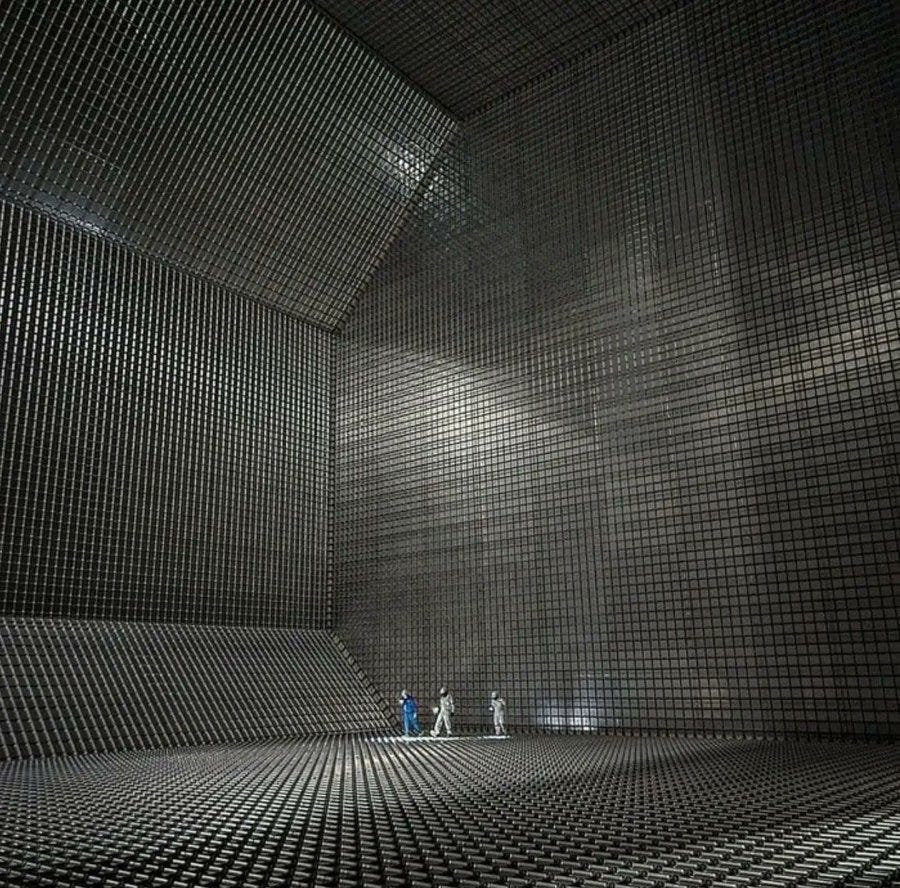
Inside the tank of an empty liquefied natural gas tanker ship.